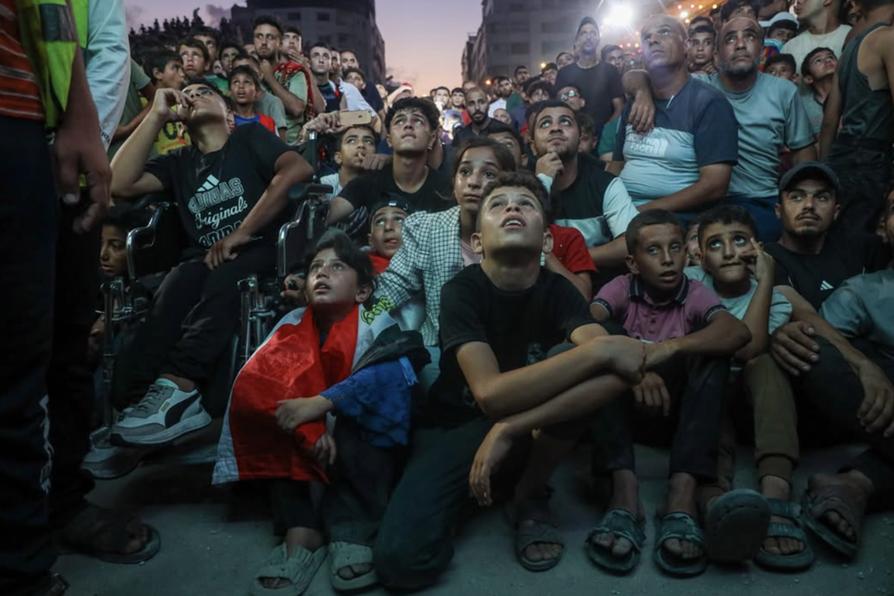
For ninety minutes the noise of war recedes. It does not disappear, because in Gaza nothing can really cancel out the roar of the explosions or the void left by those who are no longer there. But it goes further. He is covered by screams for a goal, a penalty saved, a ball that grazes the post.
It happens on the evenings of the football World Cup, when a white sheet spread between gutted buildings turns into a screen and a square of tents becomes, for a few hours, a stadium without stands.
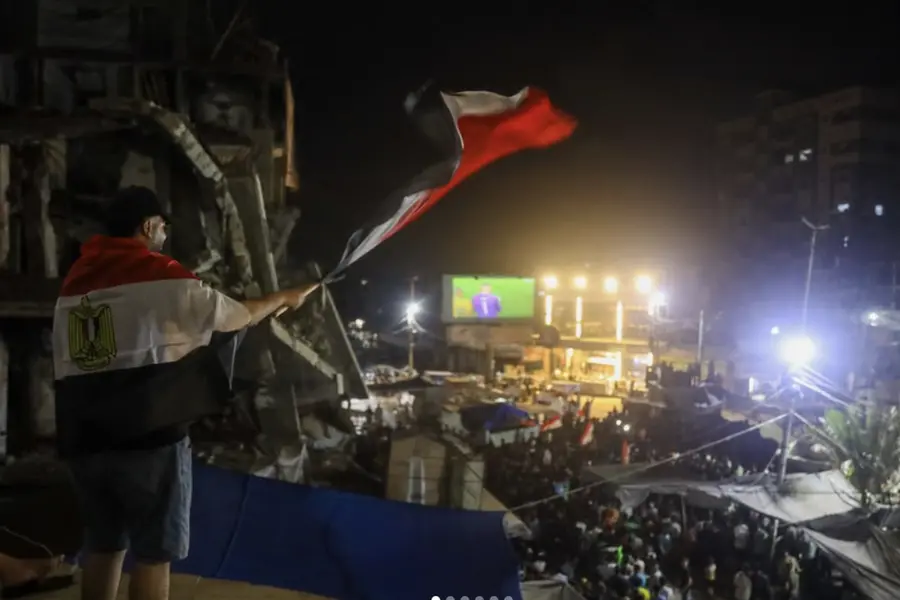
The photographs of Ahmed Younis arriving from the Strip tell one of the most powerful images of this tournament: hundreds of people sitting on makeshift chairs or directly on the ground, children with their eyes turned towards an improvised projectionfamilies reunited under the night sky. Behind them there is the rubble of a war that continues to mark daily life. In front, however, a football match passes by. Two irreconcilable realities that, for a few moments, coexist in the same frame.
The public screenings were organized by Egyptian Gaza Relief Committeean initiative supported by Egypt to offer the population a space for sharing in an area where even access to electricity has become a privilege. In many parts of the Strip, energy arrives only intermittently, the infrastructure is seriously damaged and every activity requires a continuous search for generators, fuel or small systems powered by solar panels.
Even football, in this way, becomes an achievement.
But the war knows no respite. On Tuesday, an Israeli attack killed Mohammad al Waheidi, the Committee’s public relations manager and one of the main promoters of the screenings. According to his family, he was reaching one of the screens set up to watch a match when the taxi he was traveling in was hit. Two children and another man also died in the attack. The Israeli army said the target was a Hamas militant, but acknowledged it had also hit civilians.
The episode conveys all the fragility of an everyday life in which even a moment of leisure can turn into tragedy.
Despite the ceasefire that came into force last autumn, the violence has not stopped.
According to the Gaza Ministry of Health (whose data has always been considered reliable by the United Nations, after careful and long checks), since the beginning of the truce over a thousand Palestinians have been killed and almost 3,500 have been injured. Numbers that tell how the word “ceasefire” has taken on, in the Strip, a very different meaning from what its name suggests.
In this scenario the World Cup becomes something that goes beyond sport. It is a shared language, one of the few still capable of crossing borders, rubble and isolation. For many families, following a match means allowing themselves a period of normality, remembering what it means to discuss an offside instead of the distribution of water, rejoicing for a goal rather than counting the bombings.
It’s not escapism. It is the resistance of everyday life.
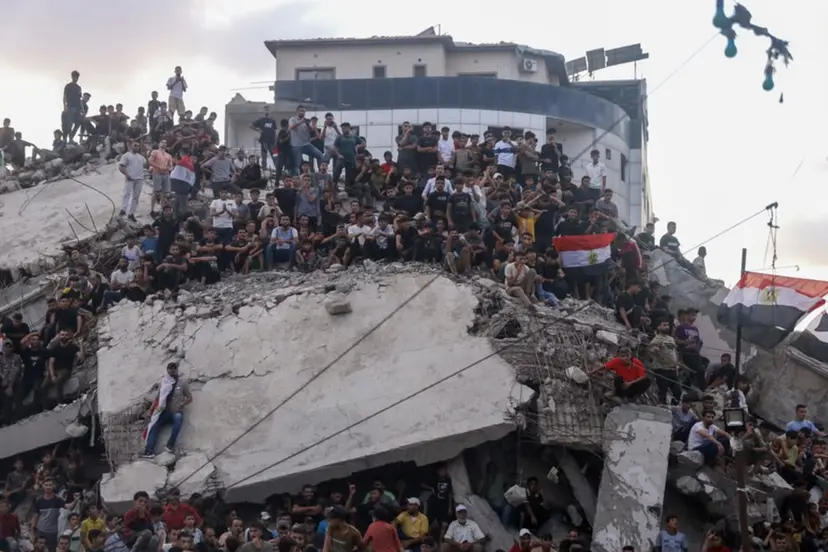
It is not surprising then that much of the Palestinian support has turned to Egypt. The geographical and historical bond between the two peoples is profound and the support expressed several times by the technical commissioner Hossam Hassan for the Palestinian cause has strengthened an already deep-rooted feeling. After qualifying for the round of 16, the coach dedicated the victory to both the Egyptian and Palestinian people, transforming the sporting success into a gesture of closeness which, in Gaza, was welcomed as a recognition of his existence.
For those who have lived isolated for months, feeling remembered on the most followed stage in world football has a value that goes beyond the result.
Yet the contrast remains painful. While millions of people follow the tournament in American stadiums or in front of their televisions, Palestinian football continues to pay a very high price for the war. Sports fields destroyed, clubs at a standstill, young people forced to abandon training, athletes killed or seriously injured. Sport, like schools, hospitals and homes, has also become one of the victims of the conflict.
The ball, which should unite, thus ends up describing two opposing worlds: on the one hand the global celebration of the World Cup; on the other, a population that struggles every day to maintain fragments of normality.
The images of the white tarpaulins set up among the ruins are not just about football. They speak of the human being’s ability to seek light even when all seems lost. Because hope often doesn’t come with grand gestures. Sometimes it takes the simple form of a game watched together, of a child applauding a goal, of a community that feels like a community again for a few minutes.
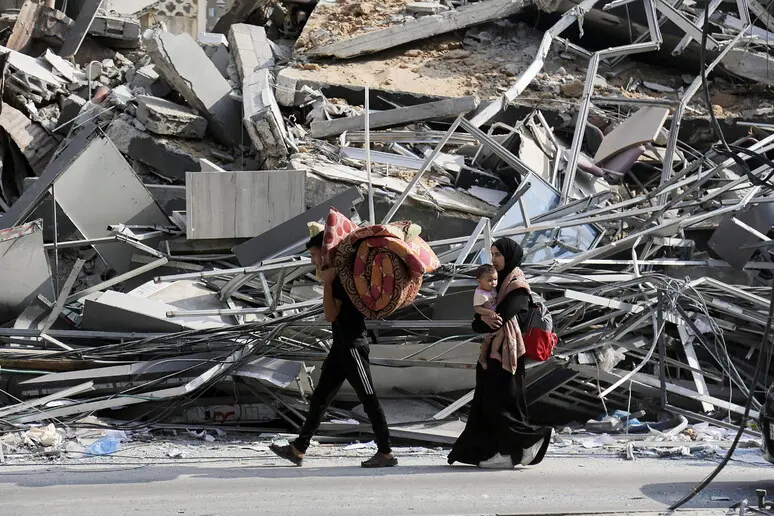
War can destroy buildings, interrupt lives, shatter projects. It is more difficult to erase the desire to find each other again. And perhaps this is precisely the deepest meaning of those July evenings in the Gaza Strip: not witnessing a World Cup, but reminding the world that, even under the rubble, a human heart stubbornly continues to beat.
Photo by Palestinian filmmaker in Gaza, Ahmed Younis