





by Salvo Guglielmino
On June 29th Rome celebrates its patrons, Peter and Paul. An anniversary that belongs to the history of the city itself, between the Vatican Basilica, San Paolo Fuori le Mura and the tradition that places the martyrdom of the Apostle on the Via Ostiense. But over eight hundred kilometers from the capital, in Palazzolo Acreide, a baroque town with Greek origins in south-eastern Sicily, the whole scene belongs to a single apostle. Here Saint Paul is not just a figure from Christian history. He is the patron saint of the city. A living, familiar presence, which every year on June 29th leaves its basilica to meet its people. The culminating moment arrives at thirteen.

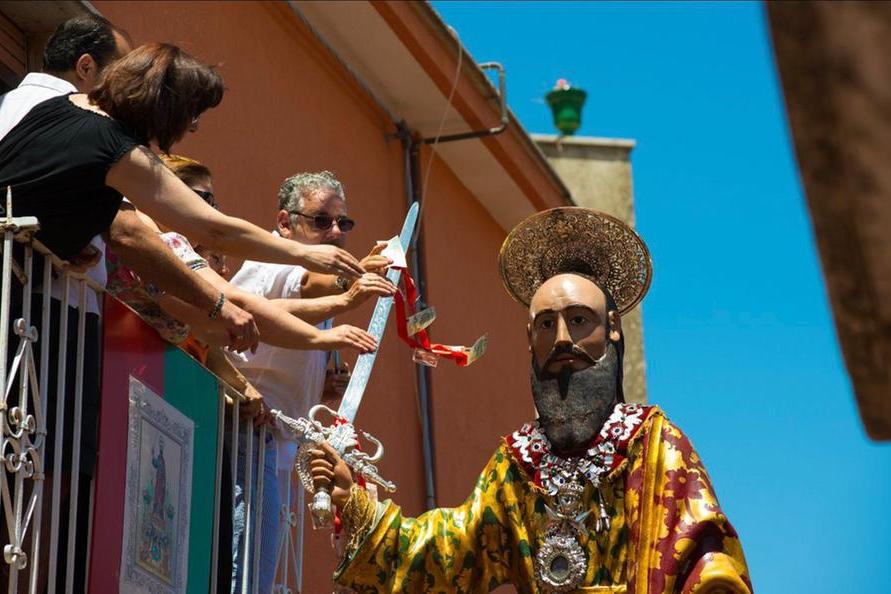
When the doors of the basilica open wide and the simulacrum looks out onto the staircase, the square explodes into a roar of applause, firecrackers and “nzareddi”, the characteristic strips of colored paper shot from above onto the fercolo. It is the “Sciuta”, the exit of the saint, the most awaited moment of the year for thousands of people. The originality of the festival lies above all in the image that the community has built of its patron. In the most widespread iconographic tradition, Saint Paul appears with his sword lowered, symbol of the martyrdom suffered in Rome. Tradition has it that the Apostle was beheaded in the place where the Abbey of the Three Fountains stands today, so called because three springs miraculously flowed from the point where his head would have touched the ground, a place of rare beauty still little known to the general public today.
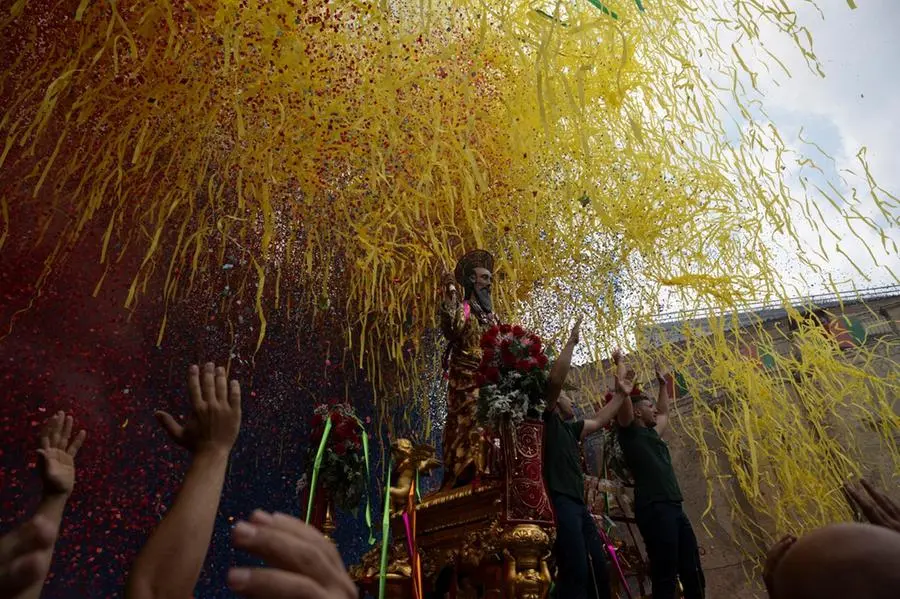
In Palazzolo Acreide, however, the sword is unsheathed and raised upwards. It is not the gesture of a warrior who fights, but of a saint who protects. He is the Paul who watches over the city, who guides and guards his community. Not the martyr, therefore, but the patron. According to a local legend, as Luigi Lombardo, a Sicilian researcher and scholar, wrote, the apostle Paul stopped to rest with his friends right around Palazzolo Acreide (the place is called “Cuozzu i Sam Paulu”) during the three days he spent in Syracuse in 61 AD. For centuries the Pauline cult has been intertwined, especially in the South, with unique popular traditions. The “cuddure”, votive breads decorated with snakes, recall the protection attributed to the saint against poisons. Until relatively recent times, the festival saw the presence of the “ciàrauli”, popular figures who handled snakes and believed themselves protected by the intercession of the Apostle. A heritage of rites and symbols that attracted the attention of scholars such as Giuseppe Pitrè and Antonino Uccello who wanted to build his “house museum” in this city. What makes the celebration even more singular is the direct relationship that is established between the saint and the community. An almost symbiotic ritual which in Palazzolo Acreide is also renewed on 10 August, with the equally popular and colorful celebration of San Sebastiano. During the procession, hundreds of families lift their children towards the statue to entrust them to its protection. It is a simple gesture but of great symbolic intensity, which is renewed from generation to generation. But it would be a mistake to reduce everything to folklore. The strength of the festival lies in its ability to still be an authentic collective experience today. We can see it in the emigrants who return every year for June 29th and in the participation of an entire community that continues to recognize itself in its patron saint. Thus June 29 tells two complementary stories. Peter and Paul, pillars of the universal Church, are celebrated in Rome. In Palazzolo Acreide the special relationship between a saint and his people is celebrated above all. Two distant traditions, united by the same figure. And perhaps it is precisely in that sword raised towards the sky that we capture the deepest meaning of the Sicilian festival: not the memory of a distant saint, but the presence of a patron who his people still feel alive and close.