




Get as close to the limit as possible without ever going beyond it, because there is a ravine beyond. But you will never know the exact point of your limit until you cross it and fall.
Where is the limit of the body of a tennis player who wins five masters 1000 in a row, having to maintain the intensity for a sequence that no one has ever achieved and then, after a three-day break, start playing a three-out-of-five Slam, perhaps at 12, with the sun shining in a May that seems like late July.
Who knows? Who knows himself like this? No one, unless you’ve been through it.
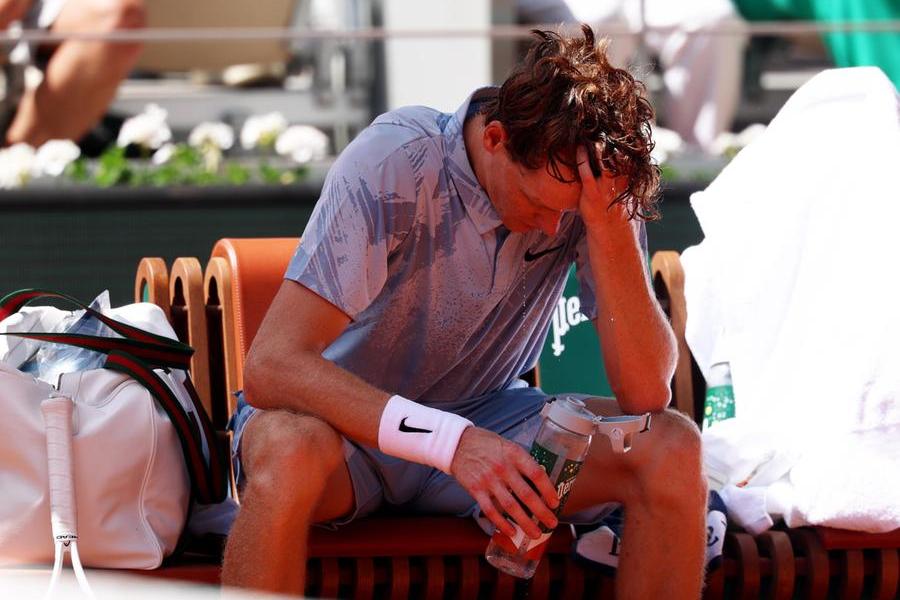
For two sets and three quarters it was a one-way match until the 5-1 in the third in favor of Jannik Sinner against Juan Manuel Cerundolo, brother of Francisco, and then this early summer got in the way and everything was reversed. On a precipice.
With hindsight, of which the graves are full, one could say that it was a gamble to slip Madrid between Monte Carlo and Rome, but if you succeed you go down in history. The story with the small letter of sport is true, but it is a story that is made like this: by hunting for records, sometimes catching them, other times falling. Sometimes making mistakes, but the proof is never there.
How long can the mind last when the body can’t take it anymore? How long can you stay there and suffer to try to get back up? Horizons or walls ahead that no one knows about.
There is a philosophy that has always accompanied Jannik Sinner, who is rational and not a gambler: “make or break” is not his style, his motto is “if I can I win, if I lose I learn”.
In hindsight it will be necessary to analyze where the programming error was, whether there was or was an accident or even an underlying physical fragility under certain conditions. Paris was the goal of the season, Jannik repeated this year. It didn’t arrive but other objectives arrived, perhaps beyond what we thought we could give. The balance on the dishes will be at the end of the season, with a cool head. It will be about understanding causes, studying solutions, knowing that no body and no mind can be asked to never lose.
The courage to try to resist, to scrape off the last residue of energy, must be admired: a form of respect for the public and for the opponent, perhaps also the attempt to experiment, to test one’s physical, sporting, mental and human resources.
Because there is a moment in which sport ceases to be a symbol and asks those who do it to the fullest to bring out everything in themselves.
After that you can win, lose, give up physically. But with the utmost professionalism and dignity, having packed knowledge into one’s baggage. Sinner was right about one thing in recent days: the highest point of his parable has not yet arrived.