





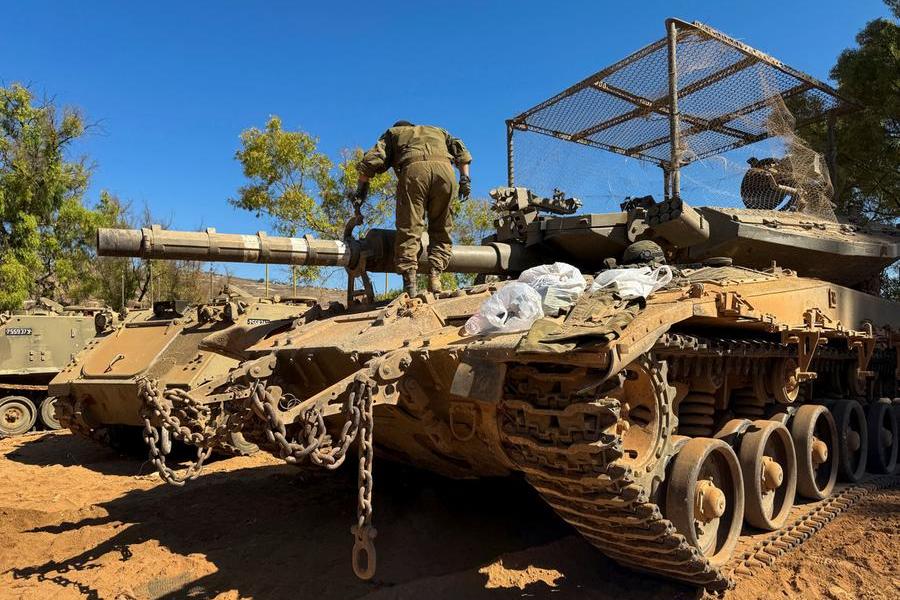
“Lebanon is determined to deploy its army on the border with Israel.” President Joseph Aoun, during a meeting in Beirut with the commander of the United States Central Command for the Middle East (Centcom), Admiral Brad Cooperstates it openly and then puts it in writing. In the statement from the Lebanese presidency, dated 29 June, we read, in fact, of the “determination of the Lebanese state to extend its authority, through the armed forces, to the border with Israel”. But while Aoun and Cooper discuss how to implement the framework agreement signed with Israel on June 26, under the aegis of Washington, which provides for the withdrawal of Israeli forces from the Land of Cedars and the monopoly of weapons in the hands of the Lebanese state with the consequent disarmament of Hezbollah, Tel Aviv has a different opinion. And so Defense Minister Israel Katz, in the same hours in which Cooper met Aoun and the head of the Lebanese Armed Forces, General Rodolphe Haykal, declared that his country “has no territorial ambitions in Lebanon”, but his army will not retreat “one millimetre” from the “three safety zones in Lebanon, Syria and Gaza”.
The Hezbollah issue, both a consequence and cause of the Israeli occupation, It’s not easy to untie. The president of the Lebanese Parliament, who, due to a precise division of powers whereby the one of the republic is always a Christian and the prime minister always a Shiite, rejects the agreement. Nabih Berri, from Hezbollah’s Amal party, said the text of the agreement did not guarantee Beirut’s rights and could not be accepted in its current form. On the afternoon of June 29th he issued a note in which he underlined that the one signed in Washington is an agreement of impositions, not an agreement that preserves the rights of Lebanon”.
Hezbollah was born as a direct consequence of the Israeli invasion of 1982. Known as “Operation Peace in Galilee”, that military intervention created the conditions of lasting instability. It began on 6 June of that year with the official pretext of repelling the armed Palestinian groups of Arafat’s PLO over 40 kilometers from the northern border of Israel, but in reality it concealed the desire of then Israeli Defense Minister Ariel Sharon to destroy the PLO, expel Syrian troops from Lebanon and install a pro-Israeli government in Beirut. The Tel Aviv army, however, did not stop 40 kilometers away, but continued up to the capital, besieging it for the first time. The mission thus turned into a long and bloody one occupation of southern Lebanon which lasted until 2000, causing a huge number of civilian casualties. THEand the United Nations called it a “blatant aggression” against Lebanese sovereignty.
The Lebanese Shiites, initially in favor of the invasion because they were tired of the Palestinian incursions and because they were historically marginalized, changed their position over time. As time passed, in fact, they felt the weight of the occupation more and more. Resentment grew rapidly, creating fertile ground for the influence of Iran’s 1979 Islamic revolutionwho saw Israel as an ideological enemy to fight.
The Tehran regime seized the opportunity and, with the support of Syria, the Iranian Revolutionary Guards began training Shiite militiamen in the Bekaa valleyforging a new resistance movement. The objective was twofold: to liberate the occupied Lebanese territories and, in the future, to establish an Islamic republic.
Hezbollah, whose name means “Party of God”, emerged as a fighting force and quickly demonstrated its effectiveness. On November 11, 1982, a suicide bomb destroyed the Israeli military governor’s headquarters in Tyre, killing more than 100 Israeli soldiers.
Faced with this new threat and the growing unpopularity of a costly occupation, Israel withdrew from much of Lebanon as early as 1985.but maintaining one «safety zone» at the border until 2000. Sharon’s strategy, which aimed to weaken Israel’s enemies, had produced the opposite effect, creating an adversary rooted in the Shiite social fabric and destined to become one of the most powerful non-state militias in the world.
In a first phase (1982-1992) Hezbollah characterized itself as an armed resistance movement, fighting both the Israeli occupation in southern Lebanon and in the Lebanese civil war (1975-1990). It is the period of attacks, guerrilla tactics and paramilitary actions that earned the group the designation as a terrorist organization by many Western countries.
In a second phase (1992-2000), known as Lebaneseization, there was the rise to the general secretariat of Hassan Nasrallah. Hezbollah makes a decisive turning point. Without giving up their weapons, the group enters institutional politics, transforming itself from a militia into a real party. He developed a dense network of social services, schools, hospitals and a media apparatus (Al-Manar TV) which guaranteed him a solid popular root among the Shiites. It thus becomes a “state within the state”, capable of offering assistance where the Lebanese state is weak or absent.
Finally the third phase, the one that continues today. After the Israeli withdrawal from Lebanon in 2000, Hezbollah broadened its horizons. The 2006 war against Israel established it as a leading military force. But it is with the beginning of the Syrian civil war (2012) that the group makes the definitive leap by intervening alongside the regime of Bashar al-Assad. Hezbollah transforms into a regional player, fighting in a conflict that goes beyond anti-Israeli resistance.
Today, with its sophisticated arsenal and its ability to fight on multiple fronts, it is a strategic ally for Iran, which continues to provide it with huge financing – estimated at around 200 million dollars a year – and military support. At the same time, its dual soul – of party and militia – makes it ambiguous and difficult to manage with a view to lasting peace.
Not to mention that, if part of the population considers Hezbollah responsible for the new Israeli invasion, another part considers them necessary to stop the advance of the Tel Aviv army. The hope is that, with the support of the United States, the already approved legislation which provides that only the State has a monopoly on weapons, at the same time with a real withdrawal of IDF troops and a strengthening of the Lebanese Armed Forces can truly pave the way for a peaceful future.