





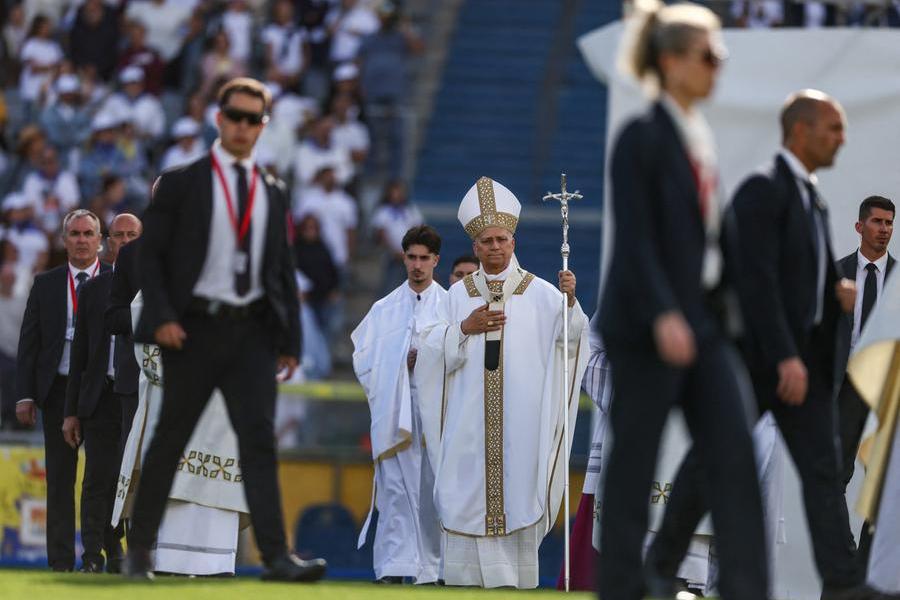
Dear brothers and sisters, after a day full of meetings and sharing, celebrating this Eucharist with you, I want first of all to thank the Lord for the so much good that is done here every day, entrusting to him everyone’s commitment and at the same time the suffering of which this land witnesses. I also invite you to pray together, in this Holy Mass, for the souls of the brothers and sisters who have lost their lives at sea.
We will place all of this on the table with the bread and wine, as we introduce ourselves, with the evening celebration of Christmas Eve, into the Solemnity of the Sacred Heart of Jesusto which the whole of Spain is consecrated.
We ask the Lord that in this moment the same feelings of humanity, mercy and compassion of the Savior’s Heart be alive in us.
We let ourselves be helped in our meditation by the Readings we have heard. In the first, God reminds the Israelites of the gratuitousness with which he loved them. He chose them not because they had particular prerogatives, gifts or merits, but out of pure love (see Dt 7,7-9), and he will always continue to love them, even when, due to their hardened hearts, they do not correspond to his feelings.
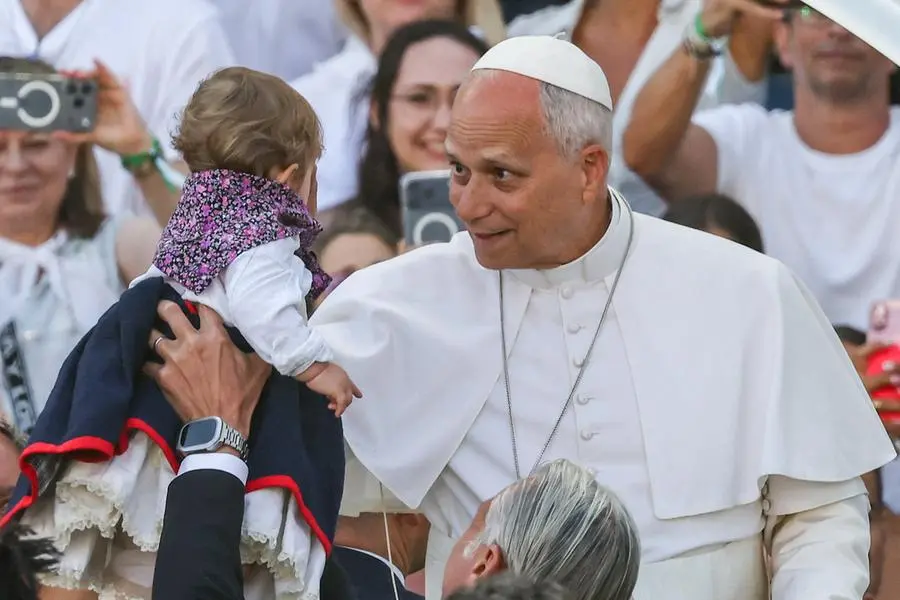
This is it the charity of God, in which our vocation to love has its roots: not founded on calculation, nor on feeling alone, nor reducible to simple philanthropy, but pervasive of our entire being: fire for the soul, light for the mind, irresistible impulse for freedom, peace and at the same time torment for the heart, which beats in harmony with other hearts, involving the whole person. Because loving is natural to man, indeed it is a condition of fullness of his very existence.
This is how love appears to us in the humanity of the Savior and in the movements of his most sacred Heart: immutable and faithful even in the face of misunderstanding and rejection, fear, sadness and human resistance (see Luke 22:39-46).
And it is in this face of God who is always “in love”, totally and constantly desirous of our good and our full happiness, that we recognize the way of life, learning a new way of existing and relating, a different yardstick for evaluating choices, a renewed and regenerating style of communion. In this regard, Pope Francis, speaking of Christ’s charity, said that “the best response to the love of his Heart is love for brothers” (Encyclical letter Dilexit nos, 24 October 2024, 167) and added: “there is no greater gesture that we can offer him to reciprocate love for love” (ibid.). “Reciprocating love for love”: here is the wonderful exchange, the «admirabile commercium» (see First Vespers of the Solemnity of Mary, Most Holy Mother of God, first antiphon) from which the Gospel invites us to get involved, translating the infinite measure of God’s love into the generosity with which we serve Himevery day, in the brothers and sisters that He himself places on our path, especially in those most needy, defenseless, incapable of making the change (see Luke 6:32-36). Just as happens on this island, in welcoming, in sharing, in selfless giving.
The gratuitousness of the Heart of Christ, however, does not stop there. It goes further, committing ourselves to helping everyone not only to survive, but also to regain confidence and get back on the path, to grow and flourish fully in their uniqueness, for the good of all. In this regard, Pope Benedict XVI wrote that the charity “of which Jesus Christ witnessed with his earthly life (…) is the main driving force for the true development of every person and of all humanity” (Encyclical letter Caritas in veritate, 29 June 2009, 1).
In the second reading, Saint John reminded us that “God sent his only begotten Son into the world, so that we might have life through him” (1 John 4:9). His words recall those of Jesus, who said that he came because we have life and we have it in abundance (see John 10:10), and who ordered the healed paralytic: “get up, pick up your mat and walk” (Mark 2:9). In these expressions we recognize the invitation to maternally embrace those who suffer, but at the same time to prepare and push those who have been injured to get up and get back on the road, for a free and dignified life.
Indeed, our charity must not be mere assistance, but is aimed at integrating people, for their full fulfillment – spiritual, intellectual and physical – and their dignified and constructive inclusion in the community (see Encyclical letter Fratelli tutti, 3 October 2020, 129). Only in this way does our meeting, even in the face of difficult and painful events, become an opportunity to sow seeds of hope on humanity’s journey towards a better future.
However, I would like to dwell, in the light of the Word of God that we have heard, on one last characteristic of the Heart of Christ: humility (see Mt 11:29). The Heart of Jesus is humble, and therefore the “learned” and the “wise” do not feel its beats, that is, those who have the presumption of being self-sufficient, of knowing everything, and of having no need of God or others. In fact, these, dazed by the echoes of a redundant, omnipresent and restless “I”, lack the silence necessary to listen to the hidden pulsation of love within themselves and in their brothers..
«Not infrequently well-being makes you blindto the point that we think that our happiness can only be achieved if we manage to do without others” (Francis, Apostolic Exhortation Dilexi te, 4 October 2025, 108). Jesus teaches us, on the contrary, that to enjoy the true joy of life, which is in love, it is necessary to come down from the pedestals of arrogance that divides, to meet in the humility that brings together brothers.
Saint Augustine said: «Where there is charity, there is peace, and where there is humility, there is charity» (In Epistolam Joannis ad Parthos, prologue). That’s right. Where there is authentic humility there is love, and where there is love there is peacebecause only in humility do we really know who we are and therefore we can love each other, meet each other, give ourselves and forgive each other in truth.
Dear ones, today we adore the Sacred Heart of Jesus, which we often depict crowned with thorns and burning with a flame, according to the visions seen by Saint Margaret Mary Alacoque. Let us remember that we are the living presence of the Lord in the world (see CONC. ECUM. VAT. II, Dogmatic Constitution Lumen gentium, 16 November 1964, 8). Let us therefore look at each other, not only on this day, but always, with respect and trust, and let us renew, in this awareness, the commitment to fulfill in ourselves, in charity, what is lacking in Christ’s sufferings, for the good of the Church (see Col 1:24). Fired by the charity of his Heart, let us be bearers of his mercy and peace, so that wars may end in the world and a new humanity, reconciled in love, may grow around us.