





The segment between Assisi and Spoleto Ducale, up to the entrance to Valnerina, is a journey of just over 80 kilometers southwards which can be easily divided into four days of walking (www.viadifrancesco.it).
An aesthetic and spiritual ascent in the green heart of Umbria (www.umbriatourism.it), where Franciscan memory is grafted onto a monumental nature designed over the centuries by peasant wisdom.
My journey begins leaving the City of Peace behind me. After passing the basilica of Santa Chiara, I leave Porta Nuova for a first stage of about 20 kilometers on a slight slope between the woods of Mount Subasio and the olive trees. After passing the Maestà of Mascicone, the path leads to Spello (www.prospello.it) which welcomes me with its monumental Roman profile and medieval heart.
Through Porta Montanara and the scenic Porta Venere, squeezed between the towers of Properzio, allowing me to stop in front of Pinturicchio’s frescoes in the Baglioni Chapel.
From Spello I descend to the Foligno plain (www.comune.foligno.pg.it),
crossing the Topino river. In the centre, the sky above the buildings is crossed by the low flight of the swifts, whose shrill chirps blend with the daily life of the residents. In Piazza della Repubblica, make a ritual stop at the plaque commemorating the place where Francis sold – in 1205 – his father’s fabrics to rebuild San Damiano in Assisi.
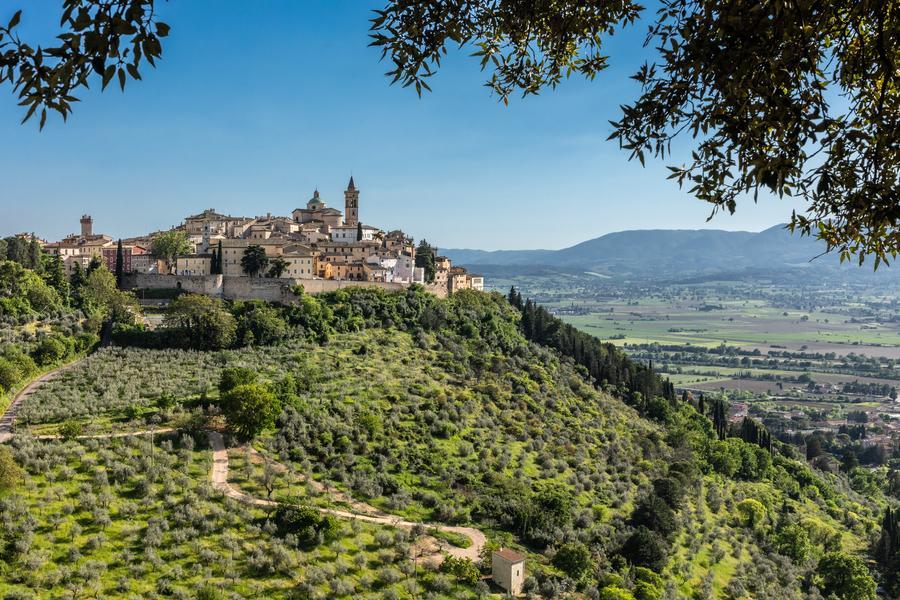
The next 13 kilometer stretch climbs towards the Trevi hill. After a stop in Sant’Eraclio to cool off at the sixteenth-century fountain, the path climbs through the terraces until, at the top of the hill, Trevi (www.treviturismo.it) opens up like a temple of light with the church of Santa Maria delle Lacrime. In front of Perugino’s Adoration of the Magi I feel how beauty is necessary: art gives freshness and caresses to the soul.
In the Museum Complex of San Francesco (www.museisanfrancescotrevi.com), the history of the saint unfolds along the arches of the cloister. Simone Cerquiglini (41 years old), the young archaeologist director, welcomes me and guides me through the frescoes of the birth of Francis, the Sermon to the Birds and the Care of Lepers. Simone explains to me: «The figure of Francesco multiplies, revealing himself as the protagonist of a painted epic that gave identity to the entire culture of Umbria». In the museum, the art historian Carlo Roberto Petrini (51 years old) reveals the secrets of the Fascia Olivata, a UNESCO candidate territory with one and a half million olive trees. Outside the town, in the locality of Bovara, I stop in front of the Olive Tree of Sant’Emiliano: a 1,700-year-old arboreal patriarch, witness to the martyrdom of the saint in 304.
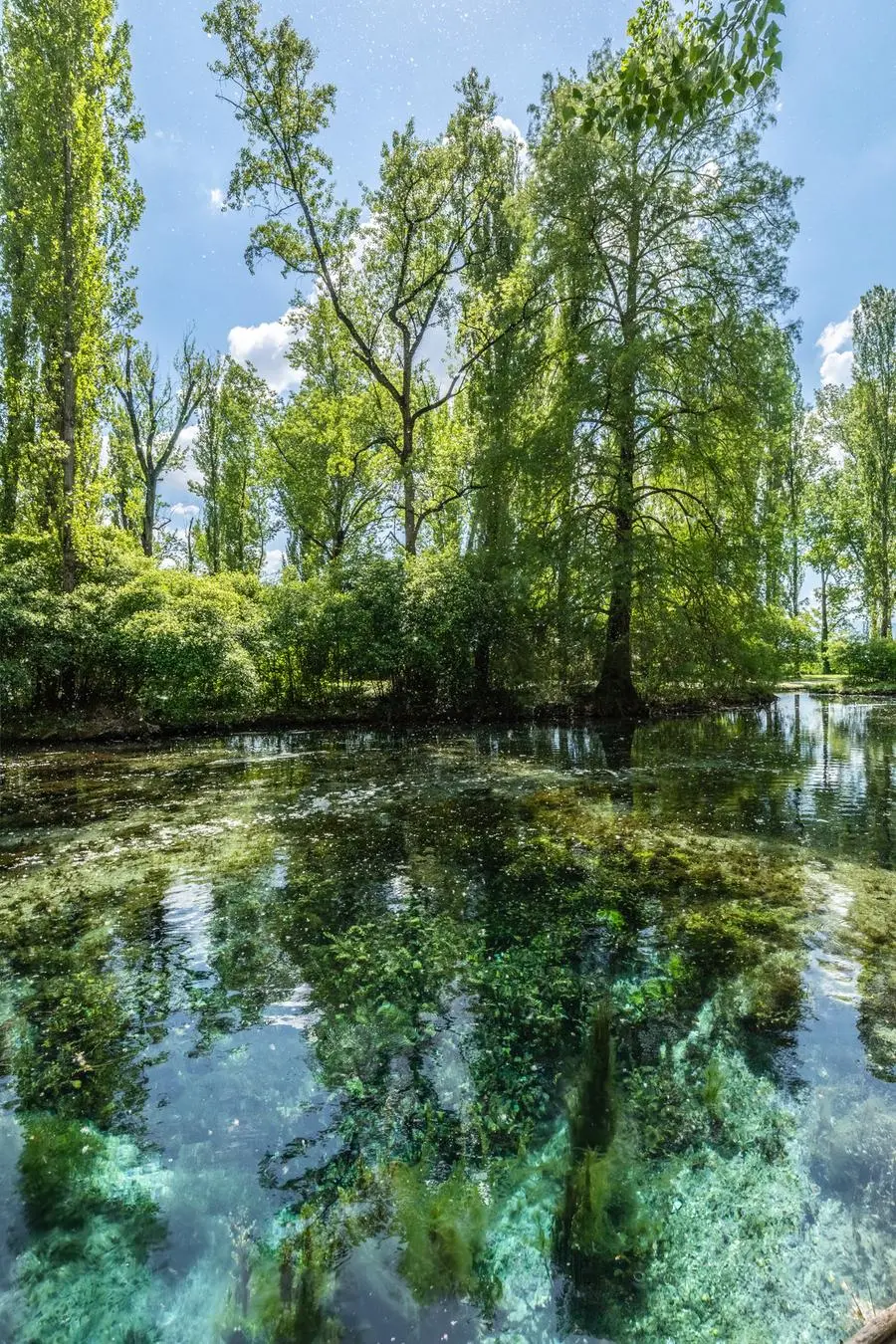
Climbing above Trevi, I reach the Hermitage of Sant’Antonio Abate (better known as the Hermitage of the Larks): an oasis on the rock where four sisters live in total hermitage, without comfort and depending on rainwater. I am greeted with a lemon and elderberry drink. Even though they are not on the route, I allow myself to go off course – three kilometers downstream – towards the Fonti del Clitunno (www.fontidelclitunno.it). The show is of extraordinary lyricism: the area, dominated by majestic poplars, is surrounded by a thick fluctuation of pollen which generates the effect of a spring snowfall under the sun. Here the myth and the precept are mirrored: if Virgil in the Georgics sang of water capable of whitening the bulls for Caesar’s triumphs, Francis reads in it the humility of “sister water”, useful, precious and chaste. It is the same clear mirror that calmed the spirit of Lord Byron and that Giosuè Carducci celebrated in his Odes.
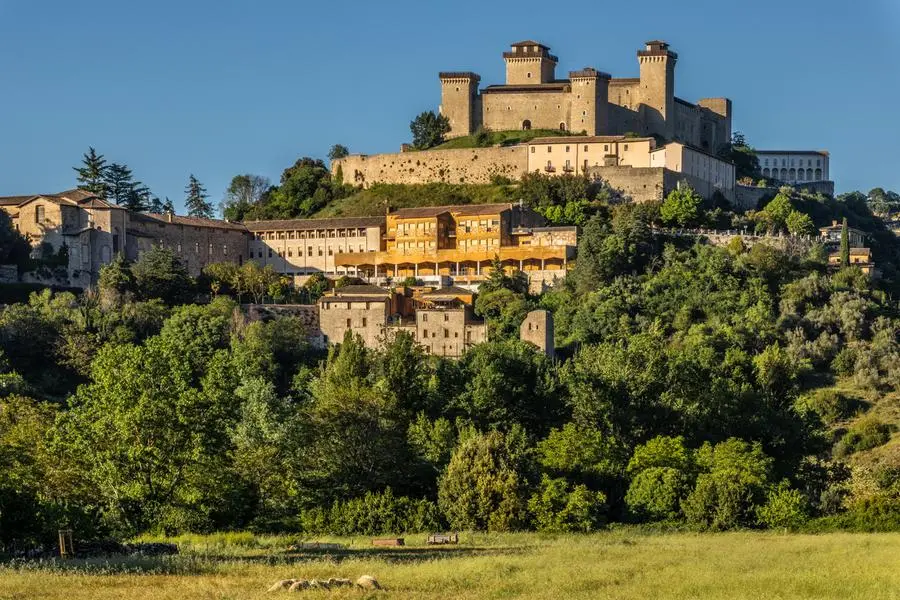
Below Poreta, with the walls of the medieval fortress, the path along the paths of the Olivata belt (www.sentierinellafasciaolivata.it) starts again from the small fountain of San Cristoforo. I pass the locality of Osteria and, after a stop in Bazzano Superiore, I descend towards the castle of Eggi. On the path, I visit the church of San Giovanni Battista with the frescoes (1527-1532) by Giovanni Di Pietro known as Lo Spagna, before entering Spoleto (www.visitspoleto.it), where in the church of San Sabino, in 1205, the turning point in Francesco’s life took place: the “Dream”. The future saint was an ambitious young man, armored in iron and heading to war in Puglia in search of glory. That night, a mysterious voice undermined his certainties by asking him whether it was more useful to follow the master or the servant. Having understood the lesson – the futility of serving the kings of the earth rather than the King of Heaven – the young man turned his horse and returned to Assisi. Looking out from the viewpoint, I understand the emotion of his phrase: Nihil iucundius vidi valle mea spoletana, “I have seen nothing more joyful than my valley in Spoleto”. In Piazza del Duomo the cathedral (www.cattedraledispoleto.it) stands out with its Romanesque façade with eight rose windows; inside – in addition to the large apse fresco of the Coronation of the Virgin – in the chapel of the Relics the emotion becomes palpable in front of Francis’ autograph letter to Brother Leo, a tiny fragment of parchment imbued with maternal tenderness.
The fourth stage (16.5 km), the most mountainous, begins from Spoleto, which leads to Ceselli. I leave the city by walking across the Ponte delle Torri, a titanic aqueduct suspended 80 meters above sea level that connects the Rocca Albornoziana to the woods. I go back towards the Hermitage of Monteluco (www.conventomonteluco.org), an oasis of centuries-old holm oaks. At the entrance I meet Thomas Nietzsche (58 years old), a traveler from Düsseldorf who is following all the sacred paths of Europe: «Monteluco gives back the sense of travel. Under these trees the value of silence is found.
After passing the Forca di Castel del Monte, the path descends towards the Nera valley, finally reaching Ceselli.