





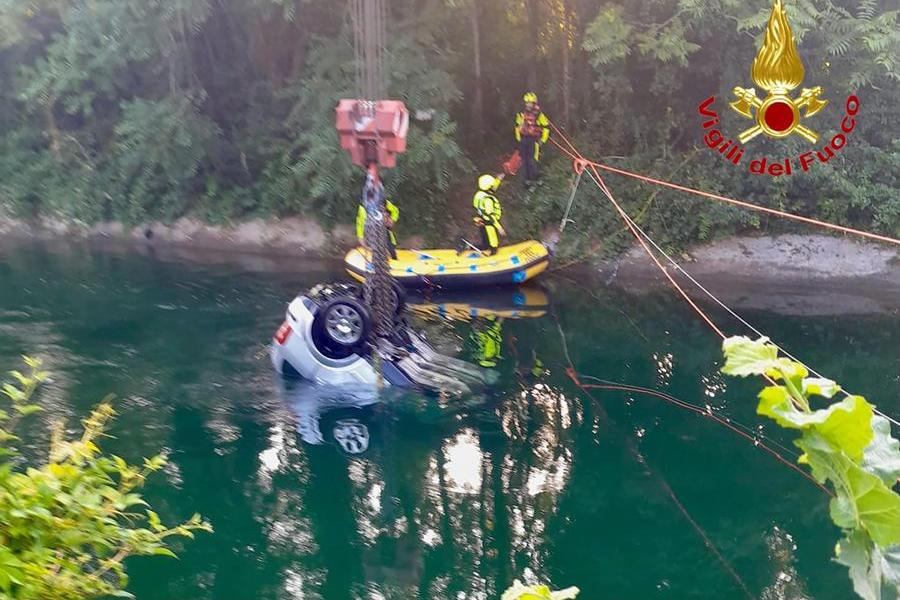
In the events of road accidents in recent days, the dynamics of which are still partly to be clarified, costing the lives of very young people, some behaviors are striking: young people who pile into a car, a boy who laughingly films a fatal road accident without thinking in the slightest about helping, a father who precedes a 10-year-old child in the car aboard a mini-motorcycle which is not authorized to circulate on the road.
Everyone, it is assumed, knows that they are doing something that should not be done, but they do not seem to perceive the risk, either direct (that someone ends up badly) or indirect (suffering a sanction if this happens). It is a topic that we often hear about, sometimes connected to social visibility, when we see that a teenager even films a scene that constitutes a crimeperhaps being the author. to show it on social media, where, in the past, the awareness of a socially reprehensible action led to hiding it, if only to protect oneself from the consequences. We talk about it with Paola Ortolan, President of the Juvenile Court of Milan, who has been dealing with the behavior of children and, indirectly, of their adults of reference for a lifetime, to understand if something is really changing on a social level.
Dr. Ortolan, what is happening, are we really, as some say, faced with an anthropological mutation, do we grow up less perceiving the consequences of our actions?
«I can speak in general terms, from the experience that leads me to meet young people who have committed things that should not be done, even if not with the degree of in-depth analysis that this topic would require. We live in a time in which we grow up as children of a culture according to which you exist not for your interiority, but for what is visible about you: from the frantic search for a virtual, perhaps fictitious, visible identity, challenges arise, for example, in the case of teenagers, online challenges that lead young people to demonstrate that they can do a certain thing which is sometimes a crime. And they end up doing so by separating the level of intellectual awareness of what they are doing from that of emotional, interior, even ethical and moral awareness, because this is what it is about even if they are obsolete words.”
In adolescence transgression has always existed, but one transgressed starting from being clear that one was doing something not to do. Is this awareness less clear now?
«In this more “fluid” culture in which you know that something cannot be done, but you are not so clear about it because it seems that everyone does this, the impression in those who do our work is that this step of awareness has been somewhat skipped. This also makes it more difficult to judge minors, when a crime is involved, because criminal law presupposes that for responsibility to arise one must be aware of what one is doing: while when you find yourself in front of kids who tell you: “yes, I knew it”, but meanwhile they look at you with a somewhat vacant look, you realize that their deepest interiority does not seem so aware, also because no inhibitory brakes have been triggered. What makes us think about the boy who shot the video of the accident is that the apologies were made when probably some adult in hindsight made him understand that he would get into trouble, while inside he was boasting to those who would look at his posts, not expecting any disapproval from his peer group.”
These are issues that call into question education, the way in which a sense of responsibility is formed. What is missing?
«We need to work on different levels: one level is the relationship with adults who must be aware and take the responsibility of clearly telling the little ones as they grow up, because the acquisition of a sense of responsibility occurs gradually, that certain actions are negative, in order to make them experience the transgression as such. On the other hand, we should work more on the peer group, because it is not true that all kids are willing to do anything as is generally said, but sometimes it is true that many do not have the strength to isolate or hold back those who want to transgress. When the silence or abstention of others reinforces the transgressive purpose, everything becomes more difficult, because it is more problematic to intervene on the group than on the individual”.
Speaking of relationships with adults, the case of the 10-year-old child on a minibike on the road with his father present is sobering. Has anyone thought about the role of the parent?
«It is striking that none of those who spoke about it, even in the news, underlined the fact that it would have been up to the adult who is responsible to prevent a 10-year-old child, who has four years left to ride a 50cc scooter, from finding himself on a road where he clearly could not and should not be: sometimes what leads to these behaviors is the desire, much more widespread than one might think, of the “champion child”, a projection of the parents’ dreams. We never think about it, because they are often glossy contexts, but how many times do we see parents exposing their children to the Internet early, taking away any legitimate space for privacy, even making their exposure a source of income? Are we sure this is not a form of mistreatment? There is a progressive advertisement that seems to me to give a good idea of the tiring parental relationship of this historical time: the adult gives a child a tablet to keep quiet and in the meantime the parent does his own business. It may also be that what the adult does is important, but the child at that moment also absorbs what is not given to him in terms of a relationship: it is clear that if a child sees the adult scrolling through social media while he is with him, it will be difficult for him to learn a balanced relationship with these tools and for him not to identify them as fundamental as he grows up.”