




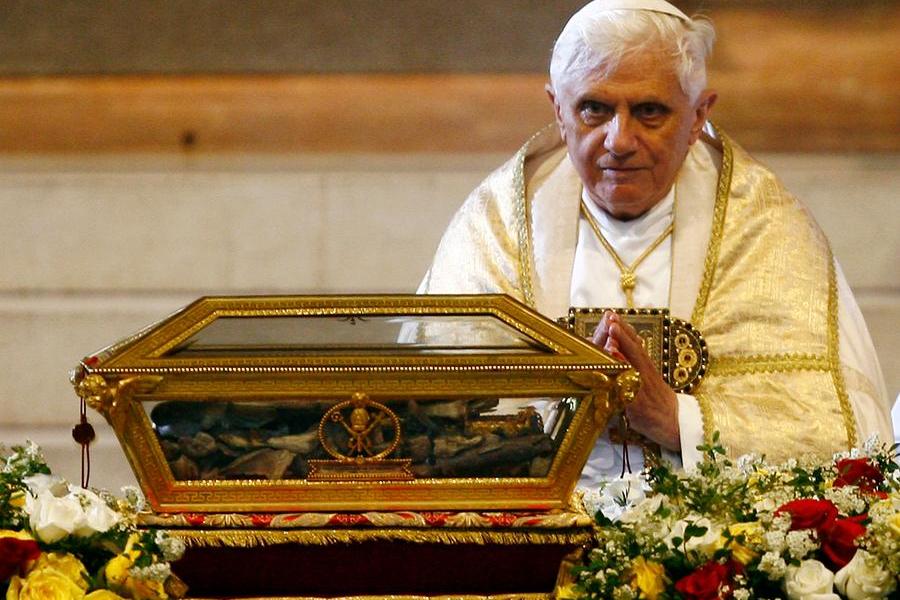
It was April 21, 2007. That day, in Basilica of San Pietro in Ciel d’Oro in Pavia (“down in Cieldauro” – down there in Ciel d’Oro – as Dante put it), which houses the remains of Saint Augustineof Severinus Boethius, and of King Liutprand, next to the convent of the Augustinians, “two” Popes met, the one in office, Benedict XVI who had dedicated a lifetime of studies to Saint Augustine, and that of the future: «In this final moment, my visit to Pavia takes on the form of a pilgrimage», said Pope Benedict then, starting his homily, «it is the form in which I had initially conceived it, wishing to come to venerate the mortal remains of Saint Augustine, to express both the homage of the entire Catholic Church to one of its greatest “fathers”, and my personal devotion and gratitude towards the one who played such a part in my life as a theologian and pastor, but I would say even more than a man and a priest. I renew my greeting with affection to Bishop Giovanni Giudici and I extend it in a special way to the Prior General of the Augustinians, Father Robert Francis Prevost, to the Father Provincial and to the entire Augustinian community”.
No one could have imagined that the photo of that day which portrayed Robert Prevost in the act of welcoming the Pope, shaking his hands warmly, before his visit to the tomb of Saint Augustine would pass away in a few decades as the handshake between Benedict XVI and the future Leo XIV, first Augustinian pope in history. He returns for the first time since Pope Leo XIV visiting Pavia on 20 June 2026, where he had been several times previously and where he had already returned as a “pilgrim” cardinal in 2024, on 25 February, to close the celebrations of the XIII centenary of the translation of the Augustinian remains to the Basilica mentioned by Danteabout the philosopher Boethius in the tenth canto of Paradiso, but also by Petrarch, in the epistle Seniles 4. intended for Boccaccio who had mentioned the Golden Sky in Messer Torello’s story on the tenth day of Decameron. That golden sky dates back to the memory of the original ceiling decorated with gold leaf of the Basilica which houses the remains, of which no trace remains except in the name.

Faithful greet Pope Benedict XVI, today, upon his arrival at the Orti Borromaici in Pavia, 21 April 2007-
(HANDLE)
During the celebration, in his homily Cardinal Prevost said: «As Saint Augustine said to his friends, we run to God not with our feet, but with our affection, it follows that the most important thing to pray for and we can pray for is the Holy Father Francis with his very difficult mission”, almost as if to perceive the weight of the responsibility of the ministry that he now carries on his shoulders.
The history of Pavia, for various reasons, has been intertwined several times with that of the popes. Don Fabio Besostri, head of the Pavia Center of the Sant’Agostino Higher Institute of Religious Sciences and deputy director of the diocesan Historical Archives, counted, between 743 and 2026, 12 visits by Popes, nine of which were “concentrated” during the Middle Ages. At that time the city, capital of the Lombard Kingdom and then of the Italian Kingdom, was an important political crossroads, also the scene of some councils in a troubled period in the history of the Church, which he gives an account of in a long story in the special issue published on the occasion of Leo XIV’s visit of the diocesan weekly Ticino: the first was in 743 with the arrival in the city of Pope San Zaccaria, about ten years after the arrival of the remains of Sant’Agostino. Among the many papal visits, that of Innocent II in 1132 was of particular importance in an “Augustinian” key, “fundamental”, writes Besostri, “to ensure the political and religious loyalty of the main Po Valley municipalities, removing them from the influence of the antipope. During this visit, on 8 May 1132, Innocent II presided over the solemn consecration of the basilica of San Pietro in Ciel d’Oro, recently rebuilt in splendid Romanesque forms. The religious act served to reaffirm the authority of the Church of Rome over one of the most prestigious monasteries in Italy, where the remains of Saint Augustine rested.”
If the city had to wait over five and a half centuries from the visit of Martin V, to welcome another pontiff: the memory of the presence of John Paul II on the occasion of the four centuries since the death of Saint Paul Borromeoin 1984 it is still in the memory of the people of Pavia as well as that, very Augustinian, of Benedict XVI which was mentioned at the beginning.
But Pavia’s bond with the Popes does not end with the passing presence, because more than one pontiff has left tangible and lasting signs in local history: Among other things, according to the Liber pontificalis, Pavia was the birthplace of the unfortunate John it says of hardship or poison.
If the name of Pavia, born Ticinum and of Roman foundation, passed through a Papia who has nothing to do with the popes, in the center of Piazza Ghislieri, which the people of Pavia confidentially call Piazza del Papa, Pius V, born Michele Ghislieri, stands enthroned in a blessing attitude towards the façade of the “Ghislieri”, today a secular institution, university college of merit, which he founded in 1567, just over a year later having risen to the throne on 7 January 1566. «Dominican ascetic, great moralizer of the Church of Rome», writes Antonio Gurrado in the celebratory volume published by Einaudi in 2017 for the 450th anniversary, edited by Arianna Arisi Rota, «determined supporter of the concrete translation of the decrees of the Council of Trent (concluded in 1563), Antonio Michele Ghislieri decides to found a college for university students that bears the name of his family. This college (rival of the Borromeo College founded by Saint Charles and established with the bull of Pope Pius IV Ad apostolicae dignitatis apicem of 15 October 1561 ed.) must be in Pavia, where the university closest to the Pope’s birthplace is located, which is in Bosco Marengo, in the Alessandria countryside; and must host students of the same origin”: still in there we study under his severe inquisitorial gaze, given that his portraits recur in the premises of the College and every April 30, the Feast of Saint Pio, the current and former collegians meet and celebrate, combining the sacredness of the mass and the abundance of joking jokes, not so much the Pope who grimly scrutinizes them, but rather the years shared in there.
The same two most important institutions of the city, the University founded in 1361 and the San Matteo Hospital, founded in the last quarter of the 15th century, were born under the trappings of a papal bull: «The university», as recalled by Paolo Mazzarello, professor of History of Medicine in Pavia, officially originated from the founding act of the “Studium Generale” by the King of Bohemia and Emperor of Germany Charles IV with an instituting diploma issued in Nuremberg on 13 April 1361 confirmed in 1389 by a bull of Pope Boniface IX. In reality, since the early Middle Ages, important schools of philosophy, rhetoric and law had existed in Pavia. At the beginning of the 9th century the grammarian and rhetorician Dungalo Scotus was active in a higher teaching center perhaps annexed to the church of San Pietro in Ciel d’Oro. In 825 the emperor Lothair, nephew of Charlemagne, in reorganizing the higher education institutes, established a school of rhetoric and law”.
The San Matteo Hospital itself, today a scientific hospital and treatment institute, dates back to 1449, when it was founded, at the request of Domenico da Catalonia, through the bull with the seal of Pope Nicholas V dated 13 September, in the rooms that now house the Aula dei 400, in front of the Aula magna of the University, where there stood a Benedictine monastery dedicated to Saint Matthew, a name that remained with the newly founded hospital, an institution that related directly to the pontifical authority and which for this reason, overcoming the link with the local Church, could enjoy great freedom of action.
But since historical events never end, It is to the words of Robert Prevost, Prior General of the Augustinians, that we must entrust the conclusion of this journey through history: in fact, it was he who recalled, in closing his speech on the occasion of the 2013 conference in Pavia, «the Latin couplet of Pope Leo XIII, with which the Pontiff ends the verses composed in his own hand on the occasion of the return of Saint Augustine and his sons to the venerable basilica of San Pietro in Ciel d’Oro:
Auspicium felix! Italae sic earns people
Alma reflorescat pax et avita fides
(Lucky wish. Thus restored to the people of Italy, may the soul flourish again – that nourishes, that gives life- peace and ancestral life – ancient- wedding ring).