




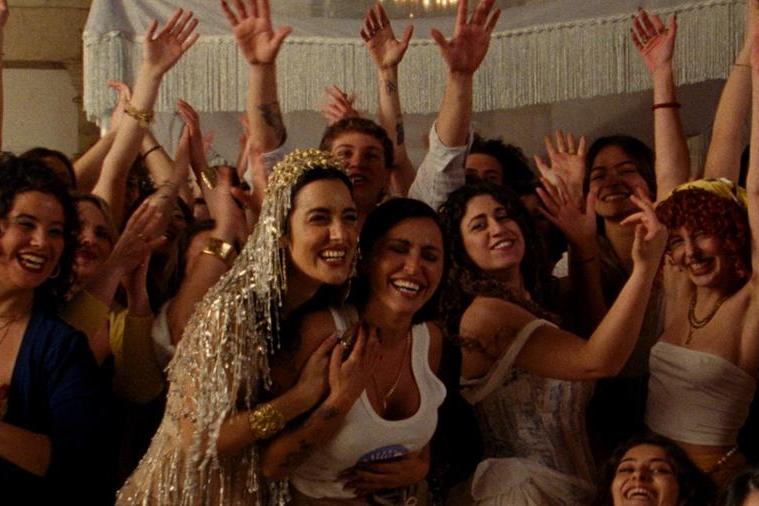
There is something profoundly discordant in the announced success of To my countrythe new single by Serena Brancale, Levante and Deliaall three artists originally from the South. Not out of tune on a musical level – indeed, the song is even catchy and perfectly calibrated to become a summer hit – but on a cultural and symbolic level. Because beneath the enthralling rhythm and suggestions of southern tradition lies a much more problematic operation: the reduction of Southern Italy to an image, to a cliché, to a product to be sold, to a “crib of lies” as someone rightly wrote.
There is a subtle violence – of which this song is the perfect example, but certainly not the only one – That it does not pass through the denial of a culture, but through its embalming. It is the violence of “cool”, of the ethnic for the use and consumption of metropolitan palates, of northerners and “hit and run” tourists.
To my country it is yet another chapter in an anthology of the cliché that is saturating the Italian cultural industry: a song that, under the guise of homage, delivers the South and the islands to a tourist narrative, immobile and, let’s face it, profoundly alienating for those who have decided to stay in these places, perhaps fighting every day, with stubbornness, willpower and a spirit of sacrifice, with what is wrong, from transport to bureaucracy, and enhancing what the South can still offer.
The mechanism is simple and ancient. A shared imagery is taken – the chairs outside the houses, the grandmothers chatting, the children playing in the street, the patronal festivals, the clothes hanging in the sun – and amplified until it becomes reassuring, recognisable, marketable. It doesn’t matter if that world exists today only in part, or only at certain times of the year.
It does not matter if depopulation, precariousness and infrastructural isolation coexist alongside those images (witness the landslides triggered by the Easter floods which interrupted the Adriatic railway line with repercussions throughout Italy), emigration not only among young people (according to the last one Svimez Report the South is characterized by a double flight: qualified young people and elderly people. Between 2002 and 2024, almost 350 thousand graduates under 35 have left the Southwhile the number of elderly people who moved to the Centre-North (“grandparents with suitcases”), driven by local health deficiencies and the need for family reunification, has almost doubled, exceeding 184 thousand).
Everything that is friction, problem, issue to be addressed (and perhaps even reported) is removed. The surface remains.
The result is a narrative that does not openly offend, but simplifies. And simplifying, when talking about complex territories, is always a risky operation. The South told in To my country it is not a living place, crossed by contradictions and transformations, by people who innovate, invest, work, but a suspended, immobile space, almost out of time. A “country”, in fact, a term that flattens cities, differences, identities, good only to be visited, consumed and then left behind like any “tourist paradise”.
The South is not a photographic set. It’s not just processions, straw chairs and Instagram filter religiosity. Reducing, as many southerners who live in the North or abroad do (and above all), the bond with their homeland to an interval between holidays (“holidays begin when I return to my country”) means emptying those territories of every working, civil and professional dynamic. It is a “sonic tourismification”: transforming identity into an exotic spice for metropolitan playlists, denying dignity to those who here try to build the future and not a museum of the past.
You might argue that it’s just a pop song, and that demanding depth from a summer hit is out of place. It’s a legitimate observation, but biased. Because popular culture, precisely in its lightness, contributes to building lasting imaginations. And when those imaginaries coincide with already rooted stereotypes, the risk is to strengthen them, not to overcome them.
The point is not to deny that certain images really exist. The full squares, the processions, the extended families are an authentic part of many southern communities. But telling them as a whole means erasing everything else: the daily work, the difficulties, the ambitions, the silent transformations, the investments, the innovation, the young people who courageously decided to stay. Ultimately, it means restoring a South that is more useful to those who look at it from outside, or to those who return there for a few days a year, than to those who live there every day.
Then there is an even more subtle, and perhaps more disturbing, element. This aestheticization of the South responds perfectly to the logic of the contemporary market, which needs recognizable, narratively simple, easily exportable places. The South thus becomes a brand: light, rhythm, nostalgia, sun, sea, wind. A product to be consumed, rather than a reality to be understood.
It is no coincidence – indeed, it is the problem within the problem – that precisely those who come from those territories and who should know them better than anyone else sometimes end up adhering to this representation, propagating these stereotypes, transforming the history of the South, its efforts, the sacrifices of previous generations, the unresolved problems and the potential it can express, into caricature, caricature, stereotype.
No, it is not up to a song to solve the problems of the South. But it is legitimate to ask that at least it does not contribute to hiding them behind a veneer of folklore.
To my country it works, and it will work. But precisely for this reason he deserves to be questioned. Because behind the lightness of a refrain something more serious is at play: the way in which we continue to talk about, and misunderstand, a fundamental part of our country. The fact that three (good) female artists from the South do this story is an aggravating factor, not a mitigating factor.