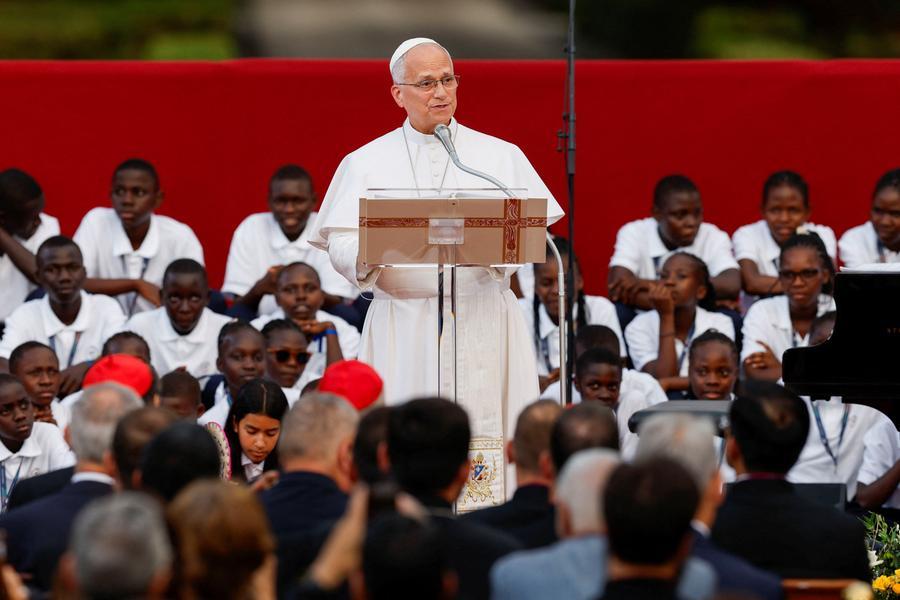






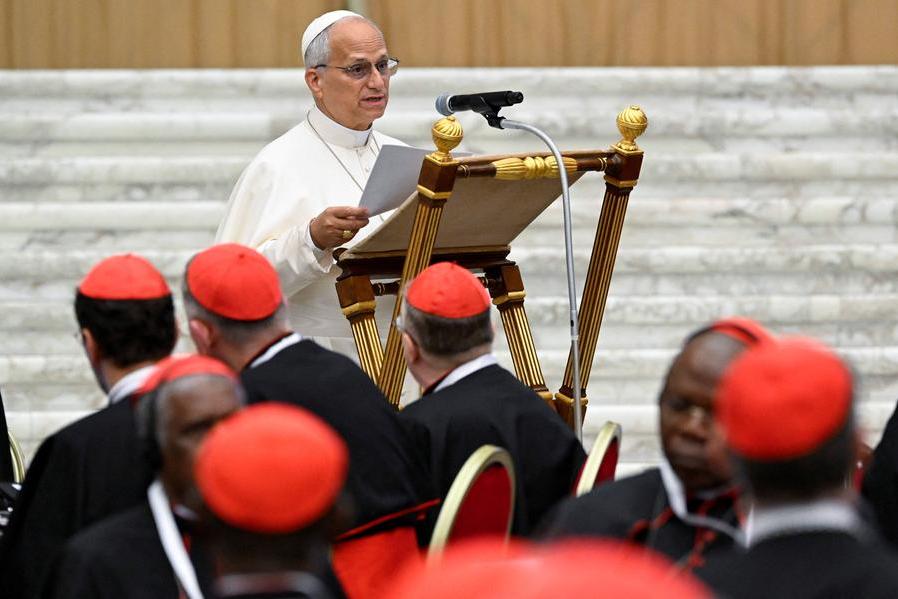
“Let’s not resign ourselves to violence, it won’t have the last word.” It is thus, with this appeal to hope and peace, that Pope Leo
The words against war are strong: «Before manifesting itself in history, war is born within us, when suspicion takes the place of trust, fear, hope and the other is perceived as a threat. But it is in the same heart that Christ continues to meet us, to speak and to convert us. From a reconciled heart, disarmed words, new relationships and a peace capable of reaching even the people can arise.”
«War is not just a conflict between states. It was born much earlier from a culture of power which, through our way of thinking, of living relationships, of exercising power, of using the economy, technology and even religion, is the root of the crisis, the answer to the question of rebuilding a culture of cooperation and dialogue, capable of giving new strength also to multilateralism so that peoples learn again to seek together the common good of the entire human family”.
He recalled the importance of the lay faithful of a Church in dialogue with the world: «On this path the contribution of the lay faithful involved in public life is essential. They need the closeness and support of the ecclesial community to experience the political charity that you have mentioned. The culture of cooperation itself grows through ecumenical and interreligious dialogue which does not attenuate our Christian identity but makes it capable of serving the common good and peace together.”
And again: «I then found the way in which some of you approached it particularly valuable the theme of the non-violent response to the many forms of violence. It is a profoundly evangelical form of inhabiting history, the result of contemplating Jesus’ way of acting. It does not consist in renouncing the conflict nor in a passive attitude but in choosing to face it without reproducing its logic. It does not renounce the truth nor silence evil but refuses to defend it with violence and to transform the other into an enemy. It begins by disarming itself. It thus reveals the logic of Easter in which love manifests itself stronger than hatred and forgiveness breaks the spiral of revenge. And this is the strength of the risen crucifix. A strength that does not destroy the enemy but makes it possible to find a brother.”
From this perspective, various groups «have underlined the opportunity to continue studying the topic of legitimate defense in light of the profound transformations that have occurred in the nature of contemporary conflicts. This reflection deserves to be further developed with the necessary theological and pastoral rigor.”
«I also welcomed with particular interest», said the Pope, summarizing the main themes of the work, «your insistence on the social doctrine of the Church. You have expressed the desire that it become increasingly the living heritage of our communities, an ordinary criterion for the formation of consciences and pastoral discernment. This does not offer pre-established solutions, but educates the Church in an evangelical way of inhabiting reality, interpreting it and responsibly directing action. Another convergence also struck me. Many of you have observed that today the common good is not simply an objective to be pursued, it is a reality to be rediscovered together. We live in a time in which it becomes difficult to even recognize what is truly good for everyone. For this reason, rooted in Christ, the Church is called to safeguard places of meeting, listening and dialogue in which a renewed culture of the common good can mature. This also requires patient educational work that helps recognize the inviolable dignity of every person and the responsibility that binds us to each other. On this journey, the poor are not only recipients of our care, but protagonists of the hope that God continues to inspire in history.”
Shortly before he had said: «Thinking back to the conversations of these days, first of all I carry with me the gaze with which you contemplated the world in the first session. Many of you have recounted the suffering caused by wars, violence, poverty and the many injustices that mark the lives of peoples. However, you didn’t stop to describe them. Behind these tragedies you have recognized an even deeper suffering. Loneliness, the crisis of relationships, the loss of hope, the difficulty of recognizing each other as brothers and sisters. It is a gaze that does not avert its eyes from the wounds of the world, but seeks their roots, recognizing, often hidden within them, a renewed demand for meaning, authenticity, spirituality and community. Many today are looking for hope and real relationships. I was particularly struck by the way you spoke about young people, in their questions, but also in the suffering that sometimes leads them to desperation and sometimes to extreme desperation to take his own life. You have recognized one of the deepest wounds of our time, but you have also been able to recognize the action of the spirit, their search for authenticity, for true relationships and meaning. I remind us that the Gospel continues to meet the deepest expectations of the human heart, listening to them and their families with humility is also a way through which the Lord continues to convert the Church.”
«Many of you also remembered the family. Where it is supported and accompanied, a school of relationships, solidarity and hope grows. Wherever it is hurt or isolated, the whole of society bears the consequences. In October we will have a meeting with the heads of the Eastern Churches and the Presidents of the Episcopal Conferences to evaluate the steps taken after Amoris Laetitia. Some families will also participate and share experiences. Their presence is essential, but I hope that all those who come prepare by listening closely and bringing the experience of the families and their Churches. You have thus tried to listen to what the wounds of the world reveal about the human heart. It is right there, in the heart, that peace is also decided.”
He focused on the responsibility of the Church: «From many of your reflections another conviction also emerged forcefully. While we questioned the responsibilities of the Church in today’s world, you continually recalled the importance of testimony, proximity, the formation of consciences and the construction of fraternal and credible communities. This testimony is born, through word and sacraments, in which the Lord supports his people and enables them to serve him. The Church is called to become increasingly what it proclaims and it is on this foundation that the necessary reforms of structures, institutions and processes can also bear fruit. So, these days strengthen my hope, not only for what we shared, but for the way we did it. In a time marked by polarization, even the way in which the Church listens and dialogues becomes part of its announcement.”
The College of Cardinals, the Pope said, is not a “Parliament, not a Congress in which opinions or interests prevail, but an experience of communion at the service of the mission. What we are learning to live in these days does not only concern the College of Cardinals, it is a style that we are called to promote throughout the Church, so that every baptized person, according to their vocation and responsibility, participates in the construction of the civilization of love and in the service of the common good”. «What matters is not multiplying meetings, but learning to experience meetings in which, by listening to each other, we learn together to listen to the Lord. Before concluding, I would like to welcome the unanimous appeal that has arisen from this consistory and make it my own. Indeed, I would like us to do it together through these words. Let’s say it to our brother bishops, to the Churches entrusted to our Ministry and to all the peoples of the Earth. God desires peace for every nation and for every people. This is why we must not resign ourselves to violence. Violence will not have the last word. God continues to open paths of reconciliation and peace in history. We have a responsibility to follow them with courage and help the world recognize them.”