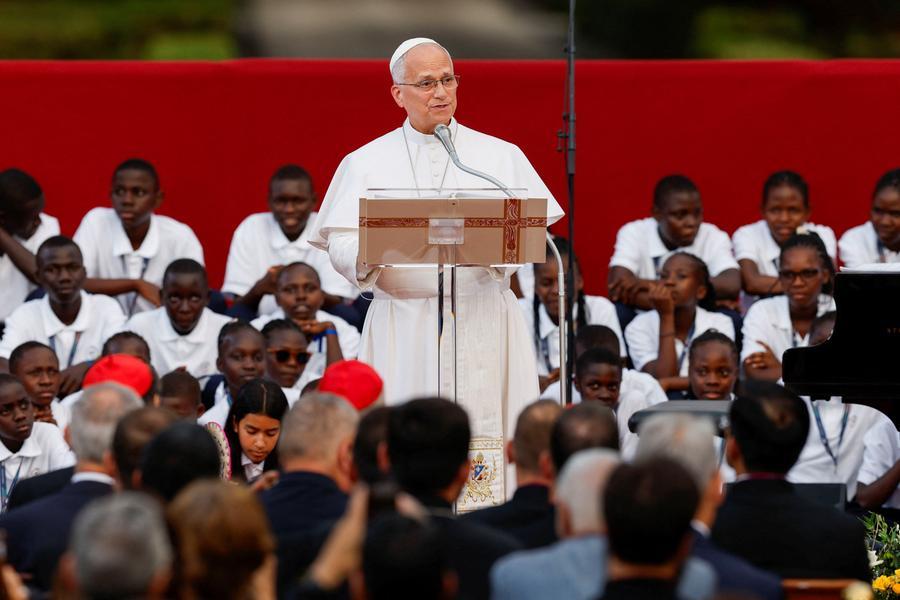







Pope Leo changes language, after reciting the Angelus, he expresses his closeness to the victims, the wounded and those damaged by the earthquake in Venezuela in the language he has in common with themthe Spanish of Latin America that he learned as a second mother tongue in the twenty years he spent in Peru, an empathetic gesture of authentic closeness, which arrives directly without mediation or translation, at the cost of a little displacing the public, who feel the gap, without warning after the “Dear brothers and sisters”.
THEimmediately afterwards he thanks in Italian the many who came to bring aid. Immediately before, commenting on the Gospel, he had spoken of love and acceptance: «Even in today’s Gospel we hear some of Jesus’ exhortations to follow and be witnesses of his kingdom. It is not a question of some external act, but of committing our entire selves in a relationship of love with Him. And to bear fruit, love requires at least three things: detachment, loss and acceptance. First of all, detachment. Jesus says: “Whoever loves father or mother more than me is not worthy of me. Whoever loves son or daughter more than me is not worthy of me.” The moment he begins to send His Apostles on mission, the Lord wants them free from any bond.”
These are words that in the Gospel sometimes disturb, because they also displace in the believer the instinct that binds to the deepest affections. The Pope explains: «But for everyone, the fact that even the most important affections find their fullness thanks to the love that Christ gives us is valid. Let’s think for example about married life. You can live it fully only by leaving your parents’ home to engage in your marital relationship. We also think about raising children. We help them to realize themselves and be happy by teaching them to walk on their own two feet and make their own choices.”
The Augustinian lesson on which he has based his life comes out: «Says Saint Augustine. Detachment from what you love is painful, but even the farmer temporarily loses what he sows. Only by losing that seed thrown into the ground will he be able to see it flourish. In this sense love is also loss. We find it difficult to understand this, especially in a world where losing is always a weakness and we are obsessed with having and possessing. Love, however, bears fruit only in giving of itself. When we are willing to lose a little of our self to make room for the other, to lose a little time to listen to a friend, to lose a little comfort to share an uncomfortable situation.”
And he continues: «Whoever keeps life only for himself, says the Gospel, actually loses it because it does not open up to the joy of love and becomes sterile. This is why Jesus invites us to embrace the cross. He offered himself, he lost himself, and precisely in this way we were able to receive his life in abundance. In the same way, if we live in the logic of gift, we too will be capable of generating new life in our relationships. Finally, the welcome. Love, in fact, is expressed in concrete choices and actions in a commitment made up of small daily gestures, such as offering a glass of water to someone who is thirsty.».
And he concludes: «Jesus, sending His disciples ahead of Him, asks them to go without provisions, that is, to be needy, because in this way they will be able to inspire welcome in those they meet. And so, by welcoming those who come in the name of Jesus, we welcome him and the Heavenly Father who sent him. Love for the Lord always passes through welcoming our brothers.”