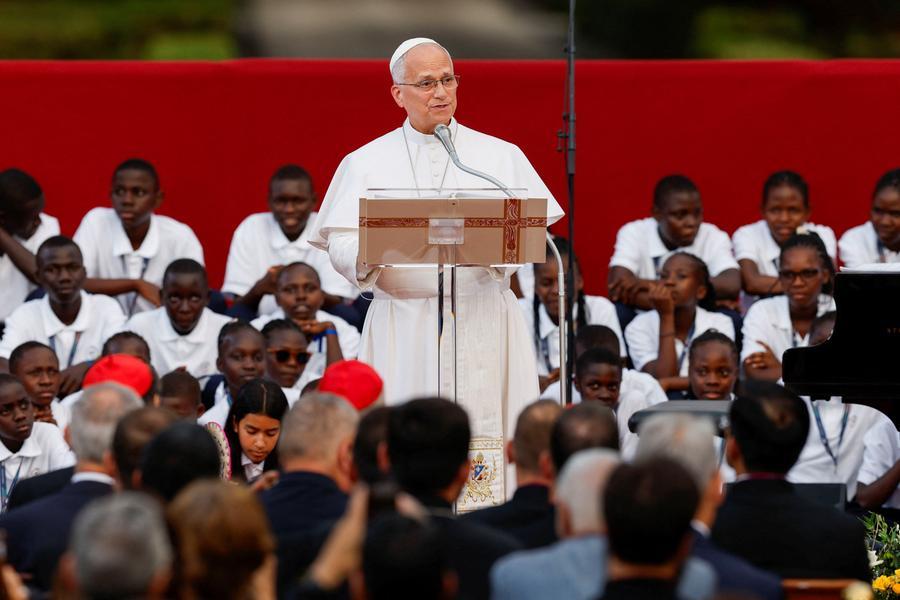






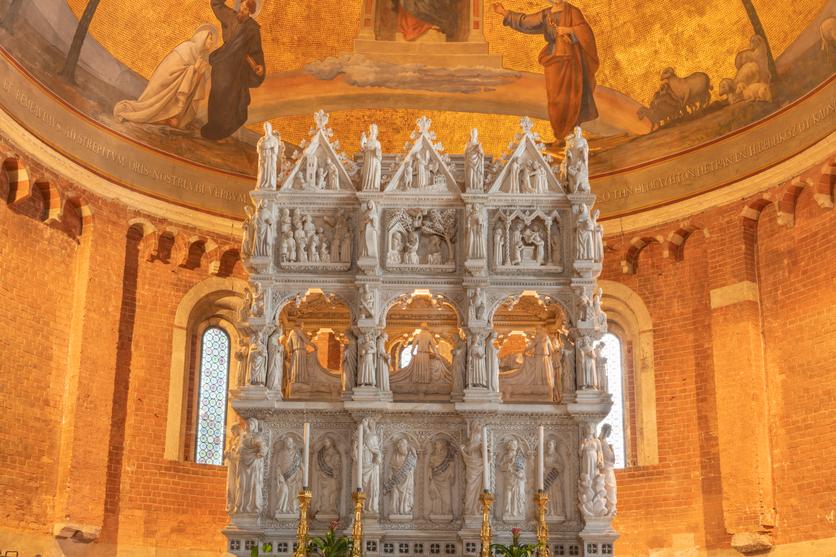
While Pavia on 20 June 2026 welcomes the first Augustinian pope in history, Leo it is natural to ask how the remains of the Father of the Church who died in Hippo in today’s Algeria and who now rests in the ark kept in San Pietro in Ciel d’oro where Benedict XVI had already been to pray in 2007 ended up on the banks of the Ticino. It helps us on this journey into Renata Crottipassionate historian of the Middle Ages, former professor at the University of Pavia and today part of the Pavia City of Sant’Agostino Committee.
Professor Crotti, how did the capital of the Lombard kingdom become the city of Sant’Agostino?
«We must make a premise: we are in the first half of the 8th century during the second violent wave of Saracen incursions into the Mediterranean. At that moment, Liutprand, 17th king of the Lombards, pursued the aim of unifying the peninsula under his dominion with a precise, far-reaching plan. The Lombards have long been Catholic, after having been Aryan for a long time and having experienced moments of heavy conflict with the Latin Catholics. Liutprand plays the role of champion of Catholicism well: the documents define him Christianus ac catholicus princeps (Christian and Catholic prince): title that he earned in the field by repeatedly taking a stand in defense of Catholicism, combining true feelings and poorly concealed political calculations. And in the meantime the king was weaving a network of international relationships, of European scope, thanks to the prestige obtained for initiatives aimed at strengthening the political and strategic role of the capital Pavia, a center of excellence of Christianity and culture”.
Is the translation of the body of Saint Augustine part of the political plan?
«The first and most obvious objective of the recovery and translation of the saint’s body from Sardinia to Pavia, in synergy with the local church whose bishop Peter was a relative of the king, was to protect the remains from profanation at a time when the Arab threat hung over the Mediterranean, but also over the Lombard kingdom and the Church of Rome, which, stimulated by this spring, began a period of mutual solidarity. Liuptrando’s second, but not secondary, objective was to provide the capital Pavia with an element of great attractiveness and exclusive value through which to acquire ever greater prestige”.
Why was the body of Saint Augustine found in Sardinia in the 8th century?
«The saint died in Hippo in 430. A first is documented translation of the body in Cagliari, to protect it from the violence of another people, this time barbaric: the Vandals who during the first wave of the invasions had settled on the coasts of North Africa, threatening to desecrate the burial place of the great saint who thus became peregrinus even in death, after having been so in life due to his wanderings from the East to the West and due to the restlessness of the spirit”.
How is it really said that Saint Augustine arrived in Pavia bought for his weight in gold by Liutprand?
«The oldest contemporary source is, as is known, the De temporum ratione liber of the venerable Bede, the father of Anglican historiography, who writes: “Liutprand, knowing that the Saracens, after having sacked Sardinia, had also profaned those places where once the bones of Saint Augustine the bishop had been moved and honorably placed, due to the devastation of the barbarians, sent to take them back and, having paid out a large sum of money, transferred them to Ticinum and placed them there with the honor due to such a great father”, this confirms that the news of the grandiose undertaking had promptly spread to distant areas, such as England. While it is surprising that such a significant event for the Christianity of the time, with a king, a bishop and the body of a saint, was not handed down by celebratory sources contemporary and close to the Lombard king, his entourage and the areas that were the scene of the epic undertaking: the contemporary sources do not even say where it was placed. To have a precise reference regarding the place of burial, we must wait until the late Carolingian age with the testimony of Adonis, bishop of Vienne, where he specifies that the body of the Saint was buried in Pavia in the monastery called “Cella Aurea”, which Liutprand himself had built and embellished cum digno honore”.
The 13th centenary was celebrated in 2023, is the date also uncertain?
«The date also represents an anomaly in the documentary panorama. In fact, no source refers to the year of the translatio: 723 is a date conventionally chosen on the basis of some evidence: the certainty that it occurred between 722, the year of the great Arab incursion, and 725, the year in which Bede finished his work. 723 is conventionally chosen, the year in which Pietro, a relative of Liutprand, with whom the king made an agreement to organize the translation. In other texts the event is described as a great popular event: “Hearing of the arrival of such an important body, all the people of Pavia, male and female, went to the river called Ticino and accompanied the coffin to the monastery. And in another source it is added “with hymns and praises the whole city went there and thanking the Lord for so much grace, they accompanied it to the basilica”.
What role did Saint Augustine have in the continuing history of the city?
«In dramatic moments, such as in 1522 following the siege of the French army, the city resorted to the intercession of the three co-patrons, San Siro, Teodoro and Sant’Agostino: in memory of the benefit received with the liberation from the siege, the grandiose fresco where the city, represented from a bird’s eye view, is defended by the three saints was placed in the church of San Teodoro. The call of Saint Augustine also leaves traces in a secular environment. For centuries a fair dedicated to Saint Augustine, in the two weeks between the 28th August anniversary of the saint’s death, a fair was organized which brought merchants loaded with gold and fabrics from everywhere to Pavia. Saint Augustine is cited in the 1393 statutes of Universitas iuristarum and of theUniversitas Artistarum et Medicorum (the faculties of law and medicine) as ‘universitatis patronus‘, patron saint of the university.”