“We should ask ourselves what excesses the people of the Middle Ages would have gone to if this great and sweet voice had not been raised.”
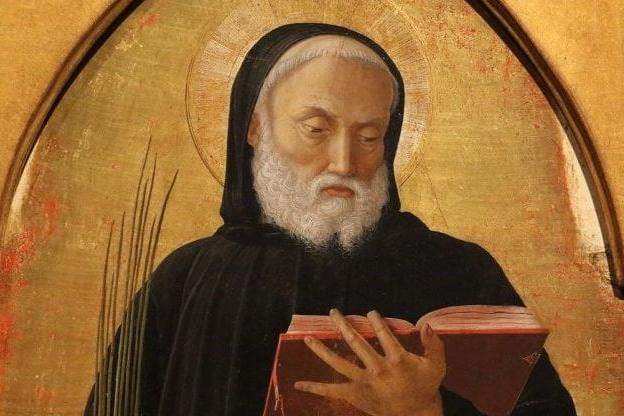
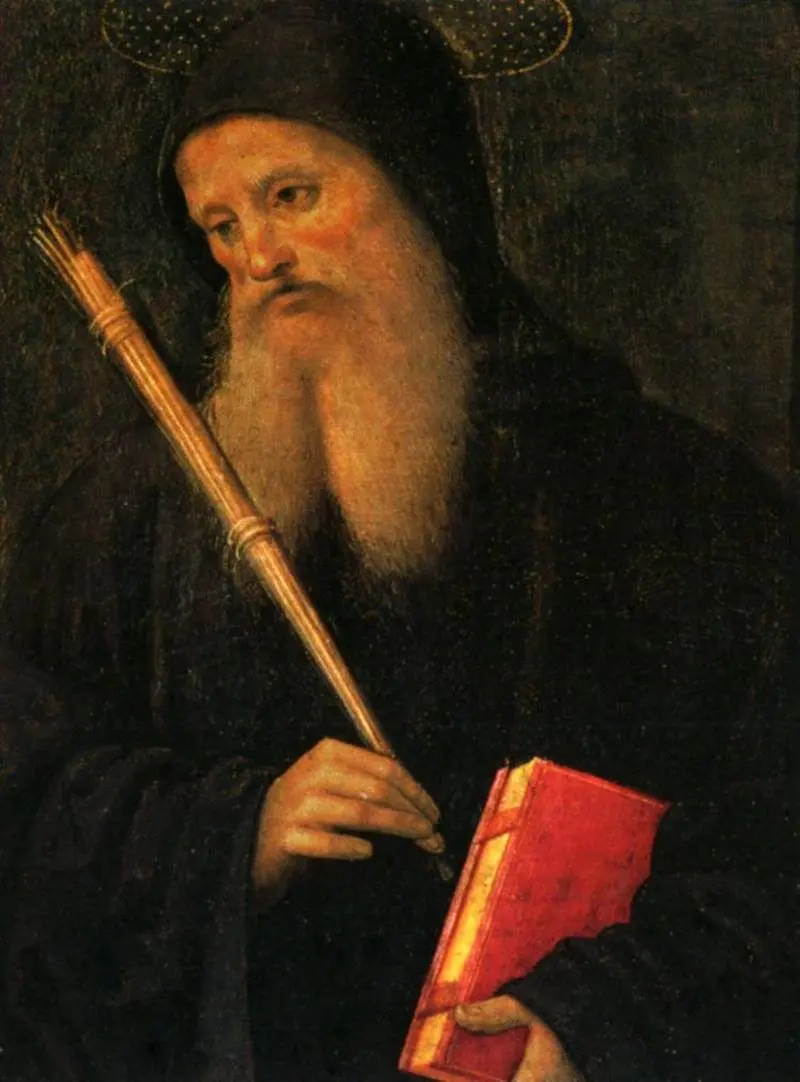
The historian said it Jacques Le Goff. The voice is that of Saint Benedict of Nursiathe patriarch of Western monasticism. After a period of solitude near Subiaco, it passed to the cenobitic form before BC Subiaco and then to Monte Cassino.
His Rulewhich summarizes the Eastern monastic tradition by adapting it with wisdom and discretion to the Latin world, opens a new path to European civilization after the decline of the Roman one. In his “school” the meditated reading of the word of God and liturgical praise play a decisive role, alternating with the rhythms of work in an intense climate of fraternal charity and mutual service. In the wake of San Benedetto, centers of prayer, culture, human promotion and hospitality for the poor and pilgrims arose on the European continent. Two centuries after his death, there will be more than a thousand monasteries guided by his Rule. For this reason in 1964 Paul VI proclaimed him patron saint of Europe. He died in Montecassino (Frosinone) on 21 March between 543 and 560 but the Church solemnly remembers him on 11 July.
To your biography, Pope Benedict XVIwho was inspired by him to choose his name as Pontiff, dedicated the catechesis of the general audience of 9 April 2008.
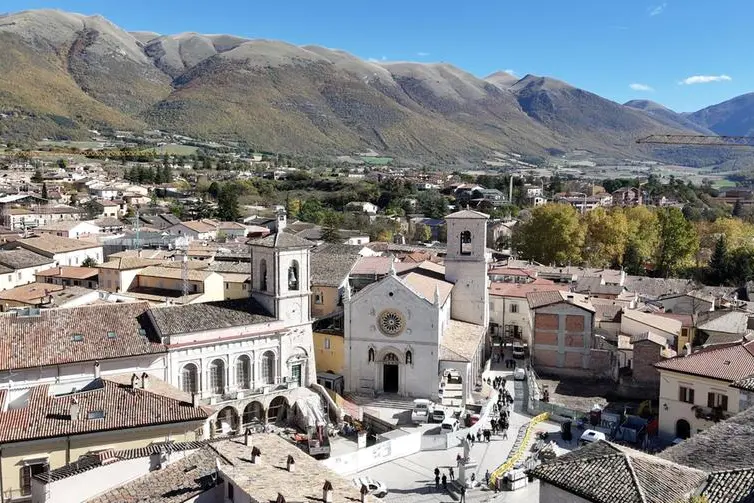
The Basilica of San Benedetto in Norcia, heavily damaged by the 2016 earthquake, was reopened for worship on 31 October 2025
(HANDLE)
Benedetto talks about Benedetto: the birth
The birth of Saint Benedict is dated aroundyear 480. He came, so says Saint Gregory the Great, “ex provinciale Nursiae” – from the region of Nursia. His wealthy parents sent him for his education in studies in Rome. However, he did not stay long in the Eternal City. As a fully credible explanation, Gregory mentions the fact that the young Benedict was disgusted by the lifestyle of many of his fellow students, who lived dissolutely, and did not want to fall into the same mistakes as them.
He wanted to please God alone; “soli Deo placeredesirans” (II Dial., Prol 1). Thus, even before the conclusion of his studies, Benedict left Rome and retreated to the solitude of the mountains east of Rome. After an initial stay in the village of Effide (today: Affile), where for a certain period he associated himself with a “religious community” of monks, he became a hermit in the nearby Subiaco.
There he lived completely alone for three years in a cave which, starting from the early Middle Ages, constitutes the “heart” of a Benedictine monastery called “Sacro Speco”.
The period in Subiaco, a period of solitude with God, was a time of maturation for Benedict. Here he had to endure and overcome the three fundamental temptations of every human being: the temptation of self-affirmation and the desire to place himself at the center, the temptation of sensuality and, finally, the temptation of anger and revenge.
It was in fact Benedict’s belief that, only after overcoming these temptations, he would be able to say to others a useful word for their situations of need.
And so, having reconciled his soul, he was able to fully control the impulses of the ego, to thus be a creator of peace around himself. Only then did he decide to found his first monasteries in the Anio valley, near Subiaco.
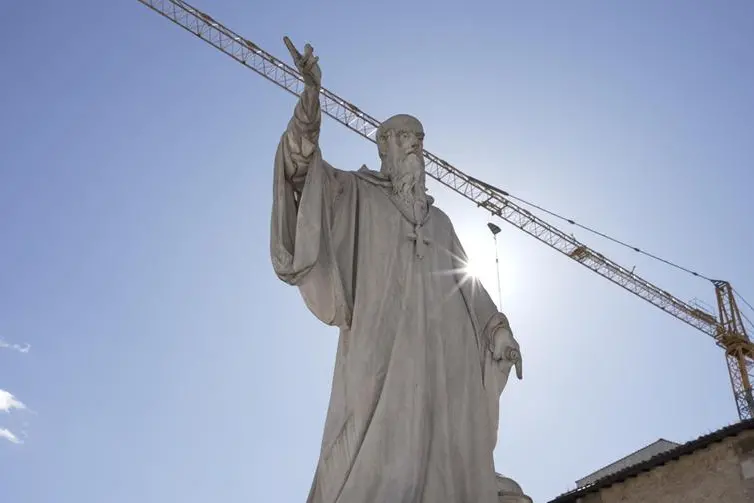
The statue of San Benedetto in front of the Basilica dedicated to him in Norcia
(HANDLE)
From Subiaco to Montecassino
In the year 529 Benedict left Subiaco to settle in Montecassino. Some have explained this move as an escape from the intrigues of an envious local clergyman. But this attempt at explanation proved unconvincing, since his sudden death did not induce Benedict to return (II Dial. 8). In reality, this decision was imposed on him because he had entered a new phase of his inner maturation and his monastic experience. According to Gregory the Great, the exodus from the remote Anio valley towards Monte Cassio – a hill which, dominating the vast surrounding plain, is visible from afar – has a symbolic character: hidden monastic life has its reason for being, but a monastery also has its public purpose in the life of the Church and societymust give visibility to faith as a life force. In fact, when, on 21 March 547, Benedict concluded his earthly life, he left with his Rule and with the Benedictine family he founded a heritage that has borne fruit throughout the world over the past centuries and still bears fruit today.
Between prayer and search for God
In the entire second book of Dialogues Saint Gregory the Great illustrates to us how the life of Saint Benedict was immersed in an atmosphere of prayer, the supporting foundation of his existence. Without prayer there is no experience of God. But Benedict’s spirituality was not an interiority outside of reality. In the restlessness and confusion of his time, he lived under the gaze of God and precisely in this way he never lost sight of the duties of daily life and man with his concrete needs. Seeing God he understood the reality of man and his mission. In his Rule he describes monastic life as “a school of the service of the Lord” (Prol. 45) and asks his monks that “nothing should be placed before the Work of God (i.e. the Divine Office or the Liturgy of the Hours)” (43,3).
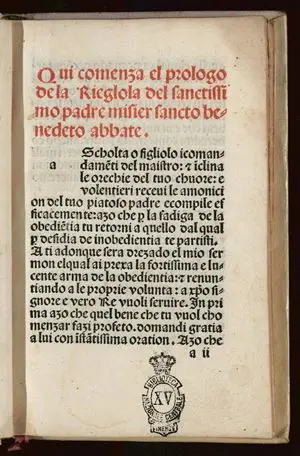
The Rule of Saint Benedict
He emphasizes, however, that prayer is first and foremost an act of listening (Prol. 9-11), which must then be translated into concrete action. “The Lord waits for us to respond every day with deeds to his holy teachings,” he states (Prol. 35). Thus the life of the monk becomes a fruitful symbiosis between action and contemplation “so that God may be glorified in everything” (57.9).
In contrast to an easy and egocentric self-realization, often exalted today, the first and indispensable commitment of the disciple of Saint Benedict is the sincere search for God (58.7) on the path traced by the humble and obedient Christ (5.13), he must not put anything before the love of which (4.21; 72.11) and precisely in this way, in the service of others, he becomes a man of service and peace. In the exercise of obedience implemented with a faith animated by love (5.2), the monk conquers humility (5.1), to which the Rule dedicates an entire chapter (7). In this way man becomes increasingly conformed to Christ and reaches true self-realization as a creature in the image and likeness of God.
The Rule: «God reveals to the youngest the best solution»
The obedience of the disciple must correspond to the wisdom of the Abbot, who in the monastery takes “the place of Christ” (2.2; 63.13). His figure, outlined above all in the second chapter of the Rule, with a profile of spiritual beauty and demanding commitment, can be considered as a self-portrait of Benedict, since – as Gregory the Great writes – “the Saint could not in any way teach differently from how he lived” (Dial. II, 36).
The Abbot must be together a tender father and also a severe teacher (2.24), a true educator. Inflexible against vices, he is however called above all to imitate the tenderness of the Good Shepherd (27.8), to “help rather than dominate” (64.8), to “emphasize with deeds more than with words everything that is good and holy” and to “illustrate the divine commandments with his example” (2,12). To be able to decide responsibly, the Abbot must also be someone who listens to “the advice of his brothers” (3.2), because “often God reveals to the youngest the best solution” (3.3). This provision makes a Rule written almost fifteen centuries ago surprisingly modern! A man of public responsibility, and even in small areas, must always also be a man who knows how to listen and knows how to learn from what he listens to.
The Abbey of Montecassino
Benedict, an example for today’s lost Europe
Benedict qualifies the Rule as “minimal, outlined only for the beginning” (73.8); in reality, however, it offers useful indications not only to monks, but also to all those who seek guidance on their journey towards God. Due to its moderation, its humanity and its sober discernment between the essential and the secondary in spiritual life, it has been able to maintain its illuminating force until today.
Paul VIproclaiming it the 24 October 1964 Patron Saint of Europeintended to recognize the wonderful work carried out by the Saint through the Rule for the formation of European civilization and culture. Today Europe – having just emerged from a century deeply wounded by two world wars and after the collapse of the great ideologies revealed as tragic utopias – is in search of its own identity. To create a new and lasting unity, political, economic and legal instruments are certainly important, but it is also necessary to stimulate an ethical and spiritual renewal that draws on the Christian roots of the Continent, otherwise Europe cannot be rebuilt. Without this lifeblood, man remains exposed to the danger of succumbing to the ancient temptation of wanting to redeem himself – a utopia which, in different ways, in twentieth century Europe caused, as Pope John Paul II pointed out, “an unprecedented regression in the tormented history of humanity“(Teachings, XIII/1, 1990, p. 58). Seeking true progress, we also listen today to the Rule of Saint Benedict as a light for our journey. The great monk remains a true master at whose school we can learn the art of living true humanism.