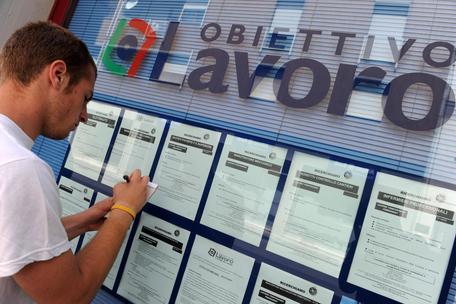
There is a profound asymmetry, almost a hidden pain, between the cold geometry of economic statistics and the living flesh of Italian society. The latest INPS annual report gives us a mirrored paradox: on the one hand, the pride of the numbers that celebrate the historic peak of employment, with over 24 million citizens included in the country’s production circuits; on the other, the silent evidence of paychecks that are getting shorter, of social security destinies that are fraying and of an entire generation suspended on the edge of vulnerability.
The symbolic figure of this transition is a precise number: 27,649 euros. It is the average annual gross salary of an employee in Italy. A fact that at first glance might even suggest an illusion of progress, a nominal increase of 14.5% compared to 2019but which, when compared to the ordinary reality of consumption and daily spending of families, reveals itself for what it is: a statistical ghost.

Here we feel the most severe lesson on the stability of our social institutions. A country in which work increases but real wages decline is a country in which the citizenship contract risks breaking down. In fact, between 2019 and 2025, the inflationary flare-up devoured over 18% of citizens’ purchasing power. It means that the nominal increase in wages has been literally swallowed up by the cost of living. Those who work are no longer automatically safe from poverty. We have baptized this figure with a ferocious oxymoron, almost a contradiction in terms: i working poor.
Men and women who clock in, offer their time and skills to the state and the market, but are unable to glimpse economic stability, neither for the present nor, tragically, for the future.
The president of the INPS, Gabriele Fava, said it with words that sound like an ethical warning for politics and for the entire national community: «There is no solid pension without stable, regular and decently paid work. If work is weak, social security will be fragile». It is the very architecture of our welfare system that is faltering under the weight of a structural mutation of the economy, increasingly unbalanced towards the macro-sector of services, where contractual intermittency, involuntary part-time work and low productivity depress the amount of contributions paid.

Translated into human terms, we are knowingly building poverty checks for tomorrow’s pensioners. Those who today accept the fragmentation of their professional path are not only paying the price for exaggerated flexibility in the present, but are giving up, piece by piece, the dignity of their old age. The average age of exit from the labor market has already risen to 64 years and 10 months – seven years more than in 1995 – and the prospect of 67 years of old age is now the de facto standard. You work longer, you earn less in real terms, you risk not having enough to live on when your strength fails.
Yet, among the folds of this scenario that the purely macroeconomic gaze would describe as an irreversible drift, an illuminating detail emerges, a fact that forces us to change perspective, to search for that profound meaning of existence that looks beyond the appearances of technological modernity and metropolitan haste. AND the link, recorded by the Institute, between smart working and birth rates. In the context of an accelerated society, accustomed to commodifying every moment and confusing value with price, flexible working has transformed for many families into an unexpected tool for reconciliation with life. It is not simply an organizational method or a digital shortcut to increase company profits; it is, in fact, the reconquest of time.
Man was not made to be a mere cog in a machine that produces incessantly, alienating him from his affections and his natural environment. Where work emerges from the physical rigidity of the old structures and gives the worker back a semblance of control over their daily lives, existence begins to flourish again. The cradles are filling up again not because monetary wealth has increased, the average 27,649 euros tells us exactly the opposite, but because a space of care, of silence, of closeness has reopened. It is an immense lesson for an Italy hit by a demographic winter that seemed incurable: children are not born only where there is a large bank account, they are born where parents can exercise the right to be there, to watch their children grow up without the all-encompassing anxiety of a time constantly taken away from private life.
However, this oasis of domestic conciliation does not erase systemic asymmetries, in particular gender ones, which represent an open wound for the social conscience. The INPS Report certifies that the The male-female gap in market access and wages continues to have painful repercussions on pensions: women represent more than half of the pensioners, but they receive a total of 163 billion euros compared to 207 billion for men. A disparity of almost a third that tells an ancient and never resolved story of interrupted careers, of family sacrifices not recognized by the State and of a welfare system that often, paradoxically, risks discouraging female work through passive subsidies that replace the creation of kindergartens and structural services.
We cannot afford to look at this Report as a simple accounting balance sheet or a cold list of financial flows. Behind the news agencies and macroeconomic analyzes lies the very soul of our country. There is the question of meaning of a young person who enters a fragmented market, the daily struggle of a mother who tries to keep her profession and her cradle together, the silent anguish of an elderly person who sees the value of their sacrifices devalued. Solving the Italian equation does not just mean chasing percentage growth in employment or calculating social security transformation algorithms. It means putting the person back at the centre, giving an ethical value back to wages and understanding that work has a profound meaning only if it serves to build life, support the family and generate hope for tomorrow. If it stops doing so, it’s no longer progress: it’s just a statistic that consumes us.