





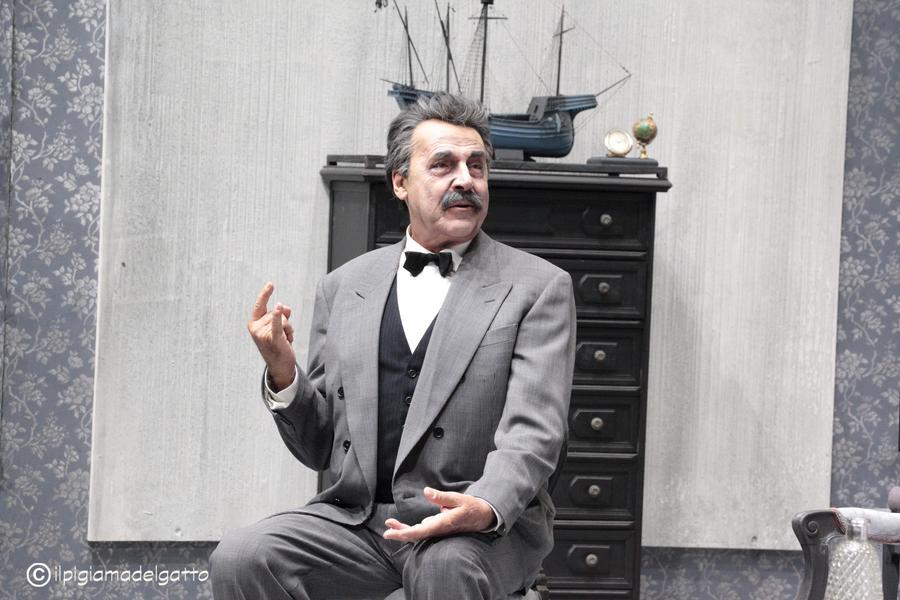
There is a risk when the classics of dialect theater are re-staged: transforming them into relics. Objects to be venerated rather than experienced. With Colpi di rudder, however, the miracle succeeds. The show directed and performed by Tullio Solenghi avoids the trap of caricature and gives the public a lively, pulsating theatre, ferocious in its comedy and surprisingly current in its substance.
The great intuition of the “Govi” project of the Teatro Sociale of Camogli is precisely this: not to embalm Gilberto Govi, but to bring him back to the open sea. After The Maneggios to Marry a Daughter and Pignasecca and Pignaverde, this new staging confirms that Solenghi has found a rare key: respectful homage without servile imitation. The physical metamorphosis is impressive – also thanks to the work of Bruna Calvaresi – but what is really striking is the character’s internal rhythm. Solenghi doesn’t “do Govi”: he captures his human breath.
His Giovanni Bevilacqua is an ancient man in the best sense of the term. A rough, direct owner, incapable of bending to convenience. One who still believes that one’s word has weight and that dignity is non-negotiable. When he discovers – mistakenly – that he has a few months to live, he stops practicing that form of hypocritical prudence that regulates many human relationships and begins to tell the truth. All of it. In everyone’s face.
And this is where Enzo La Rosa’s comedy surprises with its modernity. Because behind the mechanisms of pochade and brilliant theater lies a very bitter satire of power, of malfeasance, of cardboard respectability. The corrupt, the opportunists, the socially impeccable cowards who populate the Ligurian Provveditoria of 1940 look terribly like certain characters today. Clothes change, not vices.
The show works because it never chases the easy joke. Comedy comes from characters, from relationships, from the perfect timing of a close-knit company. And the Milan public responded with a full house. Alongside Solenghi, Mauro Pirovano confirms an extraordinarily effective stage presence: each of his entrances lights up the stage. Barbara Moselli gives the secretary Paola an intelligent, never affected grace. And the whole cast – from Roberto Alinghieri to Stefano Moretti, from Claudia Benzi to Daniele Corsetti – contributes to creating that climate of true company that is seen less and less today.
The stage system designed by Davide Livermore also deserves a special mention. Elegant without being invasive, it reconstructs a bourgeois and maritime world with measure, always leaving the actors and the word at the center. The tones are grey, as if we were in front of a black and white TV, like Govi’s comedies that we find in Rai film libraries or on You Tube. And it is an intelligent choice: in traditional theatre, the risk of aestheticism is around the corner. Here, however, everything serves the narrative.
But the authentic strength of Colpi di rudder is another. It is the courage to remember that sincerity can be revolutionary. Bevilacqua accidentally becomes a man without fear and, precisely for this reason, exposes the social comedy that surrounds him. In times of prudent languages, calibrated declarations and tamed truths, this old Genoese comedy ends up sounding almost subversive.
The audience laughs a lot. But he laughs with that hint of discomfort that accompanies successful works. Because with every lie unmasked by the Captain, one has the feeling that the target is not just 1940. And perhaps this is the secret of the long life of popular theatre: talking about men without an expiry date.
With Colpi di rudder, Solenghi demonstrates that tradition, when entrusted to intelligent hands, is not a refuge in the past. It is a very clear lens on the present. Solenghi’s final curtain call at the end of the show was also funny, almost an “encore” to thank the audience. We won’t spoil it, but it’s a lot of fun. A welcome gift.