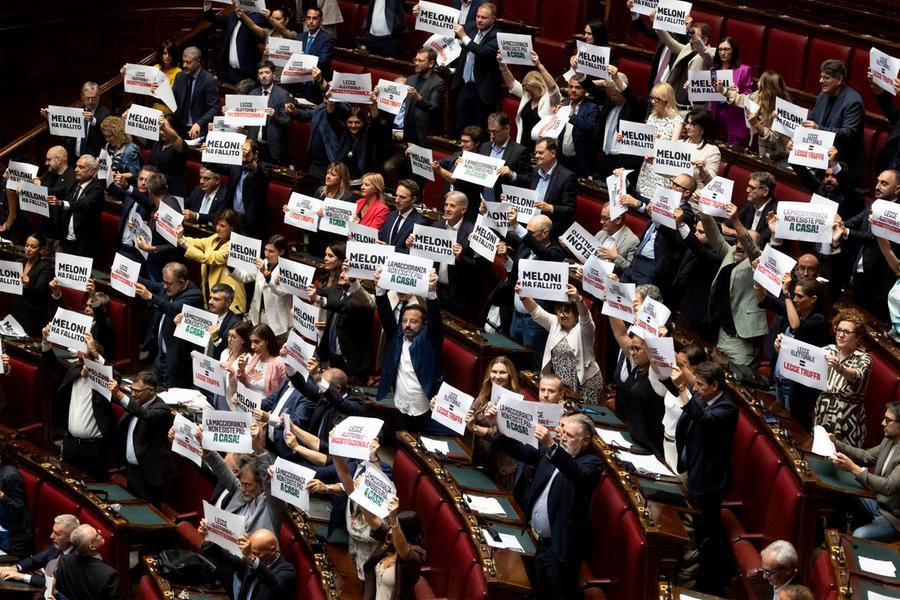
Less than ten years after the approval of the “Rosatellum”, Parliament once again changes the rules by which deputies and senators are elected. The bill which bears the name of its first signatory, the group leader of the Brothers of Italy in the Chamber Galeazzo Bignami (but has already been renamed “Melonellum”, after the name of the prime minister), was approved at first reading in Montecitorio and is now being examined by the Senate.
The new system is defined as “mixed”, but not because, as happens with the current law, it combines single-member constituencies and proportional quotas. The single-member constituencies were in fact completely abolished. The mixed component derives from the presence of a proportional distribution of seats accompanied, under certain conditions, by a majority bonus intended for the winning list or coalition. The overall result is a law that abandons personal competition in single-member constituencies and strengthens – ironically, after many declarations of intent to the contrary – the role of parties in the selection of elected officials. The majority bonus aims to promote governability, but is subject to a high and identical national threshold in the two Chambers. If no one reaches 42 percent in both Montecitorio and Palazzo Madama, Parliament will be formed through an entirely proportional distribution of seats. The reform of the new electoral law was approved in the Chamber with 217 votes in favour, 152 against and 2 abstentions. The vote was secret. «Meloni betrayed Italians and allies», attacked the secretary of the Democratic Party Elly Schlein, speaking in the chamber during the explanations of vote. «The Quirinale will never be Colle Oppio», added Giuseppe Conte, alluding to the place where the historic headquarters of Meloni’s party is located. Yesterday the exam ended after two long sessions and the suspense of many secret votes, the rejection of the amendment by FdI, Noi moderates and Udc on the preferences (complete with snipers), the incursion of the Vannaccia supporters through an amendment on the reintroduction of preferences (later also rejected), the protests of the opposition, an expulsion from the chamber, the “case” of the videos during the ballot that ended up on the Quaestors’ table and the amendment voted on unanimously which allows non-residents to vote.
A fixed premium only over 42 percent
The heart of the reform is the majority bonus. This is not a variable bonus, calculated in such a way as to automatically guarantee a certain quota of seats, but a pre-established package: 70 deputies in the Chamber and 35 senators in the Senate. The prize is awarded to the list or coalition of lists that comes first, but only if it reaches at least 42 percent of the votes in both the House and the Senate. The condition must be met simultaneously in the two assemblies.
This means that it is not enough to exceed the threshold in just one of the two houses of Parliament. If the winning list or coalition reached 42 percent in the Chamber but not in the Senate, or vice versa, the prize would not be awarded in either Chamber.
In this case, the 70 seats in the House and 35 in the Senate initially reserved for the prize would also be distributed proportionally among the political forces on the basis of the votes obtained.
The rule therefore aims to guarantee a more solid majority only when the electoral result presents sufficient national uniformity and the same political area is clearly the winner in both houses of Parliament.
The maximum number of seats
The seats of the prize are added to those won by the list or coalition through proportional distribution. The sum, however, cannot exceed the limit established by law.
The maximum limit is set at 220 deputies in the Chamber and 113 senators in the Senate. In the event that, by adding the proportional seats and those of the prize, the winning force exceeds these limits, the excess seats would be subtracted from the quota obtained in the proportional part.
Those elected in the Foreign constituency are excluded from the calculation of the ceiling: eight deputies and four senators. Any parliamentarians elected abroad by a political force would therefore be added to the national seats without contributing to reaching the maximum limit.
Goodbye to single-member constituencies
The second big news concerns the cancellation of single-member constituencies, in which the candidate who obtains the most votes is elected with the Rosatellum. The new system becomes fully proportional, except for the possible attribution of the majority bonus.
The voter will no longer find on the ballot the name of a candidate called to face his opponents directly in a constituency. Instead, a list presented by a party will vote, alone or within a coalition.
The suppression of single-member constituencies also changes the weight of alliances. With the Rosatellum the coalitions are decisive above all to conquer the constituencies assigned with the majority system. With the Bignami reform they instead become the instrument through which multiple lists can compete together to reach the 42 percent necessary to obtain the prize.
Blocked lists and no preferences
The reform does not introduce preferential voting. Voters will therefore not be able to directly choose the candidate to be elected from the voted list.
The lists will be blocked and the order of election of the candidates will be established by the parties at the time of presentation. In each multi-member constituency, up to six candidates may appear next to the symbol.
The seats obtained from each list will be assigned following the order in which the names were inserted. The actual choice of people destined to enter Parliament will therefore remain largely in the hands of the secretariats and leading bodies of the parties.
Alongside the lists of multi-member constituencies, constituency lists are provided for the possible attribution of the majority bonus. In the case of a coalition, these lists will be common to all allied political forces.
It is the so-called “list”: a list of candidates agreed in advance by the coalition parties. If the coalition reaches the required threshold and obtains the prize, the candidates on the list enter Parliament in the established order. Its composition will therefore be entrusted to internal agreements between the combined forces.
The barrier thresholds
The threshold remains set at 10 percent for coalitions and 3 percent for individual lists, including those participating in a coalition.
However, the reform introduces a repechage mechanism. For each coalition, the list that, despite not having reached 3 percent, will have obtained the best result among those remaining below the threshold can be recovered.
The restored list will then be able to participate in the distribution of seats. The other related lists that remain below 3 percent will not only not elect parliamentarians, but their votes will not even contribute to the coalition’s national electoral figure.
It is the so-called anti-fragmentation rule. Its aim is to prevent a coalition from reaching 42 percent by adding the votes of numerous very small lists without independent electoral consistency. An exception is only the best of the lists remaining below the threshold, admitted to the repechage.
The indication of the Prime Minister
Each party or coalition must indicate in its electoral program the name and surname of the person proposed for the position of Prime Minister. In the case of a coalition, the name must be the same for all the lists that are part of it.
However, the name of the candidate to lead the government will not appear on the ballot paper. The voter will continue to formally vote for a list and not directly for the Prime Minister.
The provision expressly recalls the constitutional prerogatives of the President of the Republic in the appointment of the Prime Minister and ministers. Furthermore, the provisions of article 67 of the Constitution are confirmed, according to which each parliamentarian represents the nation and exercises their functions without mandate constraints.
The indication of the name will however be mandatory. His absence will result in the inadmissibility of the lists, as already happens in the case of failure to present the electoral programme.
The rules for nominations
To participate in the elections, a political force must present its lists in at least one third of the constituencies of the Chamber. The rule therefore introduces a minimum territorial presence requirement.
A connection is also established between the candidates included in the district lists for the award and those present in the multi-member constituencies.
Whoever is nominated on the constituency list destined for the awarding of the prize must also appear as the head of the list in at least one of the multi-member constituencies of the same constituency, within one of the connected lists.
It will therefore not be possible to include in the prize list people who are completely unrelated to the ordinary applications presented in that part of the national territory.
The collection of signatures
Parties that have a parliamentary group established in at least one of the two Chambers by 31 December 2025 will be exempt from collecting signatures.
According to the text approved in the Chamber, this provision allows the exemption, among others, of Azione, Alleanza Verdi e Sinistra and Noi Moderati. However, Roberto Vannacci’s Futuro Nazionale, Più Europa and Luigi Marattin’s Liberal Democratic Party remain excluded.
During the parliamentary examination, the proposal to allow the digital collection of signatures, a method already used for the presentation of referendums, was also rejected.
News for Italians abroad
The reform entrusts the government with the task of updating, within three months of the entry into force of the law, the implementing regulation of the Tremaglia law.
The intervention will have to introduce the necessary changes to guarantee freedom, security and secrecy of the vote of Italians residing abroad.
The geographical distributions of the foreign constituency also change. For the election of the Chamber we move from the current four divisions to two: Europe and the Americas-Asia-Oceania-Antarctica. For the Senate the four divisions are instead brought together in a single foreign constituency.
The vote of those outside the office
Finally, the law introduces a stable regulation to allow non-resident voters to vote in the municipality in which they are temporarily domiciled.
A list of non-resident voters allowed to vote in their place of temporary residence will be established at the electoral office of each municipality. The possibility will concern the elections to the House and Senate, those for the European Parliament and referendums. Voters who, for study or work reasons, are temporarily in a municipality located in a region other than that of residence will be able to request registration on the list, provided that the expected stay is at least nine months. The request must normally be submitted by 31 December of the year preceding the election. Anyone who meets the nine-month requirement subsequently will be able to apply within thirty days of having acquired the requirements and in any case no later than the forty-fifth day before the vote.
Specific discipline is provided for those who are away from their residence for health reasons. Voters undergoing assistance, therapy or medical treatment in another region for a period of at least three months, including the election date, will be able to ask to vote in the municipality of temporary domicile. Also in this case the application must be submitted no later than the forty-fifth day before the consultation.