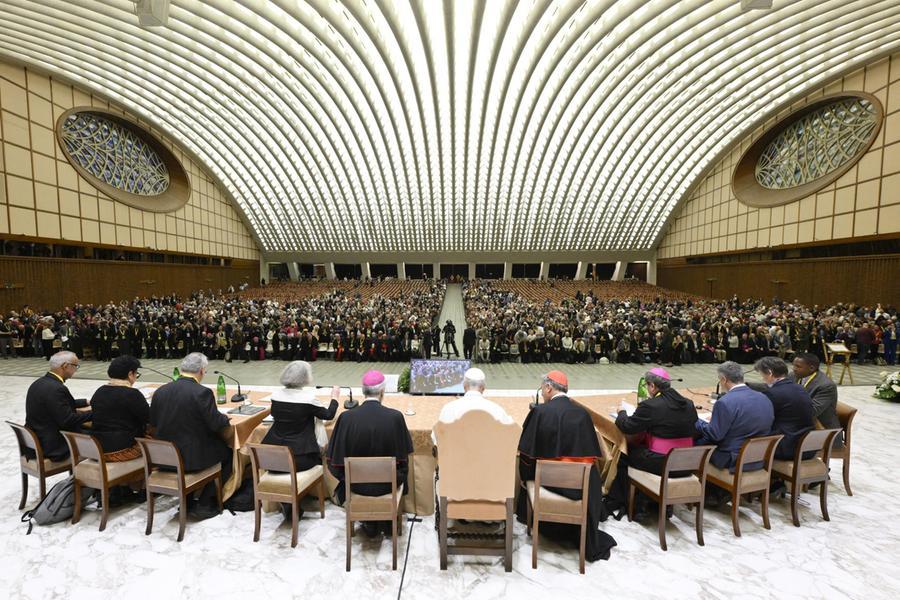






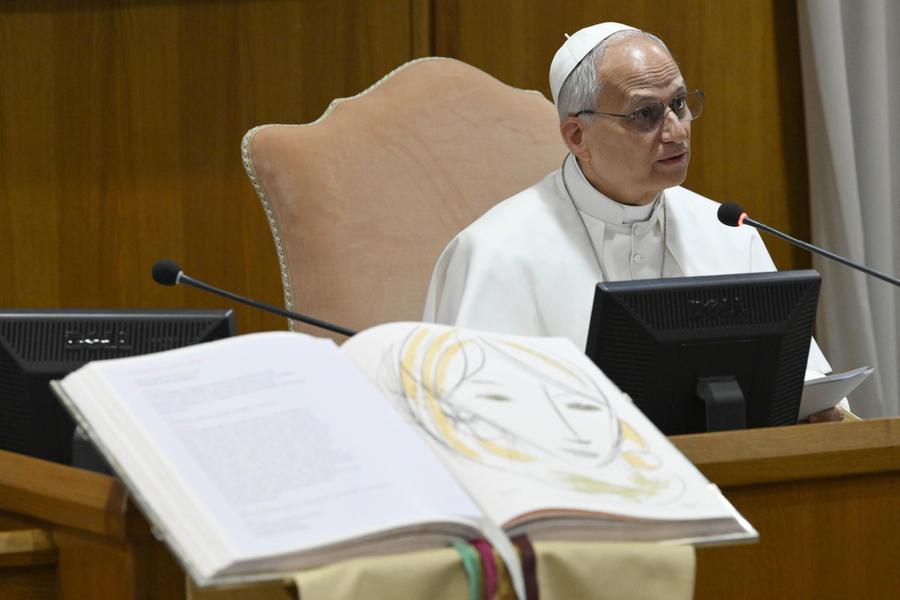
“It is certainly not by watering down the contents and softening the demands that Christianity can be made attractive.” It is one of the strongest passages of the speech with which Pope Leo XIV called on the Church not to give in to the logic of contemporary communication, during the meeting on Thursday in the Vatican with the participants in the plenary of the Dicastery for Evangelization.
The Pontiff described a context marked by a growing crisis of meaning, especially in the West, where there is “widespread religious indifference” and a progressive loss of relevance of faith in daily life. In this scenario, he observed, there is a risk of delegating everything to technology: «The great existential questions remain unanswered, while a technological culture that should respond to every need is spreading».
But, the Pope warned, the outcome is not fullness, but rather a new form of emptiness: “The underlying danger, not always perceived in its gravity, is that we will run out of breath for what is most properly human, that is, the search for meaning.”
Leone then denounced the effects of contemporary societies: «The cultural climate widespread in hypermedia and consumerist societies reduces the ability to learn with patience and to undertake with difficulty a path of personal search for the truth, with perseverance and critical sense.” In this context, he added, “every message risks being perceived as one opinion among many”.
Faced with this cultural and spiritual fragility, the Pope invited us not to give in to the temptation of adaptation: «We cannot underestimate that, especially in Western countries, the crisis of faith, together with other socio-cultural factors, has given rise to widespread religious indifference». For this reason, he insisted, the Gospel cannot be reduced to one proposal among others.
The heart of the response, according to Leo XIV, lies not in communication strategies but in testimony: «It is certainly not by watering down the contents and softening the demands that Christianity can be made attractive, but bearing witness with humility and courage to “the way, the truth and the life” that has converted and sanctified so many people.”
The Pope then recalled the need to start again from the essential, indicating Evangelii gaudium, the Apostolic Exhortation of Pope Francis, as a decisive reference: «I therefore invite you too to resume Evangelii gaudium in your work at all levels, to promote a Christ-centered and kerygmatic mission.”
Particular attention was paid to young people, often described as far from the faith but in reality, according to the Pontiff, still profoundly open to research: «The new generation has no preclusions towards the Gospel; on the contrary, many, when they rediscover it, want to know it betterbecause they perceive that the secret to being truly happy is hidden in it.”
Hence the invitation to a Church capable of accompanying: «Catechesis cannot end with the celebration of the Sacrament, but it must continue by offering an environment in which the expectations that led to adhering to Christ and his Church are met”.
In the finale, Leo