





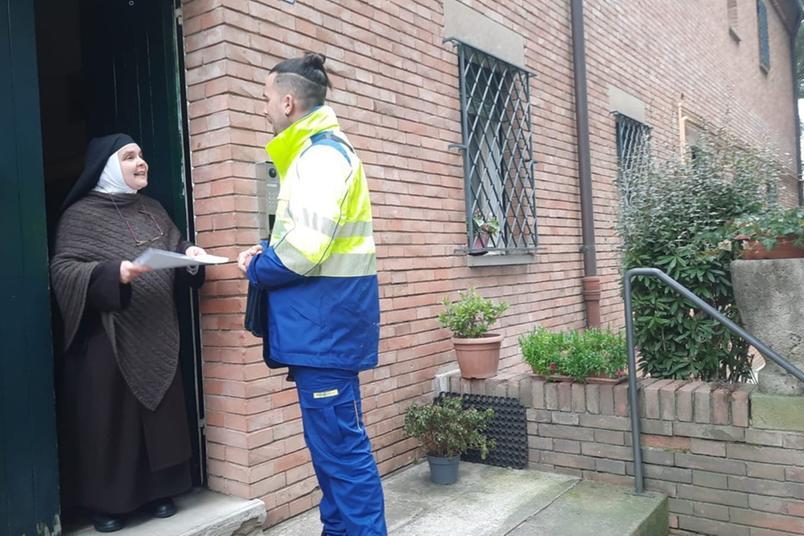

Gregory Day is the nuns’ postman. At least, that’s what they nicknamed him. Three times a week he gets on his three-wheeled scooter, the one with the yellow Poste Italiane trunk, and goes to the monastery of the Discalced Carmelites in via Siepelunga, dedicated to the Immaculate Heart of Mary, a devotion that arose after the apparition of the Madonna in Fatima, in 1917.
We are in a quiet residential area between Murri Alta and the first hills of Bologna, with buildings, villas and small condominiums surrounded by greenery, surrounded by parks and gardens that offer a magnificent panorama of the Emilian capital. Number 51 is located on the hill: «The road starts to climb and the scooter feels the slope»explains Gregory, 43 years old, Italian-English, postman in Bologna for 2 and a half years. «I climb up this street and leave behind me the “Lower Murri”, with shops, bars, services: in short, the most urban and busy area of the city».
An almost hidden building
Gregory stops in front of a brick building with a sober and intimate appearance. Here, the journalist Sergio Zavoli, at the end of the 1950s, in the most innovative period of post-war Italian radio, had created a singular radio program, entitled Clausura. With an interview with Sister Maria Teresa of the Eucharist and three of her sisters, carried out by passing a microphone through the grate of the parlor, Zavoli introduced Italians to the world of cloistered female monasteries.
«The first times I came here», Gregory confides, «I thought there was no one there. The nuns’ house does not directly overlook the sidewalk, there is a fence and an iron gate and then hedges and trees that filter the view”. If it weren’t for the cross on the roof, the monastery would seem like any other villa, nestled in the discretion and silence of holm oaks and pines, which shade the prayers of the Carmelite nuns.
«I make this trip two or three times a week», remarks the postman, «and I always stop, because the nuns receive a lot of mail. At first I was scared, I said to myself: I only ring once, then if no one answers I’ll leave the mail and go away. And instead…” Instead, the nuns came out.
The opportunity to regenerate
“They always welcome me cordially and we often exchange a few words,” adds Gregory. «Of course, I’m always in a hurry, I have to finish the tour, but the beautiful aspect of my job is the human relationship that never fails. And then, entering this monastery, among these trees… well, it gives me the opportunity to take a deep breath and slow down the pace to regenerate myself”. If the mail doesn’t require a signature upon pickup, the guy often leaves it in the wheel. “It’s still the original one,” explains Sister Teresa Benedetta, the mother prioress, a sweet and gentle voice. «Often, however, a signature is needed, now everything is digital, so it happens that the sister who is in charge of the concierge at that moment goes out and meets him in person». For them, who are cloistered, it is a small exception to the rule.
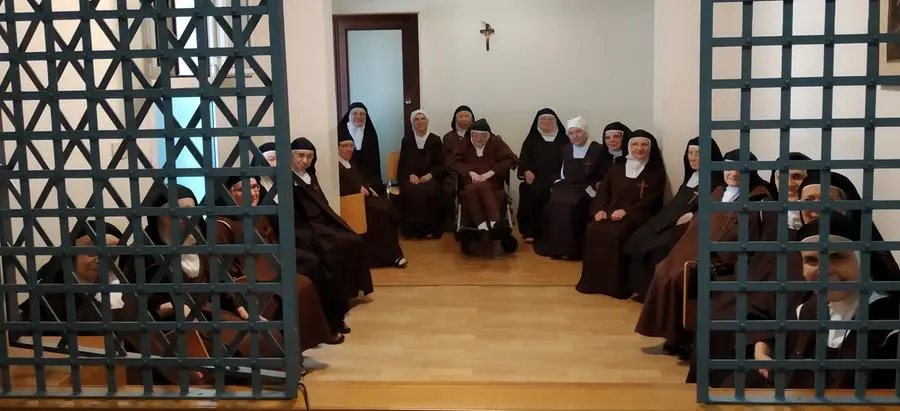
«Gregory is a discreet and friendly boy», adds the prioress. «And, for us, it is a bit of a connection with the world, because it allows us to receive letters, parcels and magazines, fundamental for our information and reflection». There are 19 Carmelite nuns in the Bolognese monastery, and their ages range from 50 to 96 years. Obviously everyone has an idea, an opinion.
«According to our rule», specifies the prioress, «every day we have two moments of “recreation”, after the main meals. On these occasions, we discuss each other freely, each one expresses her thoughts, and it often happens that articles and current affairs read in the newspapers we receive are commented on. For us, having paper magazines is very important, they offer us a glimpse of reality, they help us reflect. We can leaf through newspapers, touch them, but also keep them for our reflection. What we read then flows into our prayer and is a topic for sharing.”
The most intense periods are those of Easter and Christmas: «So, lots of letters of greetings leave and arrive from here. Every nun wants to write to friends, brothers, grandchildren, great-grandchildren… We also have an extensive correspondence with some detained people and we like to take care of the paper and envelopes of our letters». Time, then, is almost suspended, waiting for a response. And the smile lights up again when the postman knocks again.