






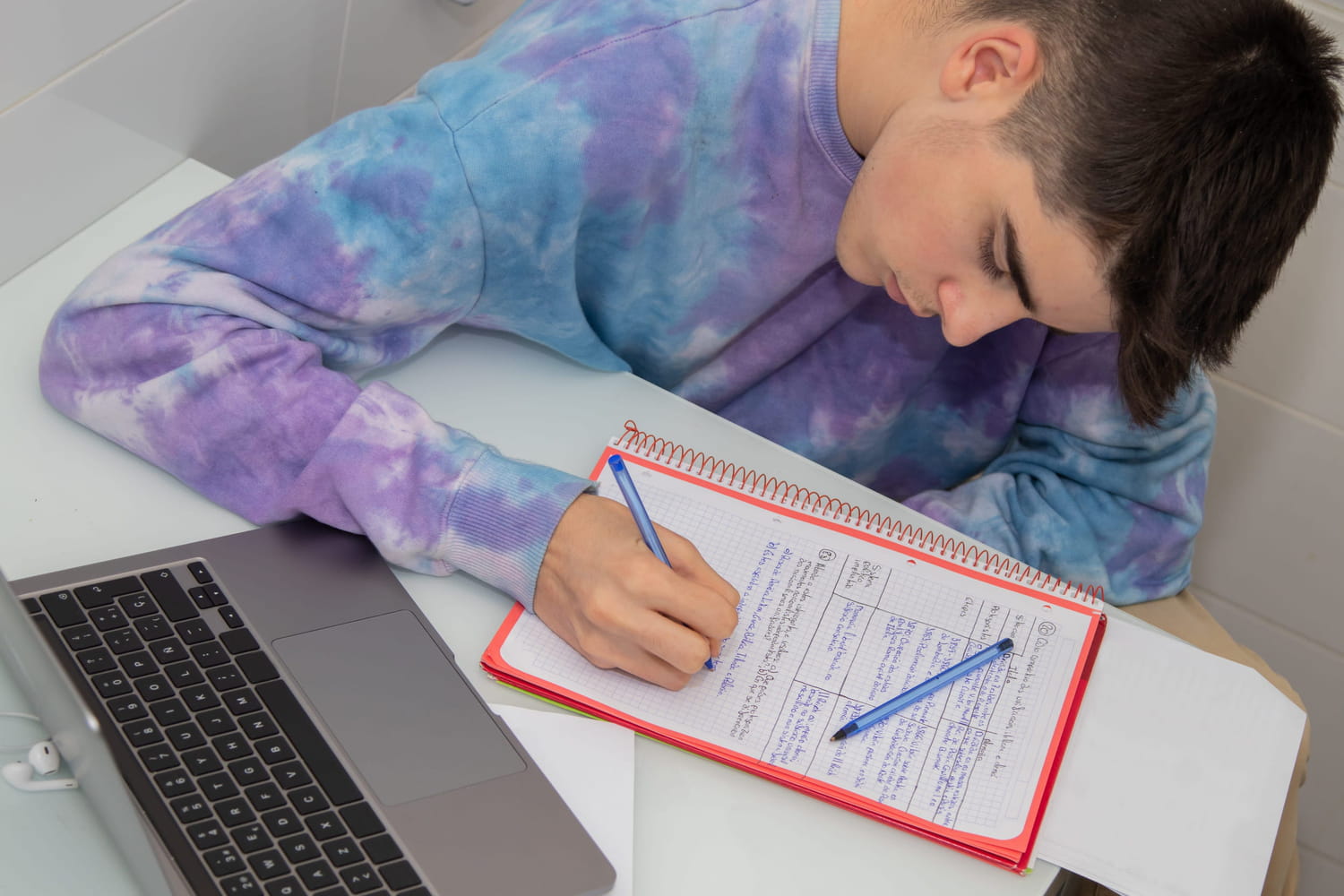
The start of the patent and baccalaureate is fast approaching. To best support your child in this final stretch, discover our simple method to structure their revisions and help them approach the big day with complete confidence.
The Brevet and Bac exams are coming very soon, and some students are still lost about the organization of their revisions. Between stress and fatigue, it’s not always easy to establish a clear program adapted to your own abilities. How to plan your revisions? How to train for an oral test? What should we do if we are already behind schedule? Here are our tips to help you see things a little more clearly.
What revision schedule should be put in place?
Here is an example of a schedule that can be revised according to your strengths and weaknesses:
- Step 1 : reread each lesson or chapter seen since the beginning of the year, then write down in a notebook everything you don’t understand so you can come back to it later.
- Step 2 : create your revision sheets. They will help you better remember the essential concepts. Don’t hesitate to use colored markers for each major concept.
- Step 3 : learn your cards out loud, especially if you memorize well by hearing.
- Step 4 : practice with exercises and exam subjects, without cheating. Work in real conditions to get your brain used to it. After a practice exam, analyze your errors using the answer key and return to the course if necessary. If some answers remain unclear, ask a teacher, classmate or parent for help.
- Step 5 : continue the exercises and reread your sheets regularly. Keep a healthy routine: get enough sleep, eat a balanced diet, move around and limit screen time. This helps you stay focused and calm.
Adapt your revisions to your natural rhythm: if you are more efficient in the afternoon, save the difficult subjects for that time. Then, day before the test, don’t revise anymore. Doing too much can create confusion. Relax, rest, do a pleasant activity to take your mind off things.
If you are already behind in your revisions, don’t panic: justadapt the program to your situation. You don’t have time to reread all your courses for the year? Skim over the major chapters and identify those on which you feel ready, and those on which you still wish to work. From now on, it is necessary to prioritize.
Apply the 80/20 ruleon the principle of Pareto’s law: concentrate as a priority on the 20% of the program which earns 80% of the points (the big coefficients or the chapters which fall almost every year). Make more concise sheets, and rely on active memory : faced with a lack of time, passive reading is an optical illusion. Prefer the “blank sheet” method: read a course summary for 5 minutes, close it, and write down from memory everything you remember. This is the quickest way to anchor information. Finally, never sacrifice your sleep to squeeze in hours of nightly revision. A tired brain stores data poorly and panics more quickly. During sprint periods, prefer short and ultra-concentrated sessions (without telephone!) followed by real recovery breaks.
Also, focus first and foremost on exercises to train in real conditions. You can resume topics from previous yearsall downloadable from the website of the Ministry of National Education, which will be perfect examples. If possible, set a timer to make sure you don’t exceed the allotted time on the day of the actual test.
At the brevet or baccalaureate, certain subjects include an oral test, such as the Grand oral or the project oral. To prepare for this, start by practicing at home with a standard subject. First alone, then in front of your family or friends to get used to speaking in public. Then ask them to ask you questions, even tricky ones, to learn how to answer correctly without panicking, to justify your choices and to argue clearly.
Also remember to record yourself to identify what can be improved: hesitations, language tics, pace that is too fast or too slow. For each test, reproduce the real conditions of the test: respect the allotted time, speak without using colloquial language, look at your audience and adopt a confident posture. Finally, on the day of the oral exam, the jury may ask you a question related to current events. To stay informed, you can read press articles, use apps or follow accounts on networks like Hugo Décrypte or Dormir Au Courant, which explain the news in simple words. And that’s not all…
Several TikTok accounts have also become references. Among them, @ines.maths and @lucasmaths4 offer clear explanations of mathematics, while @les.strateges and @carolinegiraud make philosophy more accessible thanks to educational videos on key concepts and the method. As for @yanntoutcourt, he explores several subjects to better master history-geography and improve his written responses. Useful and fun content for learning differently. The main thing is to find the method that best suits each student.