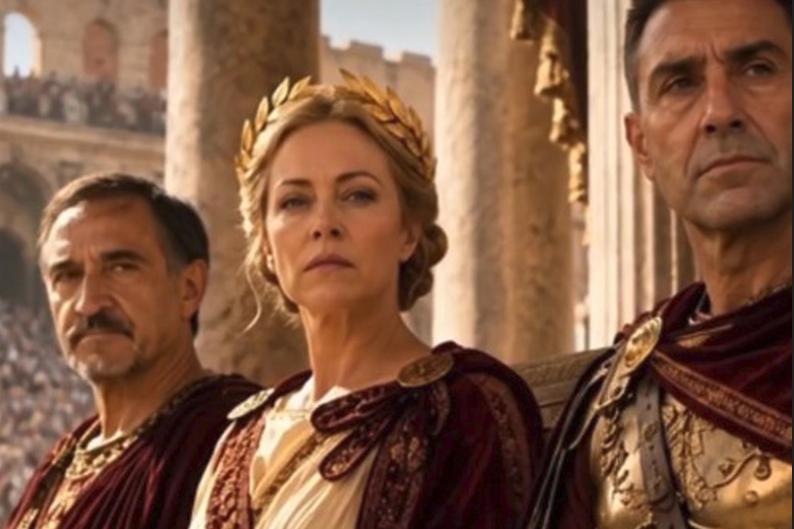
At my sign you unleash the grotesque. Roberto Vannacci publishes on his Instagram profile a vulgar video made with Artificial Intelligence in which he appears at the Colosseum two thousand years ago in the role of Ridley Scott’s gladiator, copying Donald Trump’s propaganda and self-celebratory technique (the so-called “slopaganda”, the name itself sucks). The reel, which has clear viral intentions, bears the signature of a certain “Robertus Vannaccius” and shows our hero in the role of Russel Crowe as he delivers his bitter enemies Elly Schlein, Giuseppe Conte, Laura Boldrini and Romano Prodi, dressed and linked like the Christians at the Colosseum, to a fair and to a man in the guise of Giuseppe Barboni (the vigilante manager who beat a migrant on the street). The alleged Barboni uses the hammer and sickle to kill them as punishment for retaliation (“the hammer and sickle they never used”), you will understand the laughter. There is also Vannacci’s wife who gives the middle finger to the four (by the way, Vannacci’s wife is Romanian, are we emigrating too?). Sitting in the gallery are Meloni dressed as Scribonia or Livia Drusilla (you name it, one empress is as good as another) and La Russa in the role of a consul, very complacent when Massimo Decimo Meridio Vannaccius gives the thumbs down to the unfortunates. Matteus Salvinus Padanus is missing, have you noticed? Perhaps the lion ate it just as Futuro Nazionale is stripping away the League (the polls give it 7 percent). The real Vannacci in a post absolves the video as innocent satire. Of course, very innocent. I want to see if they had portrayed him as Atilius Regulus returning from Carthage.
The technique is the one tested by Donald Trump: occupy the stage, transform politics into a personal saga, confuse consensus with cheering and history with the costume department. Once upon a time we talked in the bar and six people listened to you. Today you can speak from the virtual Colosseum and reach six million. A sophisticated mythology on a middle school play script. Moreover, in his book “The world upside down” Vannacci compared himself to Julius Caesar. But the important thing is that it works, because social media has the viral and visceral characteristic of spreading the worst nonsense with an almost hypnotic effect.
In other times we would have laughed, today we laugh a little less because behind the virtual armor emerges a less innocent symbolism and the meta-messages of Vannaccia propaganda they contain a good dose of violence and indirectly refer to fascism. As is known, all of Mussolini’s symbolism, from the fasces to the gladius, from the labarum to the Latin slogans, from the duce to the Roman salute, up to the parades, processions, triumphs and other dramas, drew from the Augustan imperial traditions (his highly cultured lover Margherita Sarfatti had made him discover them). Today they return, almost as if they were a “taste” in the figure of this retired general who took to the field, masked by that ambiguity typical of politicians who don’t know if they are there or what they do: they wink, they suggest, they exaggerate, but then maybe one day they will put it into practice, who knows.
To deflate Robertus Vannaccius, perhaps Prince De Curtis would be enough. In “Totò and Cleopatra”, faced with accusations from the capital, Mark Antony blurted out: «In Rome they slander me, damned Romanists!». And when they announced to him that the people were asking for sesterces, he replied: “No thanks, I’ll go straight.” Totò had understood that the best way to combat imperial rhetoric was to bully it. But Totò knew he was acting. Here, however, the operetta risks taking itself seriously. And when the grotesque collects enough likes, it stops being just ridiculous, as it gathers the consensus of the never-disappeared black thread present in Italy, it risks becoming serious, moving from operetta to who knows what else. And October 22nd is approaching. Who knows what Vannaccius will invent.