




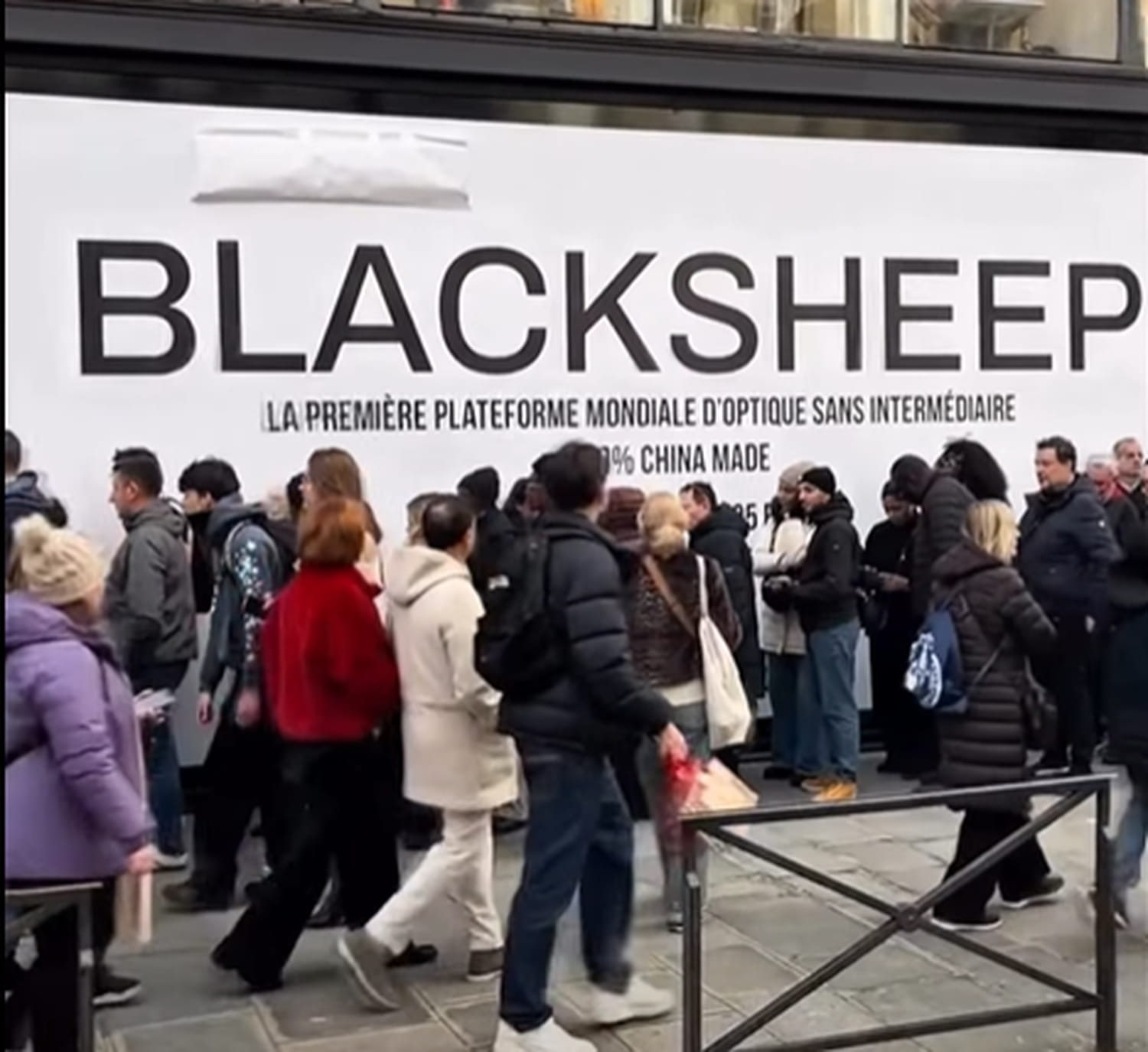
Slashed prices and minimalist concept: the Blacksheep brand has set up shop on the famous Rue de Rivoli. Where do these glasses come from? Is it quality? What you need to know.
Frames for less than 5 euros, corrective lenses at rock bottom prices and a clear promise: to sell glasses as close as possible to their manufacturing cost. Since its arrival in Paris at the beginning of December, the Blacksheep brand has aroused curiosity and questions. Behind the announcement effect, what do we really know about this new brand which is shaking up the optical market?
Contrary to the image of a start-up appearing out of nowhere, Blacksheep is led by an entrepreneur already well known in the sector. The brand was founded by Pierre Wizman, at the origin of Polette, an established player in online optics in Europe. With Blacksheep, he pushes the logic of low-cost even further, claiming a clear break with the classic optician model. This strategy took on a very visible dimension with the opening of a temporary physical space at 91 rue de Rivoli, in Paris. An emblematic address, in the heart of a shopping and tourist district, which marks the brand’s desire to speak directly to the general public.
“I’m not looking to make friends.”
If the prices displayed are striking, their explanation lies in a straightforward economic model. First, production is carried out in China, a choice fully accepted by the brand. A common manufacturing method in the global optical industry, including for products sold at a much higher price. Then, Blacksheep relies on large volumes and a deliberately restricted offer. Few models, few variations, mass production: this standardization helps reduce costs at each stage. But the main thing is happening elsewhere. Where traditional opticians include advice, in-store adjustments and monitoring over time in their prices, Blacksheep has chosen to largely do without them. The model is based on a significant reduction in services, to focus on the product itself. Clearly, the consumer pays above all for the pair of glasses, not the support. “I am not looking to make friends but I am looking to reestablish the truth in a market that lacks transparency,” declared Pierre Wizman on RTL on December 2.
This minimalist approach naturally raises the question of quality. The available feedback paints a mixed picture. For simple corrections or occasional use, some users say they are satisfied: the frames are considered visually correct and the price promise is kept. On the other hand, as soon as the correction becomes more complex, comfort may vary. Adjustment, centering and adaptation then play a determining role in everyday wear. Elements which, in such a refined model, are necessarily reduced. The more specific the needs, the more these limits can be felt.
Reading these elements, Blacksheep seems to be aimed at a clearly identified audience: those looking above all for a very low price, a quick solution or an extra pair. For these targeted uses, the offer can represent an accessible alternative.
For prolonged daily wear or specific needs, the choice of a pair of glasses is, however, based on other criteria, such as comfort and fit, which remain central for many consumers. Beyond the Blacksheep case, this arrival on the French market illustrates a broader evolution in consumption habits. As in other sectors, optics is seeing the emergence of ultra-accessible offers, which rely on cost transparency and reduction of services to lower prices.
Blacksheep does not claim to replace traditional opticians, but offers another way of purchasing glasses: more direct, more economical, and leaving the consumer with a greater share of responsibility in their choice. A model which seduces as much as it questions, and which, in any case, puts the price of glasses at the center of the debate.