



Hamlet. Or Hamnet? What’s in a name? This is what Juliet asks herself on the balcony, sighing for the boy she has just fallen madly in love with but who has the wrong name: Romeo Montague. That’s what he must have thought Will Shakespearethe moment the story of Hamlet came into his hands? The prince of Denmark had the same name (a variant of it, to be precise) as the poet’s only son, Hamnetborn in 1585 together with his twin sister Judith. A name attested in Stratford at the time, but not so common: not like John, Will’s father, or like Richard and Gilbert, the names of his brothers. It does not appear to have even been a recurring name in the family of Shakespeare’s wife, Anne Hathaway.
Hamnetthe recent and successful film directed by Chloe Zhao which on the last night of the Oscars received eight nominations, including best film, with Jessie Buckley awarded as best leading actress, brought the question of the name of Shakespeare’s son to the attention of the international public, who immediately asked themselves: but is the story of the name true? And, consequently, is what the film tells, the portrait it gives of Shakespeare’s wife and family, true?
The “bardolaters” (as GB Shaw called the worshipers of the Bard) inevitably turn up their noses: this is not Shakespeare but a fictionalized story that exploits the myth of the greatest modern writer in a contemporary and feminist key – Shakespeare’s wife is the true protagonist of the film. True, except in freely interpreting Shakespeare’s life Hamnet he’s in great company, starting with A room of one’s own by Virginia Woolf and byUlysses by Joyce, so as not to go too far.
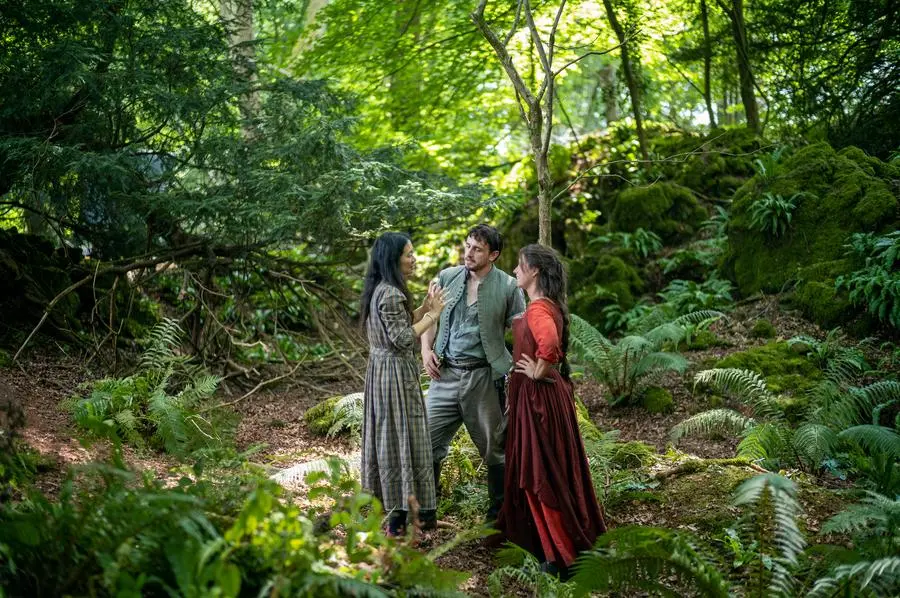
Director Chloé Zhao with Paul Mescal and Jessie Buckley (as Shakespeare’s wife) in “Hamnet”.
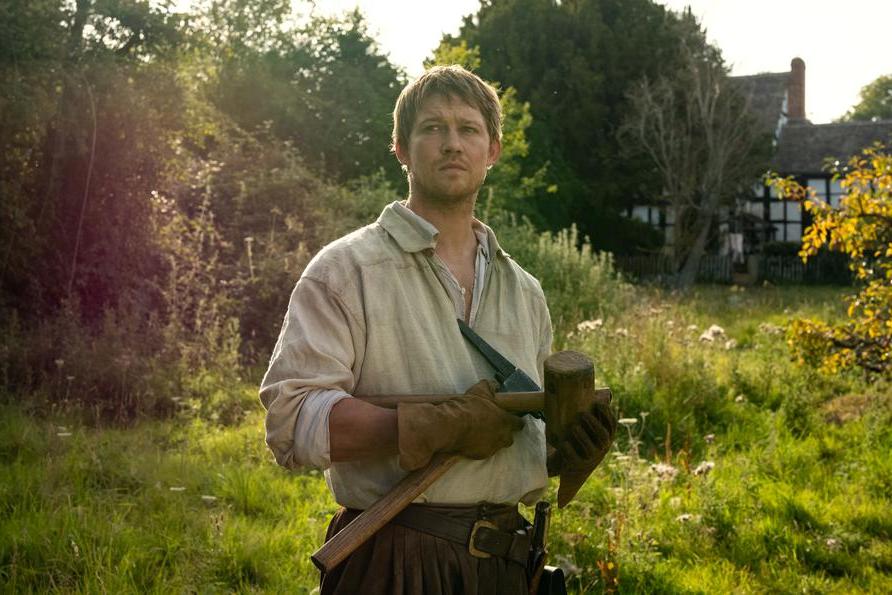
Every film about the poet’s life, from Shakespeare in Love (1998) a All Is True by Kenneth Branagh (2018), is inevitably largely the result of an imaginary reconstruction, given the little certain data we have about his life. In this tradition, Hamnet it is certainly the most original film. The first who doesn’t present it as a myth, with all the reverence that follows (also Shakespeare in Lovein his own way, he did it), but like an ordinary man. A poor man almost, at times, full of doubts and personal nightmares that Anne Hathaway partly understands and partly endures and suffers. Shakespeare’s genius is in the background, implied, rumors and concrete signs arrive (the wealth earned at the theatre) from distant London, only to then emerge with a moving and enthralling power in the performance
Of Hamlet at the theater which closes the film. But there is no doubt that she is the protagonist of the story, if not exactly the heroine Anne Hathaway (Will’s wife, not the actress of the same name: is to avoid any
overlap that the producers of the film wanted to change the name to “Agnes”). Shakespeare is the co-protagonist, if not exactly
a luxury supporting character.
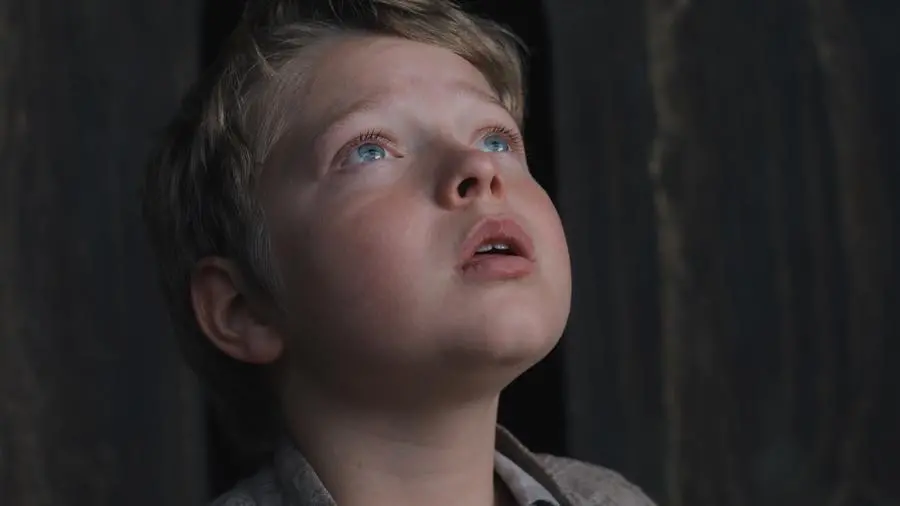
In HamnetAgnes Hathaway is a dissatisfied wife, left alone in Stratford with three children and many problems. Alone, above all, at the time of Hamnet’s death. A mother’s heartbreak is the culmination
tragedy of the first part of the story, rendered with touching realism. We hear that the film is directed by a woman and written by the director together with another woman, Maggie O’Farrell, author of the novel Hamnet (2020) from which the film derives. Fictional biographies of Shakespeare from a female perspective are, moreover, part of a well-established trend. Traditionally, the origins of the poet’s inspiration lay in his childhood in bucolic Stratford (which became a symbol of Merry Old England), and many novels have filled with fantasy the numerous gaps in Shakespeare’s real biography. These are works that move mainly in two directions.
The first depicts an idyllic life in Stratford, with at the center a great love story with Anne Hathaway, starting from Anne Hathaway (1845) by Emma Severn, passing through Shakespeare’s Sweetheart (1905) by Sarah Sterling, up to Her Infinite Variety (2005) by Pamela Berkman – all women. The second trend, more numerous as the twentieth century advanced, is exemplified from Nothing Like the Sun (1964) by Anthony Burgess, A Cry of Players (1968) by William Gibson and, more recently, by Will (2004) by Grace Tiffany, works that evoke a Shakespeare who cannot bear the limits of a provincial life and dreams of poetic fame and adventures elsewhere.
In these works, Anne is often a shrew and Will’s relatives are rude and annoying provincials. Here, as in part also in the very famous one Shakespeare in Lovewhere his wife and native Stratford are distant and embarrassing echoes for the great clandestine love affair that the poet has with Viola de Lesseps in London, Shakespeare is a typical figure of modernity: torn from the traditions and constraints of the past and projected into a tumultuous existence in the theaters of London.
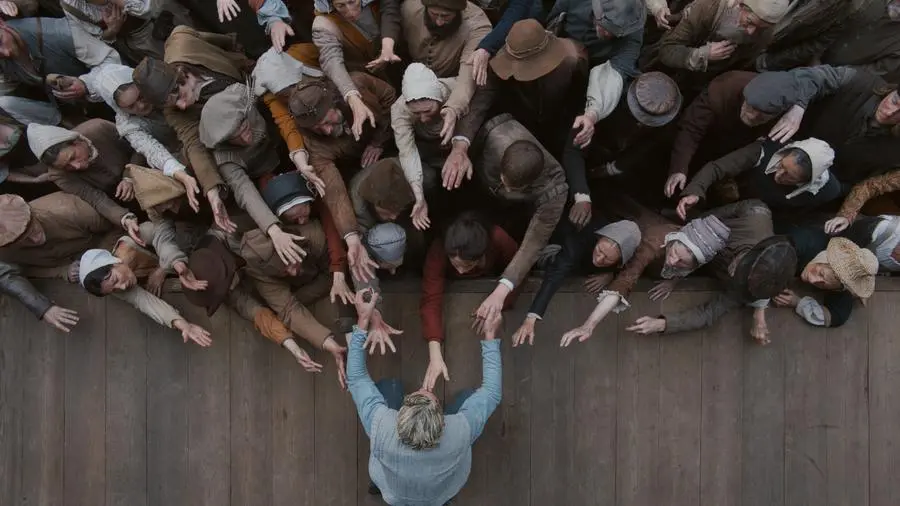
The moving final scene of “Hamnet”.
The novel and the film Hamnet clearly fit into this second tradition, with an all-female and family story that
revolves around the death of his son. Anne Hathaway’s torment has been said (but those of Shakespeare’s mother and Hamnet’s twin sister, Judith, the other prominent female figures in the film, are also vivid and touching). How is Shakespeare’s father’s torment represented? Partly directly, upon his arrival at Stratford, but above all in the writing of Hamlet, in the film masterfully summed up by the scene of To be, or not to bein a packed theater where Agnes Hathaway’s hand reaches out to touch that of the actor, with the audience imitating her, to connect the living and the dead in the silence of emotion.
Historically, there is a lack of direct or indirect evidence of how he suffered the loss of his only son. Joyce, in Ulysseshe claims
that, immediately after Hamnet’s death, the poet revisited an old drama of his, King Johninserting a new passage, Lady Constance’s lament for the premature death of her son, Prince Arthur:
The pain of my son’s absence fills the room,
he lies down in his bed, walks up and down with me,
assumes his beautiful features, repeats his words,
it reminds me of all its sweet qualities, fills abandoned clothes with its shapes. So, have I no reason to love my pain?
It’s difficult not to read verses that are so touching and inspired by the pain of losing a child. Just as in the second part of theHenry IValso written by Shakespeare shortly after the disappearance of Hamnet, the wife of the Earl of Northumberland blames the death of their little son on her husband’s absence: «He cast many glances
towards the north, to see if his father would come to restore his strength, but in vain.” And it is certainly curious that, a unique case among the playwrights of the time, and rather rare in general, Shakespeare focuses two works on the figures of two twins: The comedy of errors And The twelfth
Night. In the latter, the intrigue caused by the identical appearance of the twins, male and female, is resolved by the miraculous reappearance of the male, believed to have died in a shipwreck.
What kind of father was Shakespeare? Hamnet puts us face to face with this question. Let’s try to answer, as far as we can imagine. Proliferous in the first part of his married life: he gave birth to three children before reaching adulthood. Susanna, the eldest child, was baptized on May 26, 1583, six months after the marriage of Will and Anne Hathaway. Less than two years later, on February 2, 1585, the twins Hamnet and Judith were baptized. From then on, Shakespeare was mostly an absent father. That he moved away, as Anthony Burgess suggests, to avoid the risk of his wife becoming pregnant again, in the face of a precarious economic situation and a mutual inability to keep the relationship on the track of at least partial chastity, is an interesting conjecture. Certainly Will is in London around 1588, if not earlier. While there is a whole literature on the difficult, for some even ambiguous, relationship between Shakespeare and his wife, there has been less imaginative conjecture on the relationship between Shakespeare and his children. And they mostly concern his daughters.
Returning to the initial question, do certain names really contain the destiny of those who bear them? Certainly Hamnet/Hamlet is associated with tragic deaths in Shakespeare’s destiny. There is a sad, little-known story that Will has carried with him since he was a boy: the death of a young fellow citizen called Katherine Hamlet. I quote from Shakespeare
and love (Einaudi, 2019): «Will is fifteen years old when, with his companions, he runs to the river, towards Tiddington, to see the point where Katherine Hamlet drowned in the Avon. Did he know her? He had seen her
pass, maybe she had a pretty face and Will had turned to look at her? Certainly the impression left was great and indelible: the dead girl has the same name as Shakespeare’s most famous character, and her only son will bear his name, or a variant of the same, Hamnet. In HamletOphelia, mad, or in love, or mad for love (is there a difference? Will soon begins to wonder), drowns to death, slipping into the river while picking daisies and “long purples”, small purple orchids, beautiful flowers that crowd the
banks of the Avon, towards Stratford Lock.”
All conjectures, the bardolators will reply with conviction and indignation. For whom the Bard is not touched. The Bard is divine! This is how it has been for centuries,
at least since the first Shakespearean Jubilee held in Stratford in 1769, when the prince actor and playwright of the time, David Garrick, unveiling a statue of Shakespeare in the eyes of an enraptured crowd, proclaimed: «’tis he, ’tis he, / The God of our idolatry!». It is easier to deny the existence of a secular deity, rather than attenuate its myth. This is what anti-Stratfordians have been doing for two centuries now, denying that Shakespeare could have written the works he wrote, or that he ever existed. And it’s a curious coincidence (thinking about Hamnet and to the long and glorious female tradition of biographers and/or fictitious stories about the Bard) which significantly puts into
doubt the authorship of the plays that go by the name of Shakespeare was first a woman, the American Delia Bacon, in 1856, maintaining that the Shakespearean canon should be attributed to different
authors, including Sir Walter Raleigh, under the supervision of Francis Bacon.
It’s not true, but I like to think that, when asked the question, Shakespeare would have responded with a smilequoting one of his works: As You Like It. As you like.