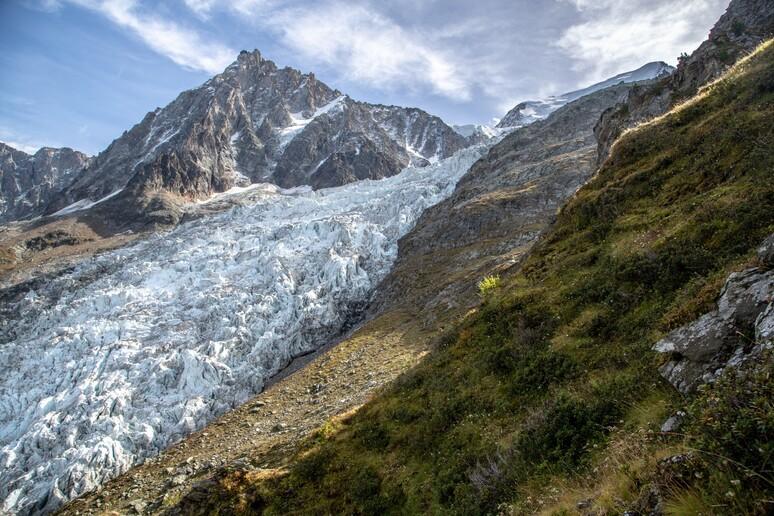



There is an exact moment in which the mountain stops defending itself and begins to consume itself. This year, in the Swiss Alps, that invisible border was crossed on June 29th. Scientists call it “Glacier Loss Day”, the day of irreparable loss: it is the date on which the reserves of fresh snow accumulated in winter run out, leaving the fossil ice, stratified over the centuries, naked under the sun. Since that day, every liter of water that flows downstream is not the natural cycle that renews itself, but the hemorrhage of a thousand-year-old body. An open wound in the heart of Europe.
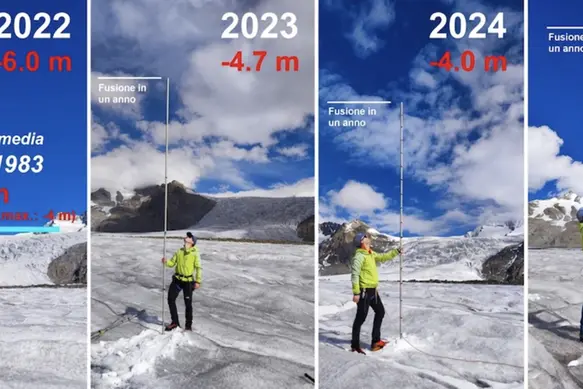
Looking at the Alpine glaciers today evokes the solemnity of a surrender that questions our civilization. There is a surgical and tragic precision in the data published by the Federal Research Institute WSL and the GLAMOS monitoring network.
What we are witnessing is not a slow geological change, but a vertical collapse that distorts the perception of time. From 2000 to 2025, the volume of Swiss glaciers decreased by 40 percent, from 74.9 to 45.1 cubic kilometers. Almost half of the ice heritage has liquefied in the space of a single generation, under the eyes of fathers who today do not know what they will tell their children.
The glaciologist Matthias Huss has translated this crisis into a breathtaking image: in these weeks of early heat, the Swiss glaciers they are losing melt water at a rate equivalent to an Olympic-sized swimming pool being emptied every six seconds.
A continuous dissipation, the accelerated and crazy heartbeat of an organism in profound suffering. Currently, the white giants are melting at a rate double the average of the decade 2010-2020, touching the records of the catastrophic 2022when the Alps lost 6 percent of their mass in just twelve months.
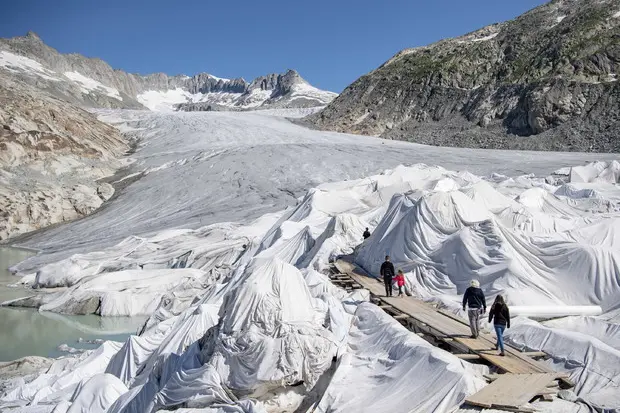
But meteorology only explains the latest push towards the abyss; it is our development model that determines the trend. The winter betrayed expectations, with snow cover in April at historic lows.
In March, the Sahara dust has set the perfect trap: the wind has transported the sand of the desert to the peaks, dirtiing the whiteness of the snow. That dark veil reduced the albedo effect, the natural ability of ice to reflect solar rays. Instead of rejecting the heat, the Alps began to absorb it. The June heat wave did the rest, turning the peaks into a furnace.
Here scientific journalism is combined with ethical urgency. Early melting is not an aesthetic phenomenon for faded postcards, but a threat to the continent’s water security. And it contains a dramatic paradox identified by the WSL: between June and August 2022, although the melting was more intense than in the hot summer of 2003, the volume of water flowing downstream was lower. How is this possible? The surface of the glaciers has shrunk to such an extent that there is no longer enough material to melt. Between 2003 and 2022, 200 square kilometers of ice disappeared, an area as large as the Canton of Zug. The fountain of Europe is running out because the raw material is running out.
This reality requires us to look beyond the numbers. There is a profoundly human and social dimension to this decline, which recalls the responsibility towards the “common home” of which Pope Francis speaks. Glaciers are the regulators of our plains, the silent guardians who quench the thirst of agriculture in the months of drought and the engines of clean energy. Seeing them vanish means witnessing the breaking of the pact of solidarity between the earth and man, between the generations who have safeguarded this balance and future ones who will inherit an impoverished landscape.
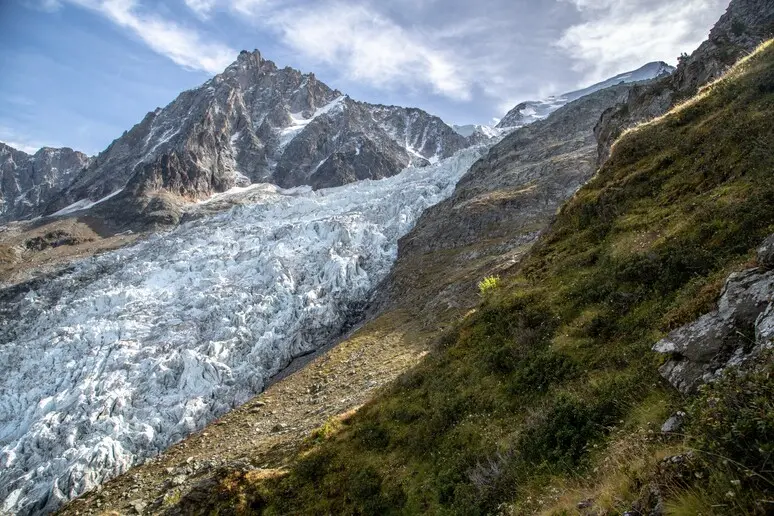
The “swan song” of the glaciers is a stern warning. The blue caves that collapse, the glacial lakes that form like artificial tears and the rock walls that crumble due to the collapse of the permafrost are the mirror of our ecological debt.
If global warming continues with the current inertia, by 2100 only small shreds of sterile ice will remain in the Alps, relics of a bygone world. There is no more time for distraction. That strip of ancient ice that dissolves under the June sun is not just water that disappears: it is a piece of our memory, our security and our future that liquefies in indifference.