





He is the patron saint of fathers but also of carpenters, cabinetmakers, carpenters, homeless people and even of Monti di Pietà and related pawn loans. On December 8, 1870, Pope Pius IX proclaimed him Patron of the universal Church. The liturgical feast of Saint Joseph is the March 19 but it is also much celebrated in the liturgical and social fields May 1stLabor Day, as the patron saint of artisans and workers, as proclaimed by Pope Pius XII. John XXIII he entrusted the Second Vatican Council to him while he was one of the favorite Saints of Pope Francis who wanted to include his name in the Canon of the Mass.
His cult has achieved great popularity as demonstrated by the declarations of many churches relating to the presence of his relics. In the church of Notre-Dame of Paris there would be engagement rings, his and Maria’s; Perugia would own his wedding ring; fragments of one of his belts would be found in the Parisian church of the Foglianti. Again: ad Aachen the bands or shoes that would have wrapped his legs are exposed and the Camaldolese of the church of S. Maria degli Angeli in Florence declare that they are in possession of his staff.
The meaning of the name
The name Giuseppe is of Jewish origin and means “God add”broadly speaking we can say “added to the family”. It may be that the beginning occurred with the name of the son of Jacob and Rachel, sold out of jealousy as a slave by his brothers. his popularity is due to the fact that he was the putative father of Jesus. Venerated in the East from the 4th century and in the West shortly before the 11th century, i.e. from when his cult began to spread among Christians. There is no doubt, however, that the fame of that name strengthened in Europe in the nineteenth and twentieth centuries.


An exemplary model of fatherhood
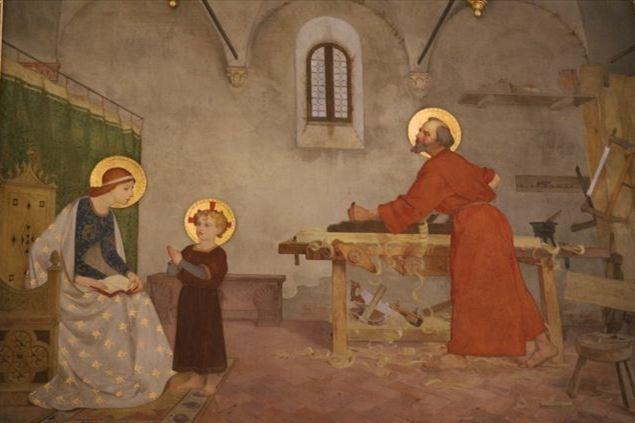
Saint Joseph was the husband of Mary, the head of the “Holy family” in which he was born through the work of the Holy Spirit, Jesus. And by orienting his life on the trail of some dreams, in which angels brought him messages from the Lord, he embodied a model of exemplary fatherhood. He certainly wasn’t absent. It is true, he was very silent, but up until the thirty years of the Messiah’s life, he was always close to his son with faith, obedience and willingness to accept God’s plans. He began to warm him in the poor cradle of the stable, he took him to safety in Egypt when necessary, he was concerned in looking for him when he was twelve years old and he had “disappeared” in the temple, he had him with him in his work as a carpenter, he helped him with Mary to grow “in wisdom, age and grace”. Joseph he was, like Mary, descendant of the house of David and of royal lineage, a nominal nobilitybecause life forced him to become the village craftsman, to get involved in careful woodworking. Work tools for farmers and shepherds as well as humble furniture and household objects for the poor homes of Galilee came out of his workshop.
Figure of generous humility
In the document of the Congregation for Divine Worship, which inserted its mention in the canon of the Mass, we read: «Through the paternal care of Jesus, Saint Joseph of Nazareth, placed at the head of the Family of the Lord, copiously fulfilled the mission received from grace in the economy of salvation». His acceptance of the pregnant Mary as his bride; even though he was well aware of not having had relations with her, and his acceptance of the “beginnings of the mysteries of human salvation” by adhering to the news of conception by the Holy Spirit makes him a leading figure in Christian life. Furthermore, the document notes, Saint Joseph has “become an exemplary model of that generous humility that Christianity raises to great destinies and a witness of those common, human and simple virtues, necessary for men to be honest and authentic followers of Christ”.
The sources of his life are the gospels of Matthew and Luke Not many certain things are known about him, no more than what the evangelists canonically reported Matthew And Luca. The so-called apocryphal gospels instead indulged around his figure. However, authoritative personalities such as Saint Jerome (c. 347-420), Saint Augustine (354-430) e Saint Thomas Aquinas (1225-1274).
It is worth reporting only one legend that circulated around his marriage to Maria. On that occasion there would have been a competition between the candidates for the young woman’s hand. That race would have been won by Giuseppe, as the dry stick that represented him, as per the rules, would have suddenly and prodigiously flourished. This obviously meant how the grace of Redemption had flourished again from the withered stump of the Old Testament.