






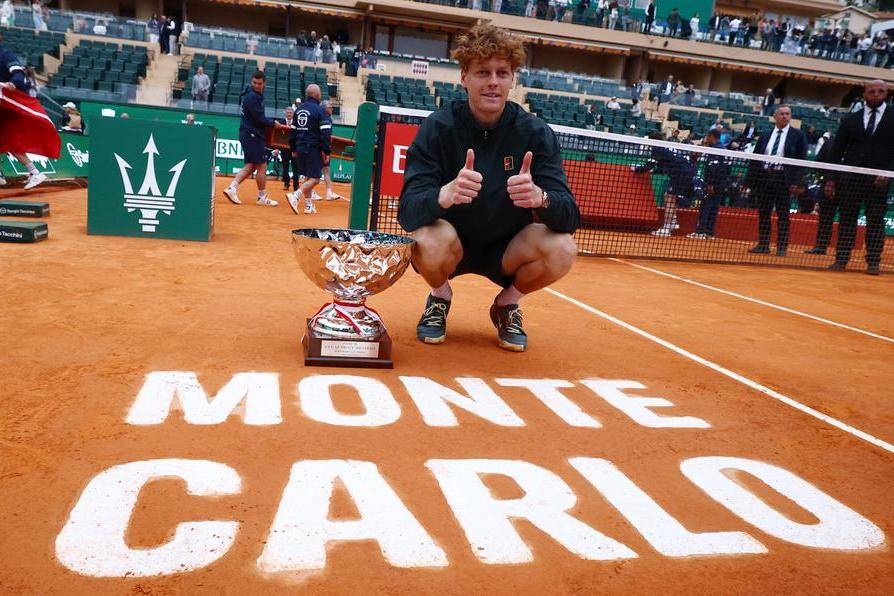
After the monstrous series of Indian Wells, Miami and Monte-Carlo, three consecutive tournaments won by 1000 points each, won in the same year, in three different time zones, and on two different surfaces, previously managed only by Novak Djokovic, on 12 April 2026 Jannik Sinner returned to the number 1 position in world tennis, displacing Carlos Alcaraz, who was defeated in the final. It is no mystery that the two are the only rivals capable of sharing contemporary tennis, leaving behind the third, the unfortunate Alexander Zverev, who in the three tournaments mentioned above took them from Sinner three times in a row in less than a month, by over seven thousand points each: a sidereal abyss.
Since the ranking has existed
If before 23 August 1973 the award for best tennis player in the world was the realm of the questionable, with the advent at that time of the first computerized world ranking the ranking became objective, even if the criteria for assigning the score have changed over time, several times in search of a mediation between rewarding quantity and quality. The first computerized number one in history was the eccentric Romanian Ilie Nastase.
Who sets the rules
The world ranking system, regulated by the ATP (Association of professional tennis) for men and by the WTA (Women tennis association) has been reformed several times over the years, the two most radical changes in 1990 with the advent of the ATP Tour (which is a partnership between the players’ association and the tournament directors) when steps were taken to discourage players from excessive programming to force them to compete more often and accumulate points on the different surfaces, and in 2000 when corrective measures were introduced to prevent quantity from rewarding more than quality and to give more weight to those who won important titles. Currently the ranking is a very stressful trap that requires players to have continuity and number of tournaments to maintain their position.
What is the ranking for?
If on the one hand it is of enormous prestige and brings a trophy apart from finishing the year as number 1, the ranking serves above all to give an objective criterion to the qualifications for tournaments, that is to establish without it being too questionable who has the right to enter by right in the main draws of the big tournaments and who to participate in their qualifiers. I am currently mandatoryi.e. mandatory, for the top 30 best players ranked in the world in the previous year: the four grand slam tournaments (Australia, Paris, Wimbledon and US open), the ATP finals for those who qualify (the first eight of each year); 8 masters 1000 out of nine (all except Monte-Carlo), 4 ATP 500, one of which to be played in the last part of the season, i.e. after the US Open. These tournaments cannot be skipped except with the valid justification of an injury or failure to qualify, under penalty of being assigned a “zero” in the calculation of the results valid for the ranking and the loss of the financial bonus at the end of the year.
How points are calculated and when they expire
The ranking points are obtained by adding the points acquired by the player in the best 19 results of the last 52 weeks (16 in the WTA): each tournament assigns a maximum of points to the winner (2 thousand for a slam, 1000 for a Master 1000, 500 for an ATP, 250 for an ATP 250) and a lower and pre-established number of points to the finalist, semi-finalist and so on. Every Monday the computer adds up the points from each player’s best 19 results over the last 52 weeks and updates the rankings, with the exception of the few Mondays that fall in the middle of a tournament longer than a week. The number 52 is explained by the weeks of the calendar year: this means that each player sees the points won in the same tournament the previous year put back into play: for example, the 1000 points won in Monte-Carlo by Sinner will expire in a year and will be deducted, only by winning it again will it be zero-sum, those who do worse than the year before lose points, those who do better gain points. This is why we conventionally speak of the points acquired in the previous year’s tournament as “points to defend”.
At the time of reconquest of the first place in Monte-Carlo a few hundred points were dancing between Sinner and Alcaraz, which is why in Barcelona and Madrid 2026 the place comes into play again and as Sinner said the calculations are made after Wimbledon when within a month the 4000 points up for grabs are distributed between the clay of Paris and the grass of London.
A chopper circuit
The mechanism is designed in such a way as to induce the best players to be versatile when it comes to the surface and to play many tournaments spread throughout the year and on all continents.
This determines the fact that the tennis circuit is among the most intense in high-level sports, because it has no downtime: it is in operation from January to mid-November with the addition of the variable Davis Cup (men’s) and Billie Jane Cup (its counterpart for women), and it squeezes both the strongest, who often reach the finals and often pass without interruption from the final of one tournament to the second round of the next, as well as those of lower rankings who are obliged to qualify for the most important tournaments on the field, and are forced to play a lot also to earn money and be able to afford the travel expenses that the circuit requires, all paid for by the tennis players. Jannik Sinner was talking about this when he said that he had agreed with his family that he would leave tennis if he had not entered the top 200 in the world by the age of 23-24, because he would not have been able to afford to continue for economic reasons.
The difficulty is not just climbing the rankings, at least within certain limits the real challenge is maintaining it. Also because when you go down, going back up is very hard. Ask to believe Matteo Berrettini. In fact, if it is true that the system helps by temporarily freezing the points in the event of serious injuries, once the freezing expires the grinder starts again, even for those who have encountered physical problems. If it’s a crisis that doesn’t have to do with injuries, the descent becomes precipitous, as Stephanos Tsitispas well knows, having fallen from number 8 to 49 in one year.