





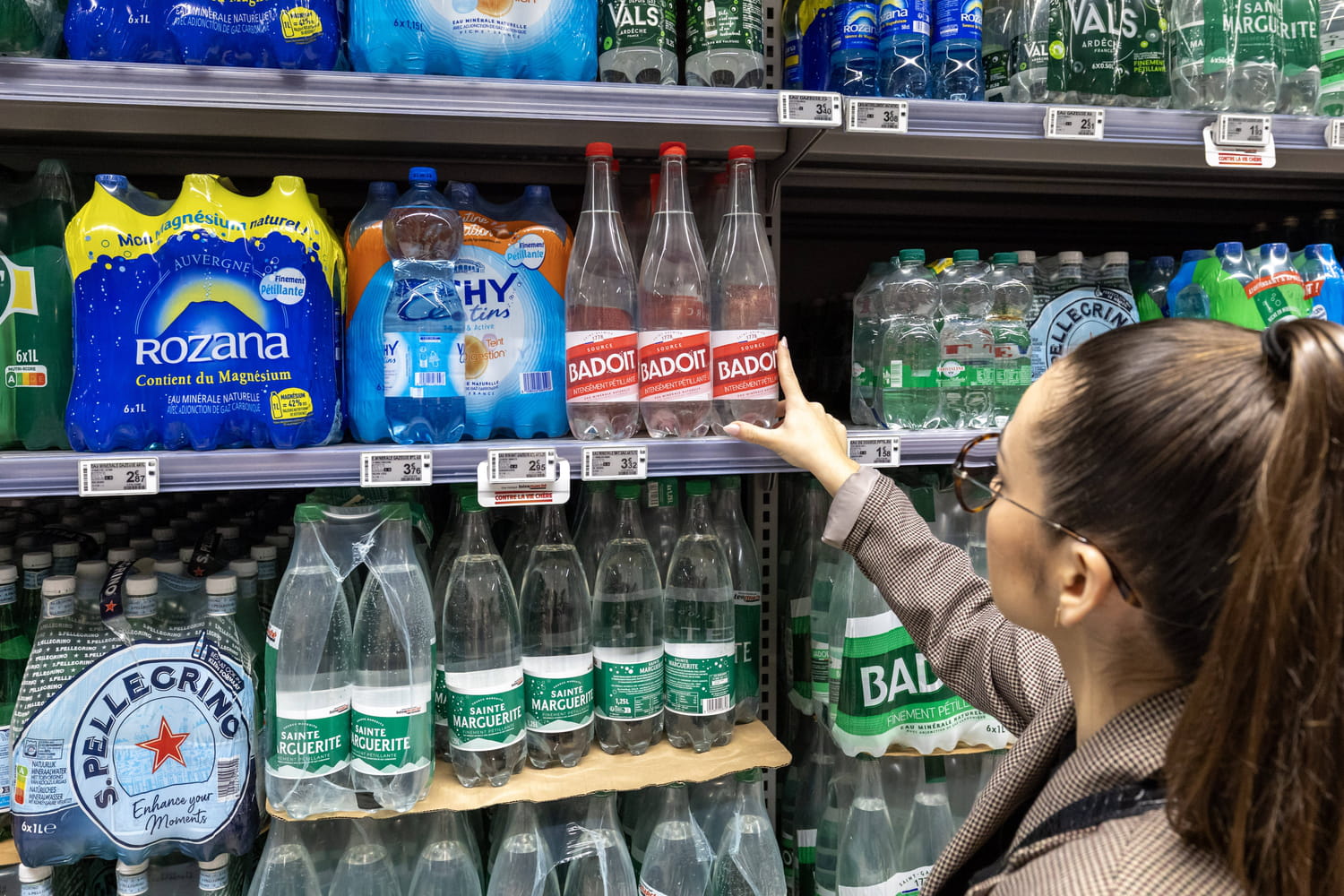
Anti-fatigue, strong bones or digestion: not all mineral waters are equal. Find out how to decipher the labels to find the one that will boost your health.
Even though tap water is increasingly popular, 45% of French people remain loyal to bottled water. And among the many brands offered in supermarkets, mineral waters stand out. Rich in calcium, magnesium, zinc… They may be preferred to fill specific deficiencies, facilitate digestion or support sports recovery. But how to navigate among all the compositions? From the sodium content to the benefits of bicarbonates, we help you choose the health ally best suited to your needs.
What is mineral water?
Mineral water is drinking water that meets very strict European regulations. According to the definition recalled by the Légifrance website “natural mineral water is microbiologically healthy water, meeting the conditions set by article R. 1322-3 of the Public Health Code, coming from an aquifer or an underground deposit exploited from one or more natural or drilled emergences constituting the source”. Natural mineral water is distinguished by its exemplary stability: its magnesium, calcium or potassium content must remain strictly identical with each sample. It is this consistency that allows it to be recognized by the Academy of Medicine for its health benefits. It is different from spring water, also sold in the supermarket.
What is the difference with spring water?
Spring water is raw water, naturally suitable for consumption and without chemical treatment, whose mineral composition can vary from one season to the next. It is the ally of pure hydration, without therapeutic aim.
What is the composition of mineral water?
Natural mineral waters are composed of minerals – elements necessary for the proper functioning of the body – such as calcium, magnesium, bicarbonates, sodium, sulfate, potassium, nitrate, silicon or fluorine in greater or lesser quantities depending on the source. You must read the labels carefully in order to know the mineral contents of different mineral waters. And in any case, if you follow a particular diet, do not hesitate to ask your doctor for advice. In other cases, it is rather recommended to vary the mineral waters in order to benefit from the different minerals because some are more mineralized than others.
Mineral waters rich in calcium (Ca)
Calcium is a constituent of bone and plays a role in muscle contraction. Calcium needs are therefore particularly important during growth, in children and adolescents, in pregnant and breastfeeding women, as well as in elderly people whose bones are weakened. Moreover, water enriched with calcium helps prevent osteoporosis. If the main food sources of calcium are dairy products, pulses or certain green vegetables and fruits, certain waters are excellent sources of calcium. Which waters are richest in calcium? Water is said to be “rich in calcium” when it contains more than 150 mg of calcium per liter.
| Water | Amount of calcium per liter |
|---|---|
| Hepar | 555 mg |
| Courmayeur | 517 mg |
| Contrex | 468 mg |
| Rozana | 301mg |
| Salvetat | 253 mg |
| Taillefine | 250 mg |
| Wattwiller | 222 mg |
| Vittel | 202 mg |
Mineral waters rich in magnesium (Mg)
Magnesium is involved in the transmission of nerve impulses and in muscle relaxation in particular. In addition to compensating for deficiencies, a magnesium intake can be proposed in particular to combat fatigue, to reduce anxiety and to treat constipation. The recommended daily dose of magnesium is 420 mg for men, 320 mg for women, 400 mg for adolescents, pregnant or breastfeeding women. Water rich in magnesium is said to contain more 50 mg/L of magnesium. Good to know: Rich in calcium or magnesium, mineral waters should however be consumed in moderation, alternating with weakly mineralized water. So, which waters are richest in magnesium?
| Water | Amount of magnesium per liter |
|---|---|
| Rozana | 160 mg |
| Hepar | 119 mg |
| Quezac | 69 mg |
| Badoit | 85 mg |
| Contrex | 75 mg |
| Courmayeur | 52 mg |
Waters rich in iron (Fe)
Almost all mineral waters contain iron, but in such tiny quantities that they cannot build up iron reserves. Only food can meet the need for iron, a mineral particularly present in offal, blood sausage, red and white meats, fish and seafood, eggs, legumes and spinach and peas. However, drinking water a little richer in iron than others (we call them ferruginous waters) is recommended for people who are anemic or iron deficient. Furthermore, pregnant women are advised to drink water rich in iron and magnesium (such as Hepar) during the first part of their pregnancy.
| Water | Amount of iron per liter |
|---|---|
| Hépar, Evian, Quézac, Volvic | 0.001 mg |
| Orezza | 0.035 mg |
| For comparison: tap water | 0.003 mg |
| Salvetat, Saint-Yorre, Rozana, Vichy | Iron free (without iron) |
Waters low in sodium (Na)
However, some may suit you better depending on your state of health. So, if your sodium (salt) intake must be limited due to a cardiovascular problem for example, you must be careful not to consume water that is too rich in sodium. Water containing more than 200 mg/L of sodium is not recommended on a daily basis (Vichy, Saint-Yorre (1744 mg/l), Badoit (171 mg/l) which are extremely rich in sodium). Prefer waters with a sodium content lower than 20 mg/L which are called “low sodium”. Moreover, they generally contain the words “suitable for a low sodium diet”. Good to know: the recommended intakes are 5 to 8 g per day and up to 10 g for serious athletes. The minimum vital threshold is 2 g.
| Water | Amount of sodium per liter |
|---|---|
| Volvic | 11.6mg |
| Salvetat | 7mg |
| Evian | 6.5 mg |
| Vittel | 5 mg |
| Courmayeur | 1 mg |
| Thonon | 3 mg |
Bicarbonate water (HCO3+)
Are you prone to heartburn and digestive problems? So-called “bicarbonate” waters can help you. Indeed, many foods that we consume every day release acids (animal proteins, cereals, salty foods, etc.). And unless you eat tons of fruits and vegetables to compensate, the body can quickly find itself in a state of chronic acidosis. The bicarbonates in mineral water are then useful for neutralizing these acids. To combat acidosis, water must provide at least 1000 mg/L of bicarbonates, more than 1500 mg/L ideally.
| Water | Quantity of bicarbonates per liter |
|---|---|
| Saint-Yorre | 4,368 mg |
| Vichy | 2,989 mg |
| Arvie | 2,195 mg |
| Rozana | 1,837 mg |
| Badoit | 1,300 mg |
| Quezac | 1,100 mg |
If minerals are our allies, certain components must be monitored to avoid any adverse effects on health. This is the case for fluoride: if it prevents cavities at low doses, an excess can weaken tooth enamel (fluorosis). The regulations are formal: any water exceeding 1.5 mg/L must be marked “not suitable for infants and children under 7 years of age”. For adults, regular consumption of highly fluoridated water is not recommended. Vigilance is also required regarding nitrates. If the legal limit for drinking water is set at 50 mg/L, experts recommend favoring water displaying less than 10 mg/L (or even less than 5 mg/L for optimal purity) for preparing baby bottles. Finally, keep your eyes peeled for chlorides, which are often very present in sparkling mineral waters. Combined with sodium, they can quickly increase your salt intake. For a balanced daily consumption, particularly in cases of hypertension, prefer water whose content remains moderate, ideally below 200 mg/L.
Diuretic mineral waters
Diuretic water increases the flow and volume of urine, therefore the elimination of urea and uric acid. In other words, it promotes the drainage of the body, the elimination of metabolic waste and helps fight against water retention. Waters rich in minerals (sulphates, magnesium, bicarbonates) have the most diuretic properties. You should not only consume diuretic waters: alternate with weakly mineralized waters, which have less than 500 mg of minerals/L such as Mont-Roucous, Volvic or Evian. Which waters are richest in sulfates and therefore most diuretic?
| Water | Quantity of sulfates per liter |
|---|---|
| Hepar | 1,530 mg |
| Courmayeur | 1,420 mg |
| Contrex | 1,187 mg |
| San Pellegrino | 476 mg |
| Vittel | 336 mg |
Sparkling mineral waters: what are the benefits?
Carbonated or sparkling waters contain, as their name suggests, carbon dioxide or carbon dioxide (CO2). We distinguish between natural gaseous waters such as Saint-Yorre, Vichy, Perrier or Quézac, (their gas comes naturally from the water source: this is thanks to terrestrial volcanic action) from carbonated or sparkling waters such as Badoit or Salvetat (their gas is added in the factory at the time of bottling). In this second case, manufacturers are required to inform the consumer via the words “with added gas” and cannot call their water “naturally carbonated”. The carbonated water passes through the rock and is loaded with minerals such as calcium, magnesium, sodium, potassium, fluorine, etc. Their mineral content depends on the brand, be sure to read the labels carefully. Sparkling waters are often rich in bicarbonates: their antacid action facilitates digestion. However, consuming too much sparkling water can have the opposite effect and cause bloating. In addition, as they contain more salt than still water, it is not recommended to consume sparkling water exclusively: it is better to alternate with still mineral water.