





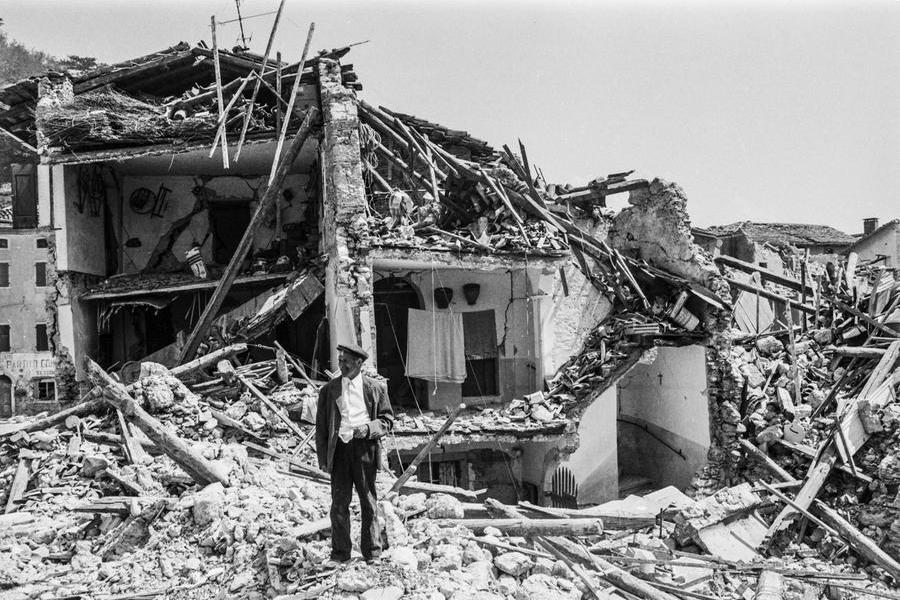
There is always an ogre in children’s ancestral fears. It comes in the dark without a precise physiognomy, it dozes off when they fall asleep to vanish at dawn. Friuli has theOrcolat. It’s like this, with the accent on the “a”, which they call the earthquake (also in the precious documentary of the same name with the voice of Bruno Pizzul, directed by Federico Savonitto): an orca that sleeps under the mountains of Carnia and when it wakes up reduces entire towns, such as Gemona or Osoppo, to shreds of walls. When he heard its roar for the first time, on 6 May 1976, Angelo Floramo was almost ten years old: he heard it in the darkness of his house in San Daniele which was trembling, he saw it in the frightened eyes of adults and in the crashed stones, still recognizable on the cathedral and on the walls of Venzonewhich only the knowledge of visionary hands in a land of stonemasons and bricklayers could imagine numbering in red, one by one, to save what could be saved and reuse it to recall “how it was and where it was”. A philological feeling in redoing that only the roots can suggest even if you have never heard the word philology. Filtering the memory through the child’s gaze of the time, he tells it in The Indian Summer of ’76 (Bottega Errante Edizioni), a tender and hard book without any contradiction.
Literary filter or self-defense?
“Both. The facts that are told are real, making them pass through the eyelashes of me as a child, as in fact it was, allows me, at almost 60 years of age, to reflect the luck that we little ones had in those terrible days, in which my family lost five people, two in Gemona, three in Majano: enlightened adults who managed to preserve childhood from the pain without removing it, saving the fairytale dimension that somehow keeps the ogre away. They didn’t deny the drama, but they made you glimpse passages beyond which a saving world of fantasy opened up, from which however you always had to return because the people who were there before didn’t add up and the chairs remained empty.”
Her grandfather, “White Eagle”, shared a tent with her as a child in the refugee camp, guiding her like an Indian chief. What role did he have?
“Fundamental. He was in third grade but knew Dante by heart, in 1925 he had lost his job so as not to get a fascist party membership card, he had joined the Resistance as a nurse, treating his comrades and enemies. He was a charmer, we kids followed him like cats following the fishmonger’s bag: in those months for me he was the gateway to fantasy: he managed to narrate a night of stars as if we were really in the Klondike and at the same time he suggested that even pain can play a fundamental role in life if you know how to accept it and transform it into something that makes you better”.
There is a moment when children understand from the concern of adults that there are things that not even they can control.
«For the first time I saw an adult cry: my uncle, after a life as a migrant, as a bricklayer in Gemona, had built with great sacrifices the collapsed house in which his sister and his 14-year-old niece, for me aunt and cousin, died. I have an indelible image: his hands, deformed by work, covering his face so that his tears could not be seen, while he repeated in Friulian “We can’t find them”. They extracted them after weeks hugging under the rubble. It’s the moment you understand that nothing will ever be the same again.”
How long did your “Indian camp” last?
«From May 6, the day of the first earthquake, to October, because the earthquakes of September destroyed the first reconstruction work and also a bit of hope. Then fortunately things began to change, the first prefabricated houses arrived as gifts from Yugoslavia, which allowed many to get out of the mud of the tents, creating villages not far from the damaged houses. We went back to school in the prefabs, discovering ourselves much bigger than a few months earlier.”
A personal before and after. Was it also collective?
«I recognize myself in the bitter thought of David Maria Turoldo in Mia terra addio, in which he said that the earthquake had buried what remained of a peasant civilization which, having nothing, made it enough to be able to share it with those who had less. Afterwards, Friuli rebuilt beautiful houses, more comfortable and safe, but with higher hedges around them, to shield the pain of the world. The Balkan route passes near us and we look with hostility at the migrants that we too have been. I think that under the rubble there also remains the remains of that ancient moral attitude that we have the duty to try to recover. From Pakistan then two thousand tents arrived as a completely free gift, today near us, in Monfalcone, the Pakistanis who work there have no place to pray to their God.”
What effect does the many rubbles of the world have on those who have been through it?
«There is no difference except in the gravity of the intentions: in Gaza, in Tehran, in Ukraine I see the destruction I know, but for us nature was not to blame, this rubble could instead be avoided because it depends on us».
What do you think saved Friuli from being “earthquaked”?
«First of all, being an autonomous region with legislative capacity. Then the visceral love for a difficult, poor, true land. I see the Friulians as the tribes who live inside a crater: as much as they know that the volcano could awaken, that crater is the only thing they have, they must love it and hold on to it. And then the fact of being border people in which cultures, languages, religions and experiences have settled for millennia.”
THE PHOTOGRAPHIC EXHIBITION WHAT A MORNING IN SPILIMBERGO
For the first time on display are 50 photographs taken by Aldo Martinuzzi the day after the earthquake that devastated Friuli fifty years ago. On May 7, 1976, between 5 in the morning and 5 in the evening, the reporter crossed the villages devastated by the earthquake with his motorbike and camera, collecting vivid testimony of those terrible moments: above is a shot taken in Osoppo. The exhibition WHAT A MORNINGorganized by the Municipality of Spilimbergo and the CRAF – Center for Research and Archiving of Photography and in collaboration with the Autonomous Region of Friuli Venezia Giulia and the Friuli Foundation. Set up in Palazzo La Loggia in Spilimbergo, the exhibition will be open to visitors until 7 June.