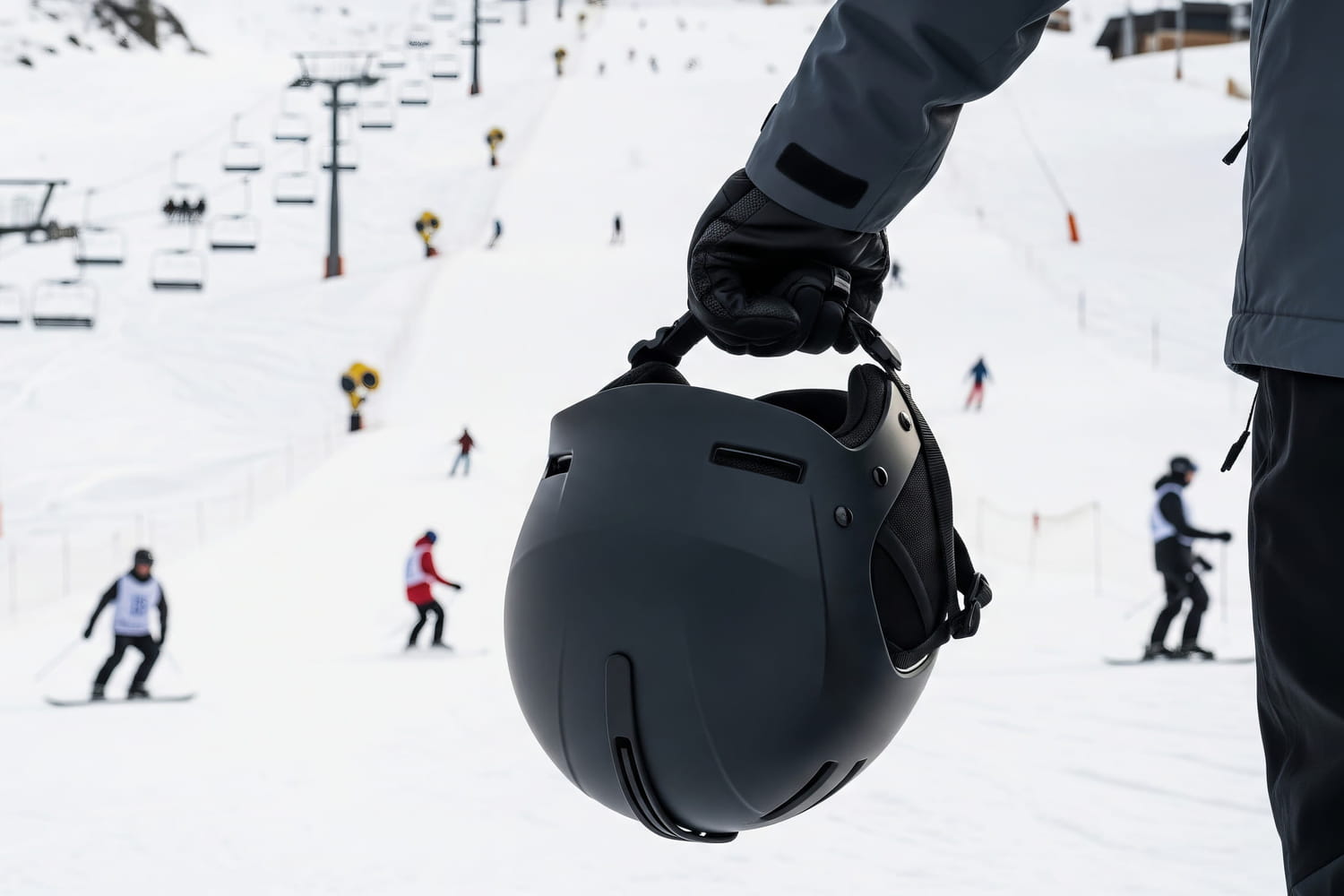




While no law requires it (not even for children), many believe that wearing helmets should be compulsory in winter sports resorts. But against all expectations, the Ecole du Ski Français does not have the same opinion.
Every year, when it’s time for Savoyard fondues and mulled wine, the debate comes back to the table: should we make wearing a helmet compulsory on the ski slopes? Long considered unsightly, its usefulness no longer needs to be proven today. Currently, in France, no legal text requires it… not even for children, unlike cycling for example, where it is required for those under 12 years old. However, according to a study by the National Mountain Safety Observation System (SNOSM), 74% of French people say they are in favor of compulsory ski helmets for everyone. But against all expectations, the ESF does not have the same opinion.
While Italy has just legislated on this subject, a first in Europe, we questioned the largest ski school in the world. Jérémie Noyrey, deputy general director of the ESF, explains to us why ski instructors are not “in favor of a legal obligation”although they “strongly encourage the widespread wearing of helmets” for all users, children and adults alike. “What would be the point? We already impose it in classes. And from what I see in practice, almost everyone wears it now. So I don’t think it would change anything.”thus attests Jérémie Noyrey.
In fact, in recent years, the use of helmets has become widespread on the slopes. Only 37% of skiers protected their heads in 2012, compared to nearly 90% in 2025, again according to the SNOSM. A figure which rises to 97% among children under 12 years old. And if it is not even obligatory for them, Jérémie Noyrey has clearly seen the evolution in practice: “A few years ago, I would say to parents, ‘You have to put a helmet on your child, it’s not possible.’ But today, we no longer need to make these kinds of remarks. Because even on a personal level, parents put it on too.”
Of course, the ESF advocates the wearing of helmets for everyone… but in reality fears the perverse effect that a law could have. “What we would like to avoid is that the helmet is seen as the answer to accidents in the mountains. And why do I say that? Because we have already seen, in the dangerous behavior of certain skiers, responses such as ‘No, but I have a helmet, I am protected’. There is sometimes this feeling of invulnerability”deplores the ski instructor. It also reminds us that, as in cars, most accidents happen when we think we are safe and we therefore relax our vigilance, such as on an “easy” track in good weather for example.
The ESF never stops saying it, it’s not just about learning a sport, but also understanding the mountain environment and respecting its dangers: “The idea is that the helmet becomes widespread everywhere, because the color of the slopes is one thing, but depending on the sunshine, the hardness of the snow, the level of the snow, the weather conditions of the day, etc., the slopes can also change. It remains a slippery territory, which can be dangerous, even on a blue slope.” Generally speaking, the ESF says it is more in favor of security “learning-based” rather than“based on sanctions”. The objective is therefore to focus on prevention: “If we draw the parallel again with the automobile, we know that awareness-raising actions are what work best.”
It must be said that awareness campaigns have had a lot to do with the developments of recent years, as have certain widely publicized tragic stories, such as those of Michael Schumacher or Gaspard Ulliel, which have helped to open the eyes of the general public to the risks posed by winter sports. This is why the famous ski school is launching a new communication campaign with the Ministry of Sports, on social networks and in all resorts, to “hammer all these safety messages” : this involves the helmet, but also behavior on the slopes, parking, etc. “It’s more effective than passing a law to make helmets compulsory”believes Jérémie Noyrey.