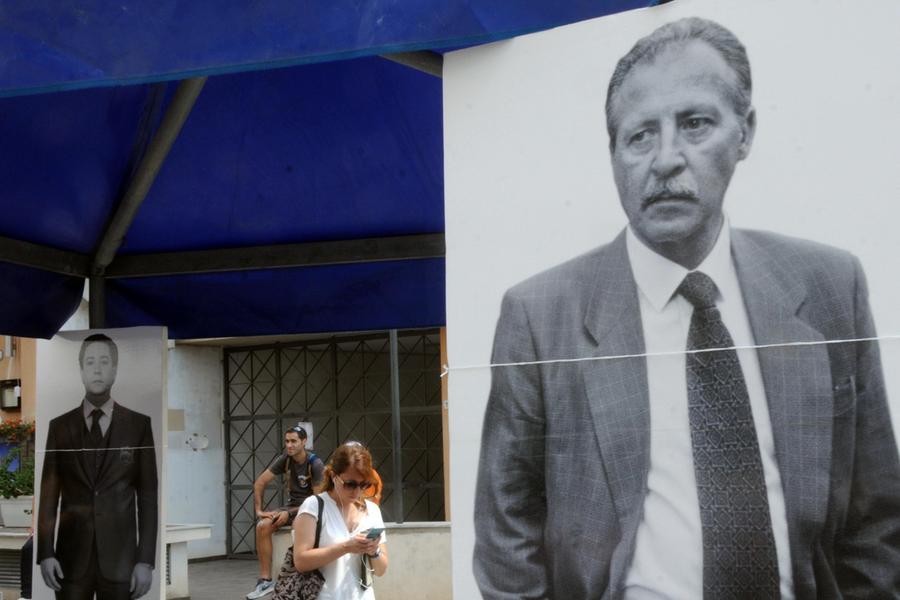
Thirty-four years after the massacre in Via D’Amelio, Italy remembers the magistrate Paolo Borsellino and the agents of his escort killed in the mafia attack of 19 July 1992.
At 4.58pm a car bomb parked in front of number 19 in via Mariano D’Amelio, in Palermo, caused the death of Borsellino and the agents Agostino Catalano, Emanuela Loi, Vincenzo Li Muli, Walter Eddie Cosina and Claudio Traina.
The only survivor was the policeman Antonino Vullo, who was parking one of the service cars at the time of the explosion.
“The massacre in Via D’Amelio, two months after that of Capaci, profoundly affected the conscience of the country. It represented the culmination of a subversive plan that aimed to undermine the democratic institutions and the very freedom of Italians”. This was declared by the President of the Republic, Sergio Mattarella. With the “contribution” of “men and women of the police forces, the judiciary, the institutions”, that “subversive plan” has “been defeated. The Republic has proven to be stronger. By capturing and condemning the executioners and instigators”.
“Thirty-four years after the massacre, our feelings of solidarity and closeness remain intact with the families of all those – men and women of the police force, of the judiciary, of the institutions – who defended our community from the mafia cancer”.
“Borsellino and Falcone are symbols of the country’s civil recovery. With their professionalism and courage they have initiated processes that previously could not be celebrated. With their commitment to the institutions they have given the State new and more advanced tools in the fight against the mafia. With their passion they have sown the culture of legality, teaching young people that the mafia logic must be countered starting from daily behavior and from school. Their commitment is part of the democratic conscience of the Republic.”
“July 19th is a date that marked the history of Italy. And it also marked my life”, added Prime Minister Giorgia Meloni. “Paolo Borsellino left us a legacy of courage, love for the homeland and trust in young people: ‘If youth refuses to give consent, even the omnipotent and mysterious mafia will vanish like a nightmare’. In his memory we continue to follow the path he showed us, with the same commitment in the fight against organized crime and in defense of legality”.
But Lucia Borsellino, daughter of the murdered magistrate, reiterated that this story is by no means over: “I was one of the eyewitnesses to the red notebook that belonged to my father. His removal from the site of the massacre cannot stop the search for the truth. Just thinking that the disappearance of this very important find could make the search for the truth impossible risks causing us to fall into desperation, understood as a lack of hope that this story can be recomposed. It means frustrating the efforts that the healthy institutions of this country have made and are making day after day. I think of this prosecutor’s office that hosts us, I think of the Caltanissetta prosecutor’s office and the parliamentary anti-mafia commission.”
Lucia Borsellino pronounced these words while speaking in the main hall of the Court of Appeal in Palermo at an event to commemorate the massacre. Borsellino’s other son, Manfredi, was also present. “Although we do not like to be public entities as his children, we cannot and do not intend to exempt ourselves in full respect of the institutions which are the beacon that has always conceived our father’s actions – he added – We cannot and do not intend to exempt ourselves from doing our part. Doing our part, even when our voice may be insidious with respect to the imprescriptible need, not to know a truth, but the actual course of how this story developed both before that after the massacres that brought our country to its knees.” For Lucia Borsellino there are many elements missing. “For this reason we stand alongside these institutions which are deploying all their energy to be able to give back to civil society and not only to us relatives of the innocent victims of the mafia, this fundamental contribution of especially cultural knowledge”.