




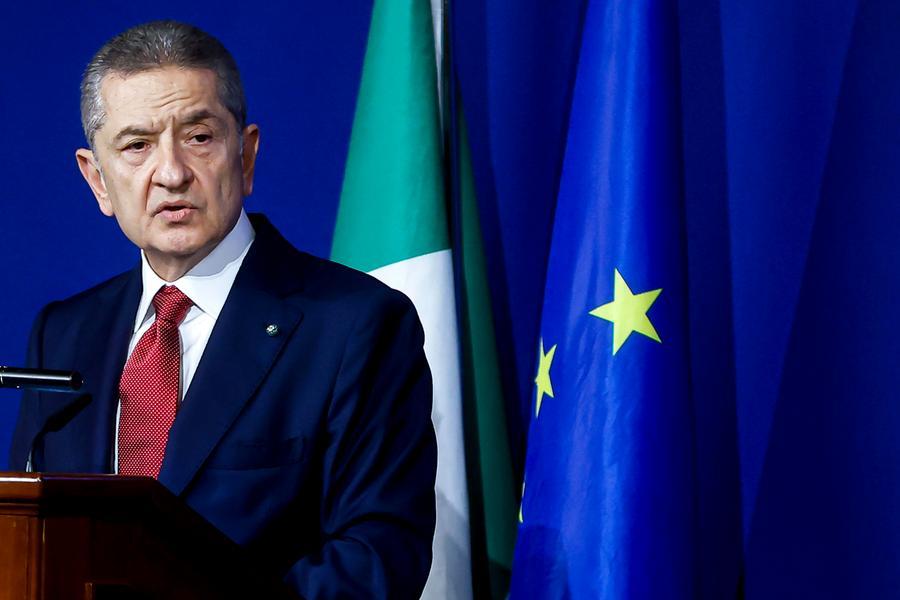
An Italian economy that has held up better than expected in recent years, but which now risks stalling in the face of the new energy crisis triggered by the Iranian conflict. It is the two-sided picture drawn by governor of the Bank of Italy, Fabio Panettain its Annual Report. Faced with a “more fragmented and unstable” world, the former ECB board member launches a clear warning: if the price shock were to translate into persistent inflation, European monetary policy will be ready to reverse course, even at the cost of revising interest rates upwards.
Between 2025 and 2026, the global picture was “dramatically changed by the conflict in the Persian Gulf”. Panetta explains that «the blockade of the Strait of Hormuz – through which a fifth of the world’s oil and liquefied gas supplies usually transit – has caused supply shortages and sharp increases in the prices of energy raw materials». In the coming months, warns the Governor, «economic activity will remain weak; in the most unfavorable scenarios, it could stagnate or contract.” On the price front, the worst is yet to come: “Inflation could reach a peak above 6 percent and, if not counteracted, remain above the target for a long time.”
Panetta, always considered an exponent of the accommodative wing of the European Central Bank, drops
any ambiguity: «Monetary policy cannot prevent the rise in energy prices from being transmitted to the production system. However, it must prevent this process from giving rise to persistent inflation, rooted in the expectations and choices of businesses and workers». His conclusion is clear: «A spiral between prices and wages must be prevented: once started, it would be harmful and costly to eliminate». In June, he announces, the Governing Council will evaluate whether to “recalibrate the orientation”, effectively opening up the possibility of a new rate increase after months of pause.
Despite a “significant resilience” since 2019 (aggregate GDP +6%, better than Germany and France on a per capita basis), Italy remains stuck in too slow growth. In 2025 the increase in GDP stopped at 0.5%, less than the euro area average. And the future does not promise better: «Without a decisive increase in productivity, the Italian economy could remain anchored to structurally modest growth rates». Panetta recalls that since the beginning of the century the product per hour worked has grown by only 6%, compared to 13-34% in other large European countries. Furthermore, the working age population is in sharp decline: “We will not be able to permanently count on the increase in employment to support development.”
The Governor asks to focus on the new generations because «the ultimate criterion of success will be the ability to offer opportunities and a future to young people”. If not
if young people are valorized, he warns, «a vicious circle is fueled. A production system that is not very innovative generates insufficient demand for qualified labor and reduces the incentives to invest in education; the skills shortage in turn makes it difficult to adopt new technologies.” Panetta recalls that between 2020 and 2024 100 thousand young people have gone abroad and spending on education is one point of GDP below the European average.
«Creating the conditions so that the new generations can realize their aspirations and contribute to the country’s progress is not just an economic responsibility: it is the civil task of this time. Only in this way will Italy be able to navigate an increasingly fragmented world without suffering its divisions, and transform the technological transition into a season of freedom, work and confidence in the future.”
The Governor defends the impact of the PNRR, which “supported demand and raised the level of annual product by almost one percentage point, on average, over the five-year period”. But he warns against a sudden braking: we need continuity in public investments and, above all, a leap in the adoption of artificial intelligence. «Italy has some of the most advanced computing infrastructures in Europe», he says, but only 16% of companies with more than ten employees use AI (compared to the EU average of 20%). “We don’t need huge public resources, but a coherent and sustained strategy over time.”
On the financial front, Panetta reassures: «Italian banks face this difficult economic phase from a position of solidity. Profitability and level of capitalization are high.”
It also opens up to new aggregations: «The high capital endowment of the system opens up space for new aggregations, national and cross-border». However, he urges caution without indiscriminate tightening: “Prudence must not translate into an indiscriminate restriction of credit.” Businesses with solid plans must be supported to prevent a credit crunch from undermining the recovery.
In closing, a historical reminder of the roots of republican Italy andmultilateral order born from Bretton Woods. Today, says Panetta, “that order is going through a profound crisis.” But the solution is not closure: «Reaffirming the value of cooperation does not mean ignoring the fragilities of the previous structure. It means preventing the search for protection from turning into isolation.” For Europe, he concludes, “what is at stake is not only competitiveness, but its ability to impact the balance of an increasingly unstable world”.