

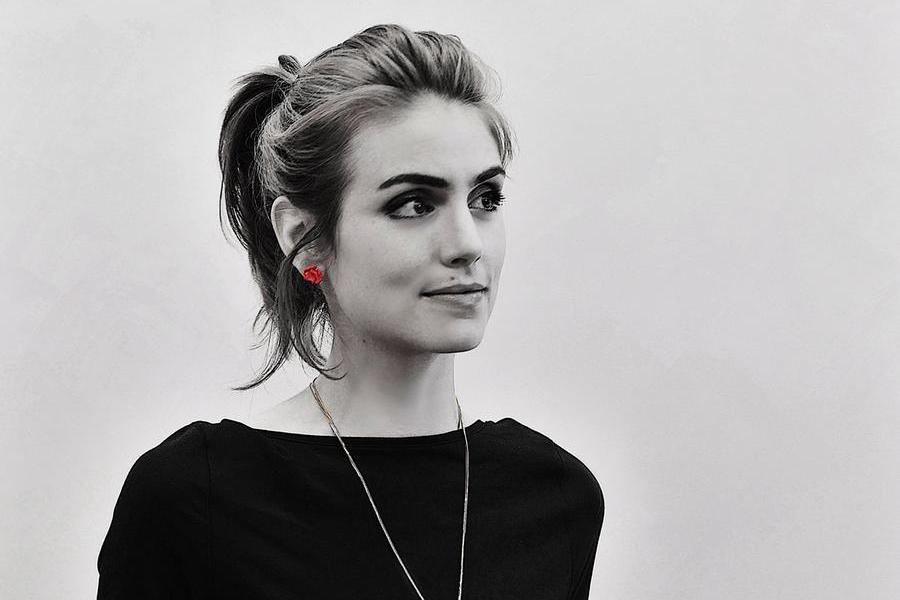



Sarah Aziza is a Palestinian American writer, journalist, and translator. His book will be published by Feltrinelli on 28 April Bodies and boundariesawarded the Palestine Book Awards 2025. This is a memoir in which a young woman, herself, of Palestinian origin and raised in the United States, tells of her descent into the hell of anorexia and at the same time retraces the history of her Gaza family, exiles for three generations, on a journey that leads from Gaza to the Midwest, to New York and back.
Sarah, your book begins with your personal health crisis, but soon turns into a multigenerational story of exile, silence, and survival. How has your personal story morphed into a larger narrative?
At first I didn’t think about it: the doctors and psychiatrists I met told me that my problems were only about me and that it was up to me to “get better”. But then I started dreaming about my Palestinian grandmother and this sparked in me the desire to know more about her. As I started researching and asking my father and other relatives to share their memories of her, the story expanded, until I soon began thinking in generational and historical terms. It was only then that I began to see how the trauma of the Nakba and exile was passed down from generation to generation, and how I was not an exception: these things lived in me too, in my body and my psyche. I suffered from anorexia, which in many ways is an illness created by the desire to disappear. I understood: it makes sense to fight this way, to want to disappear, when all around you there is a world that tries to erase your people and your history. I literally didn’t know how to stay here. But I began to understand that it wasn’t because there was something wrong with me: it was a sign of injustice in the world.
How important is your grandmother to your Palestinian identity? How strong is his connection to his memory and how did he try to make it present in your life?
My grandmother is one of the most important people in my life: she is present next to me every day, even if she is no longer here. It represents so much more than fond childhood memories – the delicious food, the fun games, the happy moments. It also represents the unfinished work of justice and liberation. His body suffered a lot. In old age she could barely walk: her knees and back had been damaged by many difficult years living as a refugee after the Nakba of 1948. She was courageous, resilient, stubborn, honest, playful, kind, but she also carried a deep pain that I have come to understand in writing this book. I know that now it is up to me to carry that pain, and I try to do so responsibly, as motivation to continue the fight for a free Palestine.
Can we contrast her grandmother’s figure with the dominant female figure in the United States today?
I’m not sure I know exactly who the “dominant” female figure is in the United States: it seems to me that there are different types of ideals. But certainly, at first glance, people might think that my grandmother wasn’t that “successful” or that “important” in terms of her visible impact on the world. He couldn’t read. He didn’t have a high-level job. She was poor. Yet he always carried himself with unshakable dignity. She refused to be humiliated or cast aside. That strength amazes me every time I think about it. I hope I can be even just a little bit like her.
How helpful was the use of Arabic in your book? Is this a way to get more in touch with your family’s history?
Coming into contact with Arabic is one of the most therapeutic things in my life. It has a beauty and depth that seems almost magical. I see it as much more than just an element of a culture. It’s a culture of its own! And as a writer, I appreciate it for its ability to express delicate and profound things with art and precision: this appreciation goes beyond the fact that it is my family’s native language. I am grateful to have been able to include it in the writing of this book: it serves, among other things, as the thematic framework of each chapter. I’ve heard from readers that this brings something unexpected and meaningful to the text, and I’m grateful for that.
What is family for you?
Family, for me, is another way of saying love: my family includes my blood relatives, but also those who I choose to love and share my life with, and who in turn choose me. Love does not erase the differences between us – my identity as an Arab and Palestinian is still very important to me – but love is about ethics and a way of life that can permeate any language, any culture, any space. I feel at home when I feel I am seen and cared for, just as I am.
Is writing a form of resistance to the genocide in Gaza? How do you see the future for the people of Gaza?
Sometimes I struggle to think that writing can be defined as “resistance,” because when thousands of bombs are dropped on civilians, it seems like a failure to sit in front of a computer and type. I’ve tried several times to “stop” writing, but I keep coming back, because it’s simply who I am, the way I think and move. I don’t think writing is enough in itself, but I accept that I will continue to write as long as I live. So I ask myself: what kind of writing can resist genocide, colonialism, injustice? It should be writing that challenges our understanding of the world, that points to the need for change. But I also hope that my words can connect us, reconnect us, to our own souls. I think many people are deeply alienated from themselves and others – and in this state of disconnection, we will feel helpless and helpless. We will forget that alternatives exist, that the world doesn’t have to be this way. Without connection and imagination, we will never feel motivated to reach beyond ourselves to create change, to care for or advocate for others. We will lose hope.
What is your wish for the Italian readers of the book?
I am grateful to have readers and honored to be published in Italian. I hope that Italian readers read it with an open heart. I hope they let themselves be touched and moved: sometimes it can be painful, but I firmly believe that the final message of the book is hope. And whether it’s my book or the works of other Palestinians, I hope they continue to turn to us. Many people choose to look away, even though the genocide affects us all, especially those living in the West.