



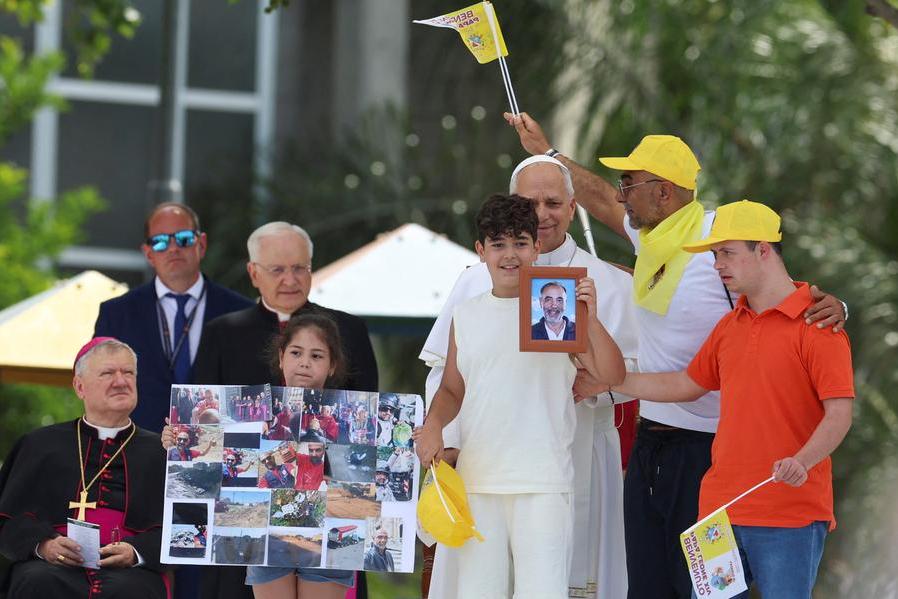
Rigorous fight against illegality, land reclamation with environmental monitoring and disease prevention activities, and promotion of an agriculture “which has been and is synonymous with excellence”. The mayor of Acerra, Tito d’Errico, presents the priorities of the municipal administration to the Pope. Together with the mayors of the 90 municipalities which, according to the map drawn by the Ministry of the Interior, fall within the area of the so-called Land of Fires, it is committed to integral protection of the environment which «cannot be separated from social development, from the right toeducation, by strengthening health infrastructure and creating employment opportunities that allow our young people to invest their talents here, without being forced to leave their homeland.”
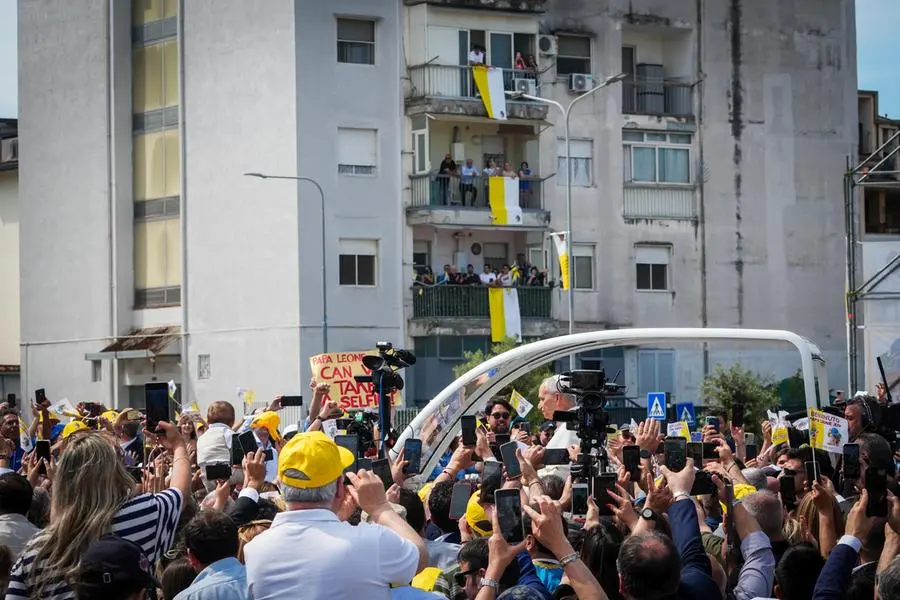
The square lights up, applauds, waves banners. “For a land of sun and no more fires”“Acerra land of Laudato si’”, “Pope Leo, guardian of the faith, courageous witness of peace”. Along the streets leading to Piazza Calipari, for the meeting with the authorities and citizens, the people of Acerra disseminated a catechesis on the environment taken from Laduato si’. Among the white and yellow colors they remind us that “Human life itself is a gift that must be protected from various forms of degradation“, that “God has entrusted the world to the human being”, that “young people demand change from us” and that “every change needs motivation and an educational path”. Photos of the victims are also raised in the square. Shortly before, in the cathedral, the Pope had greeted one by one the mothers who were clutching to their chests the images of their children who are no longer with us and caressed the sick and their families. The bishop of Donna, in an atmosphere of great emotion, presented the names and stories to Leone.
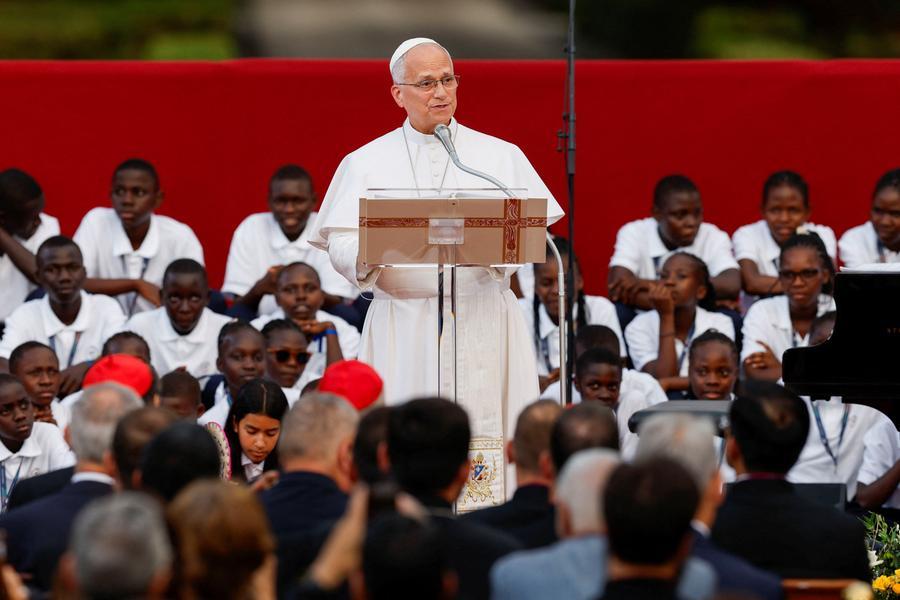
In Piazza Calipari, in an ideal continuation of the speech made in the cathedral, the Pontiff reiterated that he was happy to return to a region where “no injustice can erase the beauty”. And he explains «the main meaning of my presence today in Acerra: to confirm and encourage that leap of dignity and responsibility that every honest heart feels when life sprouts and is immediately threatened by death».
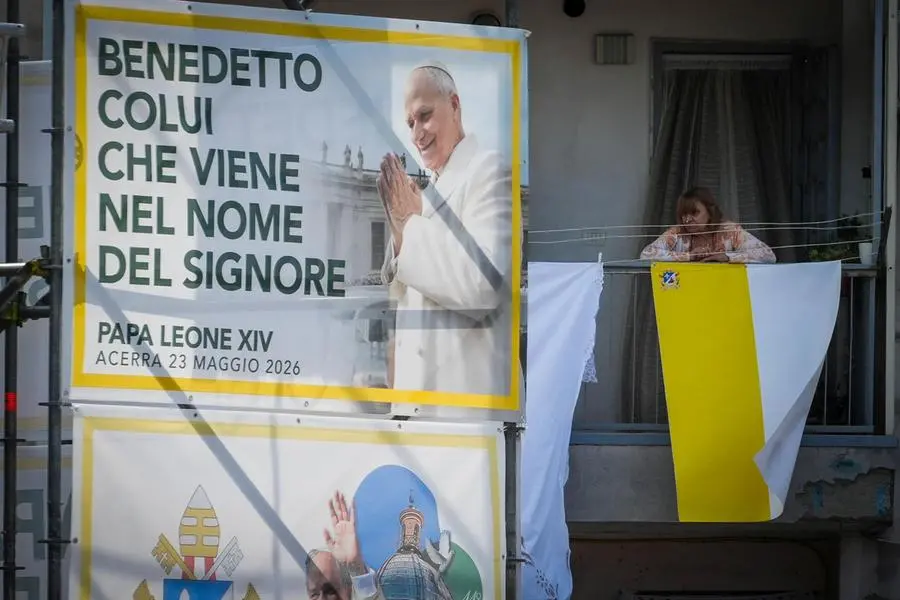
A banner welcomes the Pope to Acerra
(HANDLE)
Talk about the meeting in the Cathedral, with «some family members of the victims of the pollution which, in recent decades, has sadly made this area known as the “Land of Fires”: an expression that does no justice to the good that exists and that resists, but which has certainly facilitated a widespread awareness of the seriousness of the malfeasance and indifference that has left room for crimes». He invites, like Pope Francis, the Church to be “outgoing, missionary, synodal”, to “dare to prophecy despite resistance and threats”. But then he also speaks to the population. And he denounces that “subtle convenience” that always exists “in resignation, in compromises, in postponing necessary and courageous decisions. Fatalism, lament, blaming others are the breeding ground of illegality and a principle of desertification of consciences.” He asks everyone to assume their responsibility, to choose justice, to serve what is good. «The common good comes before the affairs of a few, of party interests, whether small or large»he underlines. Remember that this «land has paid a high tribute, has buried many of its children, has witnessed the suffering of children and innocents. The value and weight of that pain require us to try together to be witnesses of a new pact.” It is the time of rebirth, which does not mean removal, but «ethical action and industrious memory. It is the moment for a contemplative gaze, the one to which the Encyclical Laudato si’ called all human beings, each starting from their responsibilities”.
He speaks, in the words of the encyclical Laudato si’, of integral ecology. Not an ecological culture that seeks urgent and partial answers, but a politics that looks at the whole, giving «form to a resistance in the face of the advance of the technocratic paradigm». A paradigm which «is at the origin of the multiplication of conflicts, behind which there is the race to grab resources; we see him resisting every time those with political and institutional responsibilities are too weak towards those who are strong; we find him active in a technological development that aims at the dizzying profits of a few and is blind to people, their work and their future. For this reason, if we are called to change, it is starting from our gaze.”
Leaving a better world for new generations cannot be, as many consider, too great an ambition. «The educational commitment is within our reach and is a priority. Education of young people, of course, but also of adults; of children, but also of the elderly; of citizens and their rulers; of workers and employers; of the faithful and of the pastors: we all still have something to learn.” Learning is what “makes us a community”.
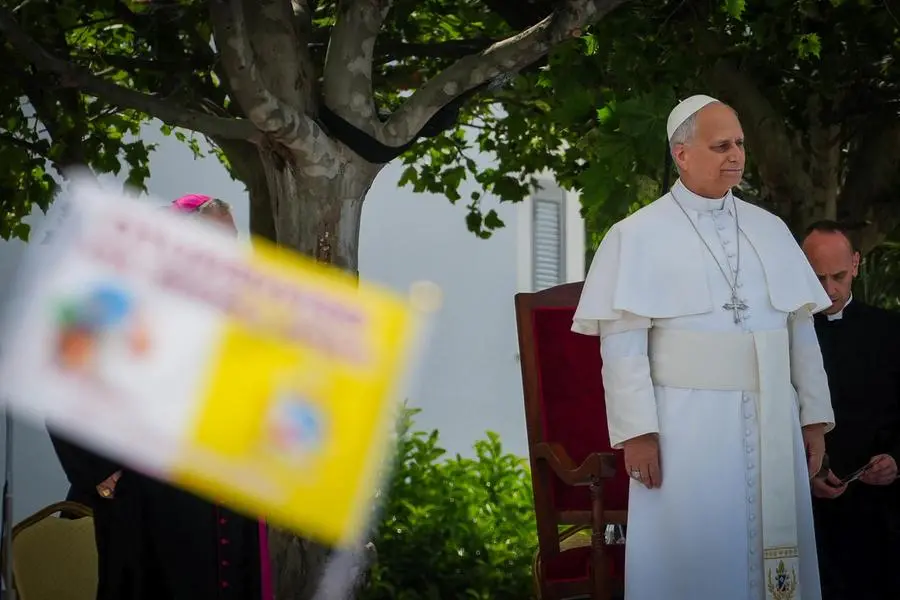
AND we must learn to change our economic, civil “and even religious” mentality, says the Pope, to «build the good that will heal this earth and the entire planet». Asks to strengthen the pact between people, institutions, public and private organizations «which is already bearing its first fruits on an educational and social level. It will not only counter and undermine criminal alliances, but will positively connect and multiply the best forces and great ideas that are already in your hearts.” He thanks those he calls «pioneers who, «with their courageous commitment, were the first to denounce the evils of this land and brought attention to the obscured and denied reality of its poisoning: I am thinking in particular of the members of environmentalist associations» and asks them to continue to monitor «the health of creation as one watches on one’s doorstep, reject temptations of power and enrichment linked to practices that pollute the earth, water, air and coexistence. We will create, step by step, but rapidly, a less individualistic economy, a less consumerist system. How much waste, how much waste, how much poison have come from a growth model that has bewitched us, leaving us sicker and poorer. Let us then learn to be rich differently: more attentive to relationships, more intent on enhancing the common good, more fond of the territory, more grateful in welcoming and integrating those who come to live with us.”
From this conversion also arise new lifestyles and new good community practices. This can be done «through people and companies that cultivate a sense of limits, not that of irresponsible violation; that have the taste for recovery, not the logic of invasion; hunger and thirst for justice instead of possession.” We need to “desire a more inclusive, more united community, less affected by marginalization and polarization”. A narrow street to follow, an uphill and poorly traced route. He gives a concrete example starting from the name “land of fires” which «refers to the fires lit on the edges of cities, sometimes by rejected and marginalized minorities of brothers and sisters of whom few have knowledge and respect.
Marginalization always produces insecurity: the uphill path is to counter marginalization. And finally, recalling the jubilee year of Saint Francis of Assisi he explains that «peace is founded on care for others, on brotherhood: we were placed in a common home to learn to live together. The problems of this house are our problems; its beauty is our beauty. We have the task of keeping watch as sentinels in the night. We can be among those who will observe the new dawn.”
Finally the bishop Di Donna thanks the Pope for his visit and, pushing to complete the reclamation and increase controls, he says, almost shouting, three times: «Never again land of fires!»