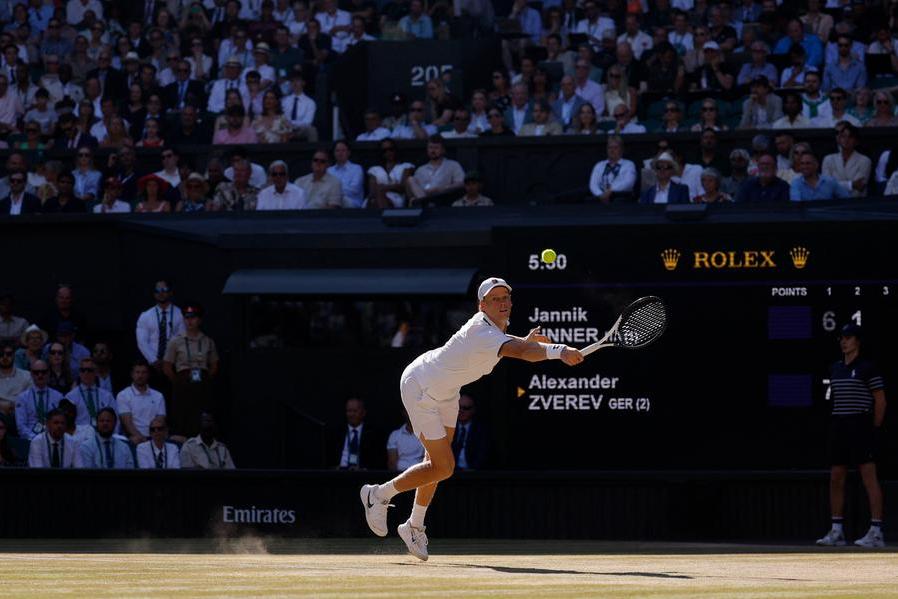
An error and immediately afterwards an ace or a particularly valuable point, managed with courage, determination and confidence. Knowing how to temporarily “forget” the mistake that has just happened, without dwelling on it, without letting it get stuck in your head and ruining the rest of the match is a characteristic that Jannik Sinner has demonstrated since he was very young, but which emerges more and more as he progresses and as the stakes become more difficultbecause the stage and the pressure on the favorite grows with each important victory.
It is one of its truly winning characteristics, because it is a little against nature: it is natural to regret mistakes, to risk them triggering the perverse mechanism of the fear of making mistakes which leads anxiety to dominate the field and induce one to make mistakes again. Jannik, on the other hand, manages to make mistakes and also to stay in the discomfort of a critical situation on the field, maintaining self-control, without allowing himself to be imprisoned by the negative thoughts that like everyone else he must have, and indeed despite everything to look forward and always focus constructively on the next point, rather than destructively ruminate on the previous one sent into the net or outside the lines. And he succeeds even when the mistake led to a great opportunity not taken which sent him down, liable to become decisive. In these situations, Jannik, instead of trembling, of getting “the little arm” as they say in the jargon, often gets through to the next point giving his best, even more so if forced to play it under pressure because it is decisive.
This way, it fixes the error immediately. And only afterwards, having brought the boat to port, metaphorically, the game out of the quicksand, he coldly analyzes the game in good and in the sea, and then works consistently on his own weak points to learn not to fall back into the same fragilities, ultimately to grow, to learn from the past without getting entangled in it.
Of course, unlike the tennis court, which ultimately remains a game even if it is serious at that level, life exposes us to errors with serious consequences, even irreparable ones. It is impossible to “forget” that kind of mistakes, fortunately rare, but there are others, not so serious, of which we are equally good at remaining prisonersi, even when the consequences have been marginal or overcome. But it is human rights that say that even those who have made serious mistakes have the right to a chance to repent, but repentance also comes from becoming aware of the mistakes committed and the subsequent possibility of “forgiving” them, so as not to repeat them and to improve.
Well, it would be nice to be able to learn from the inner strength of the South Tyrolean boy, not yet 25 years old and already so mature, to carry himself into everyday life, at work, at school, in relationships, with the same wisdom that Jannik manages to apply to tennis. It would be nice to learn from Sinner’s games to forgive oneself the limitations of the past, not out of frivolity or arrogance as would those who put them behind them to remove them and claim them, but to remain focused on improving themselves, on life ahead, on what good and good things can still be done to build and build themselves, rather than remaining prisoners of what has already been done wrong and which, rehashed endlessly, risks compromising the constructive part of what remains, as well as serenity and balance.