






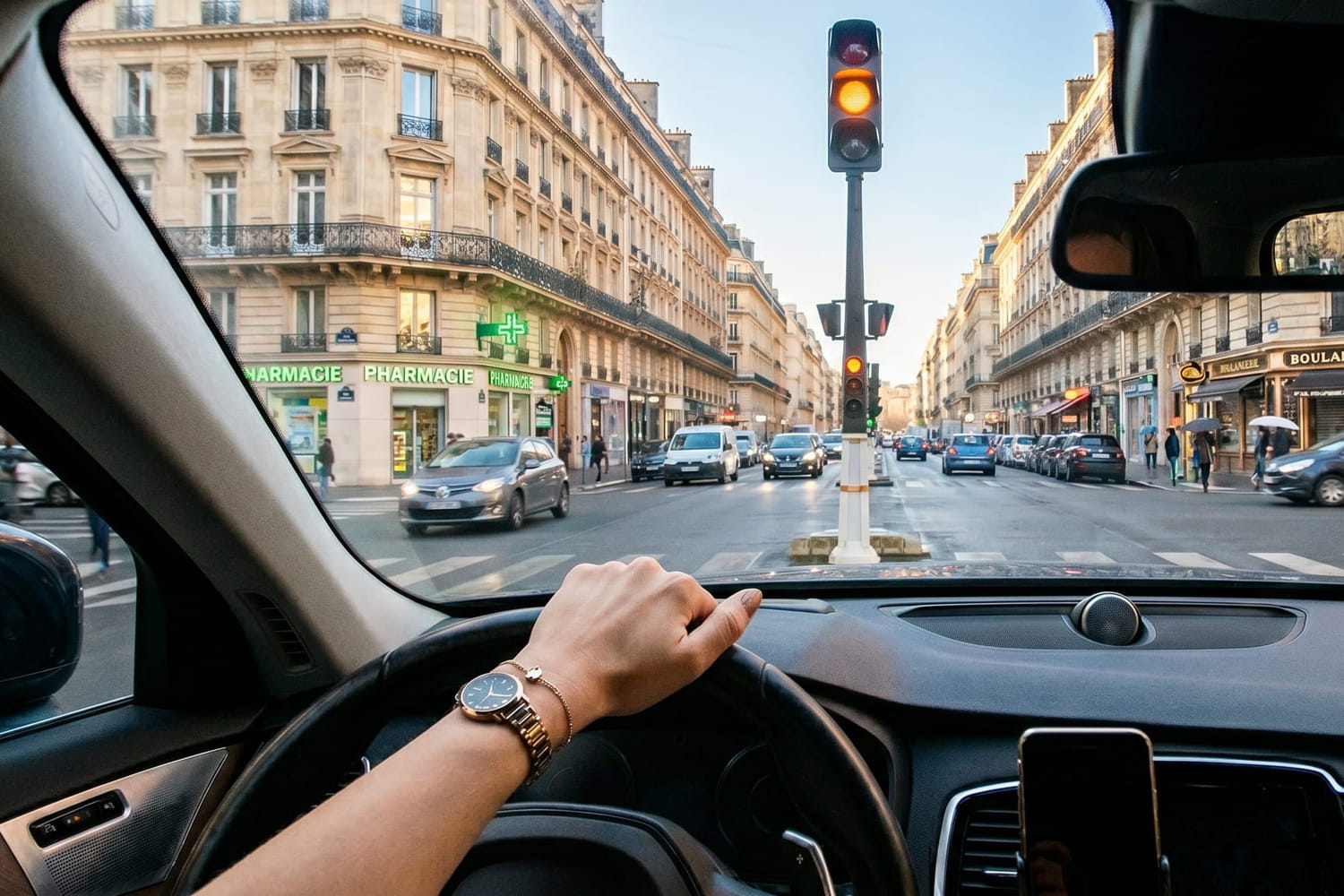
Experts demonstrate that this often criticized behavior reveals a little-known psychological ability.
We often look at them askance, we call them reckless or impatient. However, people who speed up when the light has just turned orange are not always impatient or civic-minded people. According to several works in psychology and studies on road cognition, this habit actually betrays an underestimated brain quality.
To understand the phenomenon, behavioral psychology researchers from the Cumming School of Medicine in Canada tested the reactions of several adult volunteers on ultra-realistic driving simulators. The principle was simple: they subjected the drivers to several scenarios. As they drove along quietly, the light turned orange at a time calculated to be “annoying.” Sometimes the light would change while the car was still far away (giving time to gently brake), and other times it would change at the last moment, right under the driver’s nose. The scientists were able to analyze three things: the thinking time, the movement of the foot and the gaze of each driver. The idea was to see if the driver was surprised (he accelerated out of fear reflex) or if he was strategic (he calculated in a flash that accelerating was the smoothest solution to clear the intersection).
At the end of their study, the researchers realized that people who accelerated at orange lights had a great capacity for decision-making under pressure. Where the average driver gets bogged down in indecision – that critical moment when one hesitates between squeezing at the risk of being hit from behind or passing at the risk of burning red – the “go-getter of the orange” analyzes and decides quickly. This demonstrates confidence in their motor skills and greater contextual intelligence. He doesn’t just see the light, he sees all the traffic and chooses the option which, in his opinion, makes the passage smoother.
However, be careful not to turn this “quality” into a privilege. On a legal level, the Highway Code is clear: stopping is obligatory at orange lights (or “fixed yellow” according to official terms). Article R412-31 specifies that you can only pass if stopping cannot be done in sufficient safety conditions (for example, if a heavy goods vehicle hits you too closely). Accelerating at an orange light when you could stop is punished with a fine of 35 euros, without loss of points.
Because if your brain is fast, physics is relentless: acceleration in urban areas considerably reduces your field of vision and increases kinetic energy in the event of an impact. To be used with extreme moderation, therefore.